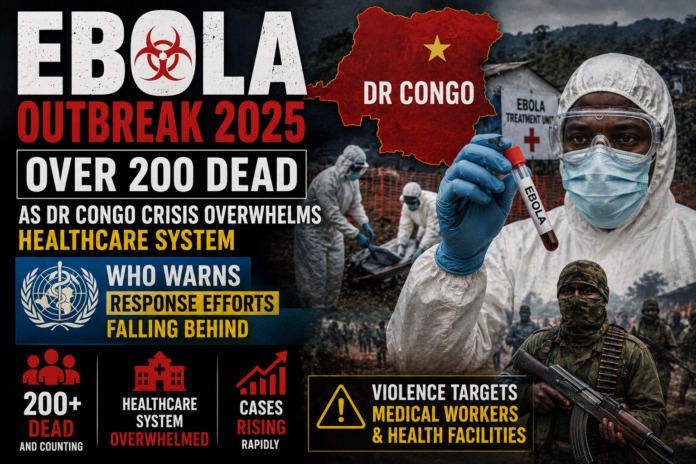

KINSHASA, DR CONGO – The Democratic Republic of Congo is facing its deadliest Ebola outbreak in years, with over 200 confirmed deaths as the highly contagious virus spreads across multiple provinces, overwhelming an already fragile healthcare infrastructure. The World Health Organization (WHO) has issued an urgent warning that response efforts are falling dangerously behind the rapid pace of transmission, while violent attacks on medical facilities are further hampering containment operations.
The Current Crisis: A Deadly Resurgence
Health officials confirmed on Friday that the death toll from the current Ebola outbreak has surpassed 200, with cases reported in the eastern provinces of Ituri and North Kivu, as well as new clusters emerging in previously unaffected regions. The outbreak, which began in late March 2025, has accelerated at an alarming rate, with epidemiologists warning that the actual number of infections may be significantly higher due to limited surveillance capacity in conflict-affected areas.
According to the DR Congo Ministry of Health, at least 380 confirmed and probable cases have been documented since the outbreak began, representing a case fatality rate of approximately 53 percent. This figure is consistent with historical Ebola outbreaks, which typically kill between 50 and 90 percent of those infected, depending on the virus strain and the quality of medical care available.
WHO Sounds Alarm on Response Capacity
During a press conference in Geneva, WHO Director-General Tedros Adhanom Ghebreyesus stated that the fast-moving outbreak is outpacing response efforts, creating a critical gap between the resources deployed and the epidemic’s trajectory. The organization has called for an immediate increase in international support, including funding, medical personnel, and logistical assistance.
The challenges are enormous. We are seeing transmission chains that we cannot fully trace, healthcare facilities that lack basic protective equipment, and communities that are deeply skeptical of medical interventions due to years of conflict and mistrust, Tedros said. Without a massive scale-up in our response, this outbreak could spiral into a regional crisis.
The WHO has deployed more than 150 epidemiologists and healthcare workers to affected areas, but officials acknowledge that current resources are insufficient to contain the outbreak. Vaccination campaigns using the rVSV-ZEBOV vaccine have been initiated, but access to remote and insecure areas remains a significant obstacle.
Violence Against Healthcare Workers
One of the most disturbing aspects of the current outbreak is the series of violent attacks targeting Ebola treatment centers and healthcare workers. Over the past two weeks, at least three health facilities in the Ituri province have been attacked by armed groups, resulting in the deaths of two healthcare workers and forcing the temporary suspension of operations.
These attacks are not random. They are deliberate acts of violence against those trying to save lives, said Dr. Michel Yao, the WHO’s emergency response coordinator for the region. When we cannot protect healthcare workers and facilities, we cannot stop Ebola. It’s that simple.
Local authorities believe some attacks are perpetrated by armed militias that view international health organizations with suspicion, while others may be linked to community resistance fueled by misinformation about the disease. Social media platforms have become conduits for false narratives claiming that Ebola is a fabrication or that vaccines are part of a Western conspiracy, further complicating response efforts.
The gunfire attack on the Bunia Ebola Treatment Center on May 20 was the third violent incident within four days, forcing Médecins Sans Frontières (Doctors Without Borders) to evacuate staff and suspend services. The facility was treating more than 30 confirmed Ebola patients at the time of the attack.
Healthcare System on the Brink
The DR Congo’s healthcare infrastructure was already severely weakened before the current outbreak began. Decades of armed conflict, political instability, and chronic underfunding have left the country with one of the world’s most fragile health systems. Many rural health centers lack running water, electricity, and basic medical supplies.
In Ituri province, where the outbreak is most severe, there is approximately one doctor for every 20,000 people, far below the WHO-recommended ratio. Hospitals are overcrowded, with patients often lying on floors due to a shortage of beds. Personal protective equipment (PPE) for healthcare workers is in critically short supply, increasing the risk of nosocomial transmission.
We are asking our nurses and doctors to fight Ebola without proper protection. It’s like sending soldiers into battle without armor, said Dr. Jean-Jacques Muyembe, director of the National Institute for Biomedical Research in Kinshasa. If we lose our healthcare workers to infection, we lose our ability to respond.
At least 18 healthcare workers have contracted Ebola since the outbreak began, and five have died. These infections not only reduce the already limited workforce but also contribute to fear and stigma surrounding the disease.
International Response and Funding Gaps
The international community has pledged support, but funding remains woefully inadequate. The United Nations has appealed for $87 million to support Ebola response operations through the end of 2025, but as of late May, only 34 percent of that amount had been received.
Canada announced new Ebola travel measures this week, including enhanced screening at major airports for passengers arriving from affected regions in Central Africa. The Public Health Agency of Canada (PHAC) outlined protocols requiring travellers from the DR Congo and neighbouring Uganda to undergo temperature checks and health questionnaires upon arrival.
Several humanitarian organizations, including the International Rescue Committee (IRC), have warned that the confluence of conflict, aid cuts, and disease could fuel an even larger crisis. IRC officials noted that recent reductions in humanitarian funding for the DR Congo have left millions of people without access to basic health services, creating ideal conditions for epidemic diseases to spread.
Regional Spillover Concerns
Health authorities in neighbouring countries are on high alert. Uganda, which shares a porous border with the DR Congo, has already reported several suspected cases, though none have been confirmed as of this writing. Rwanda and South Sudan have intensified border screening measures and are working with the WHO to prepare isolation facilities.
The risk of regional spread is very real, said Dr. Matshidiso Moeti, WHO Regional Director for Africa. The DR Congo has nine neighbouring countries. If this outbreak is not contained quickly, we could see transmission across multiple borders, which would exponentially complicate response efforts.
Lessons from Previous Outbreaks
The current crisis evokes memories of the devastating 2018-2020 Ebola outbreak in the same region, which killed more than 2,280 people and was declared a Public Health Emergency of International Concern. That outbreak highlighted the critical importance of community engagement, trust-building, and security for healthcare workers.
Experts emphasize that the 2025 outbreak requires not only medical interventions but also comprehensive approaches that address the underlying social, political, and economic factors driving community resistance and insecurity.
Conclusion: A Race Against Time
As the death toll continues to climb and new cases emerge daily, the DR Congo faces a race against time. The international community must act swiftly to provide the resources, personnel, and political support necessary to contain this outbreak before it becomes a regional catastrophe. Healthcare workers on the ground are performing heroic work under impossible conditions, but they cannot succeed without sustained, coordinated, and adequately funded support from the global community.