
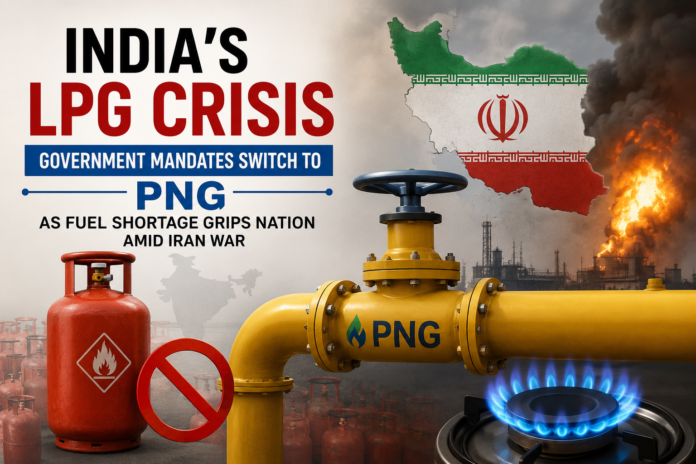

New Delhi, May 28, 2026 — India is grappling with an unprecedented liquefied petroleum gas (LPG) crisis that has forced the government to take drastic measures, including mandating a switch to piped natural gas (PNG) for millions of households. The crisis, triggered by the ongoing Iran-Israel war and severe supply chain disruptions in the Persian Gulf, has exposed critical vulnerabilities in India’s energy security architecture.
The Ministry of Petroleum and Natural Gas has notified the Liquefied Petroleum Gas (Regulation of Supply and Distribution) Amendment Order, 2026, which gives households in PNG-covered areas just three months to switch from LPG cylinders or risk losing their cooking fuel supply altogether. This unprecedented move comes as India struggles to secure adequate LPG supplies with 60% of its imports trapped or rerouted due to the closure of the Strait of Hormuz since March 1, 2026.
The Supply Crisis: From ₹900 to ₹4,000 on Black Market
The impact of the crisis has been severe and immediate. When the Strait of Hormuz—through which 90% of India’s LPG imports transit—effectively closed in early March 2026, cooking gas prices skyrocketed. A standard 14.2 kg domestic cylinder, which cost around ₹800 before the crisis, surged past ₹913 in Delhi by May 2026. More alarmingly, black market prices have reached as high as ₹4,000 in some states as desperate consumers compete for limited supplies.
India’s LPG consumption dropped by 13.1% in April 2026 compared to the previous year, falling from 2.5 million tonnes to just 2.2 million tonnes. This sharp decline reflects not just price pressures but actual supply unavailability—consumers unable to get refills even when willing to pay premium prices. Long queues outside gas agencies, businesses shutting down, and restaurants struggling to operate have become common sights across Indian cities.
Government’s Emergency Response: The PNG Mandate
Facing this energy emergency, the government has taken a multi-pronged approach. The most controversial measure is the PNG mandate under the Natural Gas and Petroleum Products Distribution Order, 2026. Under this order, households in areas where PNG infrastructure is available must switch within three months of receiving notice, or risk losing their LPG supply—unless a connection is technically infeasible.
The government has barred households with PNG connections from retaining or obtaining subsidised domestic LPG connections. However, the amended provisions offer some flexibility: consumers who obtain PNG connections can either apply for termination of their LPG connection within 30 days or obtain a transfer voucher for future restoration of the LPG connection in a non-PNG area.
This policy aims to free up LPG supplies for areas where PNG infrastructure doesn’t exist, particularly rural and semi-urban regions that depend entirely on cylinder-based cooking fuel.
Domestic Production Boost and Alternative Supply Routes
To cope with the crisis, India has dramatically ramped up domestic LPG production. Refineries have increased output by over 21% since strikes on Iran began in February 2026, reaching approximately 46,000 tons per day. This will further rise to 50,000 tons after Nayara Energy Ltd.’s refinery restarts in May following maintenance.
The government has also invoked the Essential Commodities Act through the Natural Gas Supply Regulation Order 2026, which gives full priority to households for PNG and LPG, and to transport sectors for CNG. Industries have been capped at 80% supply, while fertilizer plants operate at just 70% capacity.
To diversify supply sources, India is sourcing oil and gas from Algeria, Norway, Canada, and Australia, routing shipments via the Cape of Good Hope to bypass the Hormuz chokepoint. Indian Oil Corporation and Bharat Petroleum have secured approximately 650,000 tons of additional supply for May, including record volumes from the United States. America is set to export a record 471,000 tons of LPG to India in May 2026 alone.
The Kerosene Revival: A Step Backwards
In a move that highlights the severity of the crisis, the government has temporarily reintroduced Public Distribution System (PDS) kerosene—a fuel India had nearly phased out—for household use. The notification issued on March 29, 2026, allows streamlined distribution of superior kerosene oil (SKO) for 60 days across 21 states and Union Territories, including several previously classified as “SKO-free.”
This revival of kerosene represents a significant policy reversal. For years, India had been transitioning away from kerosene toward cleaner LPG under the Pradhan Mantri Ujjwala Yojana (PMUY), which provided 104.29 million subsidised LPG connections to poor households. The return to kerosene—a more polluting and less efficient fuel—underscores how desperate the situation has become.
The government has also implemented a 25-day cylinder booking gap to prevent hoarding, as panic buying threatened to exacerbate supply shortages.
Impact on Pradhan Mantri Ujjwala Yojana Beneficiaries
The crisis has particularly affected the 332.1 million active domestic LPG connections in India, including 104.29 million subsidised connections under PMUY. These connections, distributed largely to economically weaker households, were meant to provide clean cooking fuel and reduce indoor air pollution from traditional biomass burning.
However, with supply constraints and affordability pressures mounting, many PMUY beneficiaries are finding it difficult to obtain refills. The 13% drop in LPG consumption in April 2026 has been attributed not just to price shocks—which the government partially absorbed through intervention—but to actual access issues. Energy policy analysts note that supply chain disruptions have made it physically difficult for people to get LPG refills, even when they can afford them.
This has forced many rural and low-income households to revert to traditional cooking methods using firewood, dung cakes, and crop residues, reversing years of progress in clean cooking fuel adoption.
Expert Analysis: A Structural Vulnerability Exposed
Energy policy experts view the 2026 LPG crisis as a fundamental wake-up call for India’s energy security strategy. “This crisis exposed the vulnerability of depending on a single maritime chokepoint for critical energy supplies,” noted Sumit Ritolia, lead analyst at Kpler. “India’s 60% import dependence for LPG, with 90% of those imports transiting through the Strait of Hormuz, created a perfect storm when geopolitical tensions escalated.”
Joint Secretary Sujata Sharma from the Oil Ministry acknowledged the challenges but emphasized government action: “India has been facing challenges in LPG, but the government has taken several steps. Enough cargoes have been tied up.” However, the total secured supply—approximately 71,000 tons per day including domestic production and imports—remains below the pre-crisis consumption of 100,000 tons daily.
Analysts predict that while supply chains may normalize from June 2026 as alternative routes stabilize, prices are likely to remain elevated due to higher Atlantic Basin sourcing costs compared to traditional Persian Gulf suppliers.
The Road Ahead: Energy Self-Reliance or Continued Vulnerability?
The 2026 LPG crisis has sparked intense debate about India’s path toward energy self-reliance. While the PNG mandate aims to optimize limited LPG supplies by redirecting them to areas without pipeline infrastructure, critics argue it places the burden of adjustment on urban households rather than addressing structural import dependencies.
India’s petroleum reserves stand at just 10 days of imports, while LPG and LNG reserves last only a few weeks—dangerously thin buffers in times of geopolitical crisis. The government’s short-term measures—boosting domestic production, diversifying suppliers, reviving kerosene, and mandating PNG adoption—may stabilize the immediate situation but leave fundamental vulnerabilities unaddressed.
Long-term solutions require massive investments in domestic natural gas production, strategic petroleum reserves expansion, accelerated City Gas Distribution network rollout, and potentially a shift toward alternative cooking technologies including electric induction and biogas. Until then, Indian households remain at the mercy of Middle Eastern geopolitics and maritime chokepoints thousands of kilometers away.
As restaurants close their kitchens, households queue for hours, and black markets thrive, the 2026 LPG crisis serves as a stark reminder: energy security is national security, and India’s cooking fuel crisis could be the catalyst for a fundamental rethinking of the nation’s energy future.