
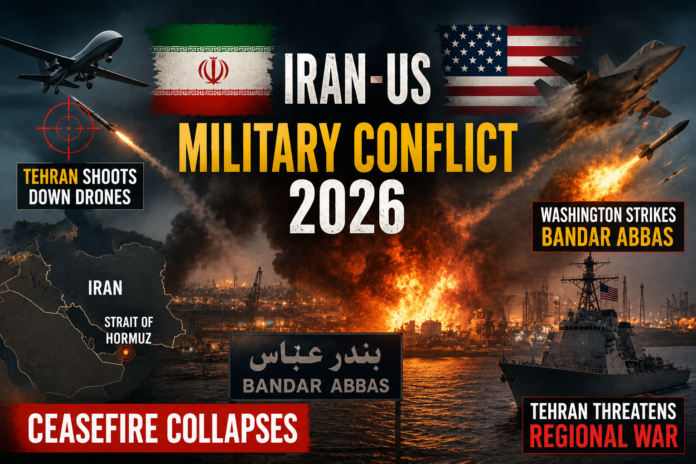

Washington and Tehran are locked in an escalating military confrontation that threatens to unravel a fragile ceasefire established just weeks ago, as United States forces conducted fresh airstrikes on Iranian missile installations near Bandar Abbas while Iran’s Revolutionary Guards shot down American drones and engaged fighter jets that entered Iranian airspace.
The renewed hostilities, which erupted on Monday May 25, 2026, mark the most serious breach of the April 8 ceasefire agreement that was brokered by Pakistan following nearly two months of intense warfare that began on February 28 when the United States and Israel launched coordinated strikes against Iran over allegations of nuclear weapons development.
According to US Central Command (CENTCOM), American forces executed what officials described as “self-defense strikes” targeting missile launch sites and naval vessels attempting to deploy mines in the strategic waters near the Strait of Hormuz, the critical maritime chokepoint through which one-fifth of the world’s oil and natural gas supplies flow during peacetime.
“US forces conducted self-defense strikes in southern Iran today to protect our troops from threats posed by Iranian military forces,” stated CENTCOM spokesperson Captain Tim Hawkins in a Monday evening press release. “We continue to safeguard our forces while exercising restraint amid the ongoing ceasefire.”
The strikes concentrated around Bandar Abbas, a major southern port city that houses a significant Iranian naval base along the Strait of Hormuz. Iranian state media reported multiple explosions in the area, with local authorities launching investigations into the incidents that rattled residents late Monday evening.
Iran’s Response and Escalatory Rhetoric
In a swift response on Tuesday, the Islamic Revolutionary Guard Corps (IRGC) announced that Iranian air defense systems had successfully intercepted an American unmanned aerial vehicle and engaged with a US fighter aircraft and another drone that had violated Iranian airspace. The announcement, carried by Iranian state television, emphasized Tehran’s determination to defend its territorial integrity.
“Iran maintains its legitimate and definite right to retaliate against any violations of the ceasefire agreement,” declared an IRGC spokesperson in comments broadcast across Iranian media outlets. The Guard Corps issued stark warnings that further American or Israeli strikes could expand the conflict beyond the Middle East region.
“Any additional aggression will be met with crushing blows in places you cannot even imagine,” the IRGC statement warned, referencing Iran’s network of regional allies and proxy forces that span from Yemen to Lebanon and from Syria to Iraq.
The Iranian government has formally protested the American strikes through diplomatic channels, summoning intermediaries in Qatar and Oman to convey Tehran’s position that Washington has violated the terms of the April ceasefire. Iranian Foreign Minister Hossein Amir-Abdollahian called the US actions “a dangerous provocation that threatens regional stability and the nascent peace process.”
Background: The February 28 Conflict and April Ceasefire
The current tensions represent a dangerous regression in what many analysts had hoped would mark the beginning of a de-escalation process. The conflict erupted on February 28, 2026, when the United States and Israel launched Operation Epic Fury and Operation Roaring Lion respectively, conducting widespread airstrikes across Iranian territory.
The allied strikes targeted what Western intelligence agencies described as facilities associated with Iran’s alleged nuclear weapons program, though Iran categorically denied possessing or pursuing such capabilities. Tehran responded with massive barrages of missiles and drones targeting US and Israeli military installations throughout the Gulf region and broader Middle East.
The warfare resulted in the effective closure of the Strait of Hormuz, causing global oil prices to spike dramatically and creating severe energy supply disruptions worldwide. According to Iran’s Ministry of Health, the conflict resulted in at least 3,468 Iranian deaths, including 376 children and 496 women, before the ceasefire took effect.
Pakistan successfully mediated a two-week ceasefire agreement that commenced on April 8, providing both parties an opportunity to engage in indirect negotiations aimed at achieving a more comprehensive peace settlement. The ceasefire was subsequently extended to facilitate continued dialogue, with talks centered in Doha, Qatar.
Ceasefire Violations and Maritime Tensions
Despite the ceasefire agreement, multiple incidents have undermined confidence in the peace process. On April 12, just four days after the ceasefire commenced, the United States announced a naval blockade designed to restrict maritime traffic to and from Iranian ports, a move Tehran condemned as a fundamental violation of the agreement.
Tensions escalated further on April 20 when US naval forces seized an Iranian cargo vessel near the Persian Gulf, an action that Iran denounced as “piracy” and a clear breach of international maritime law. The vessel was reportedly carrying commercial goods destined for regional trading partners.
On May 8, the United Arab Emirates accused Iran of launching missiles and drones that struck an oil refinery in Fujairah, injuring three Indian nationals. The UAE stated that its air defense systems intercepted 12 ballistic missiles, three cruise missiles, and four drones, describing the attacks as unprovoked aggression against civilian infrastructure.
These incidents coincided with President Trump’s initiative to escort stranded commercial tankers through the Strait of Hormuz, which had remained largely closed since the conflict began in February. On May 14, an Indian cargo ship carrying livestock sank off Oman’s coast, while another vessel was reportedly boarded by “unauthorized personnel” near Fujairah and redirected toward Iran.
On May 17, a drone strike ignited a fire near the UAE’s Barakah Nuclear Energy Plant, raising international alarm about potential nuclear safety implications amid the ongoing hostilities. While the UAE did not explicitly blame Iran, authorities indicated the drones originated from the “western border.”
Diplomatic Efforts Amidst Military Escalation
Despite the recurring military confrontations, negotiations aimed at achieving a lasting peace agreement remain active. Senior Iranian officials traveled to Qatar this week to participate in discussions with mediators about ending the conflict and securing the release of frozen Iranian financial assets held in international banks.
The talks reportedly involve a proposed 30-day timeline during which the United States would lift its naval blockade on Iranian oil ports while Iran would resume normal commercial shipping operations through the Strait of Hormuz. However, significant disagreements persist regarding language concerning Iran’s nuclear program and the timeline for sanctions relief.
US Secretary of State Marco Rubio indicated in recent statements that progress has been made in the negotiations, though he acknowledged substantial work remains. Rubio referenced discussions from NATO meetings in Sweden regarding potential military options—termed “Plan B”—to forcibly reopen the Strait of Hormuz should Iran refuse to allow commercial traffic to resume.
According to sources familiar with the negotiations, the United States transmitted what officials described as a “final offer” to Iran on Wednesday, accompanied by warnings that rejection would result in resumed military strikes. The proposal addresses nuclear enrichment, sanctions relief, and maritime freedom of navigation, but specifics remain closely guarded.
President Trump, speaking at a press event on Monday evening, issued a stark ultimatum regarding Iran’s uranium enrichment activities. “Enriched uranium must either be immediately handed over to the United States or, preferably, destroyed in coordination with the Islamic Republic of Iran,” Trump stated, setting a confrontational tone as negotiations continue.
Regional and Global Implications
The escalating military confrontation carries profound implications that extend far beyond the immediate participants. The instability in the Persian Gulf region threatens global energy markets, with the potential closure or disruption of Strait of Hormuz shipping lanes posing existential challenges to energy-dependent economies worldwide.
International humanitarian organizations have expressed grave concern about how the conflict is impacting crisis situations elsewhere. The ongoing war has disrupted global supply chains for medical equipment and humanitarian aid, with particular consequences for Sudan’s humanitarian crisis.
According to Save the Children, medical shipments intended for at least 400,000 people in Sudan remain stranded in Dubai due to the closure of the Strait of Hormuz. The World Health Organization suspended operations from its global emergency logistics hub in Dubai, leaving Sudan without critical cholera supplies and other essential medicines as that country endures its own devastating civil war.
The financial disparity highlights troubling international priorities. The $3.2 billion funding gap in Sudan’s 2025 humanitarian plan—designed to keep 21 million people alive for an entire year—would be covered by just three days of US military operations in the Iran conflict, according to estimates from the Iran War Cost Tracker based on Pentagon briefings.
Energy analysts warn that a full resumption of hostilities could drive oil prices to unprecedented levels, potentially triggering global economic recession. During the initial February-April fighting, oil prices surged by over 60 percent, contributing to inflation spikes across developed and developing economies alike.
The Path Forward Remains Uncertain
As Monday’s strikes and Tuesday’s Iranian response demonstrate, the fragile ceasefire hangs by a thread, with both sides maintaining military postures that could rapidly escalate into full-scale warfare. Multiple US officials and intelligence personnel canceled Memorial Day weekend plans in anticipation of possible military operations, according to sources familiar with the planning.
Defense and intelligence officials have begun updating recall rosters for US installations overseas as troops rotate out of the Middle East theater, part of efforts to reduce American military presence in the region while maintaining readiness for potential Iranian retaliation.
House Republicans in Washington abandoned an effort Thursday to hold a vote limiting President Trump’s authority to conduct military operations against Iran after concluding they lacked sufficient votes to advance the resolution. The failed legislative effort highlights divisions within the American political establishment regarding the appropriate response to Iranian actions.
Regional allies and international observers watch nervously as the situation unfolds, recognizing that the stakes extend far beyond bilateral US-Iran tensions. The possibility of regional escalation involving Israel, Saudi Arabia, the UAE, and other Gulf states raises the specter of a wider Middle Eastern conflagration with catastrophic humanitarian and economic consequences.
Whether the current round of diplomatic efforts in Doha can produce a breakthrough remains highly uncertain. Both Washington and Tehran face domestic political pressures that complicate compromise, while deep mutual distrust accumulated over decades of adversarial relations hampers progress toward meaningful de-escalation.
The coming days will prove critical in determining whether diplomacy can prevail over military confrontation, or whether the April ceasefire will be remembered as merely a brief respite in an escalating conflict that threatens regional stability and global security for years to come.