
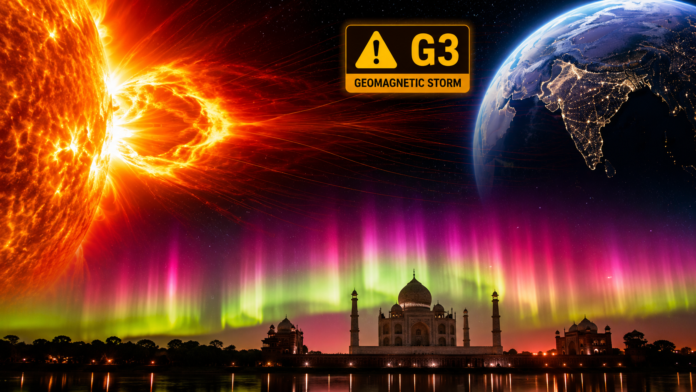

In a spectacular display of solar activity, Earth was struck by a powerful coronal mass ejection (CME) on Monday, June 8, 2026, prompting NASA and NOAA’s Space Weather Prediction Center to issue a G3 (strong) geomagnetic storm alert. The cosmic event has created breathtaking auroras visible across northern India, Europe, and Australia, marking one of the most significant space weather events of the year.
The Solar Eruption That Shook Space
The extraordinary event began with an M1.8-class solar flare emanating from Active Region 4461 on the Sun’s surface. This mid-range flare triggered the ejection of approximately one billion tonnes of magnetized plasma into space, racing toward Earth at an astonishing speed of 1,400 kilometers per second.
According to NASA’s Solar Dynamics Observatory, which monitors the Sun continuously, the filament eruption occurred on Saturday, June 6, and has been crossing the inner solar system at speeds that classify it among the fastest CMEs of 2026. The sheer velocity and mass of this solar outburst caught the attention of space weather forecasters worldwide.
“The Sun has been restless all week,” explained Dr. Maria Rodriguez, a solar physicist at NASA’s Goddard Space Flight Center. “We’ve observed multiple flares and eruptions, but this particular CME stands out due to its speed and the favorable alignment of its magnetic field structure.”
NASA and NOAA Issue Storm Warnings
The Space Weather Prediction Center (SWPC), the United States agency responsible for monitoring solar activity around the clock, issued a G3 geomagnetic storm watch on Saturday evening. Forecasters warned that conditions could briefly escalate to G4 (severe) levels if the CME’s magnetic field aligns unfavorably with Earth’s magnetosphere.
The G3 classification indicates a strong geomagnetic storm capable of causing several impacts on Earth’s technological infrastructure. While such storms are generally manageable, they can affect power systems, spacecraft operations, and satellite-based navigation systems.
The Deep Space Climate Observatory (DSCOVR) satellite, positioned at the L1 Lagrange point between Earth and the Sun, detected the CME’s arrival at approximately 6:00 UTC on June 8, providing crucial advance warning to infrastructure operators worldwide. This early detection system gave power grid managers, satellite operators, and airlines between 15 to 60 minutes to implement protective measures.
Auroras Paint the Sky Across Multiple Continents
The most visually stunning consequence of the geomagnetic storm has been the widespread appearance of auroras far beyond their typical polar regions. Parts of northern India, including Jammu and Kashmir, Himachal Pradesh, and Uttarakhand, witnessed rare displays of the northern lights painting the sky in shades of green, purple, and red.
“This is an exceptionally rare opportunity for people in India to witness auroras,” said Dr. Ananya Sharma, an astrophysicist at the Indian Institute of Astrophysics in Bangalore. “The combination of the storm’s strength and clear, dark skies in mountainous regions created perfect viewing conditions.”
Similar displays were reported across central Europe, with observers in Germany, Poland, and the Czech Republic sharing spectacular photographs on social media. In the southern hemisphere, aurora australis sightings were confirmed in southern Australia and New Zealand, where the lights danced across the horizon in unprecedented displays for those latitudes.
The Kp index, which measures geomagnetic activity on a scale from 0 to 9, peaked at 7 during the early afternoon hours of Monday. While this occurred during daylight hours when auroras were not visible, forecasts suggested the index would remain at 6.3 through the evening hours, maintaining strong enough conditions for widespread aurora viewing after sunset.
Understanding the Science Behind Solar Storms
Coronal mass ejections are among the most powerful events in our solar system. They occur when the Sun’s magnetic field lines become twisted and tangled, eventually snapping and releasing enormous amounts of energy and matter into space. When directed toward Earth, these eruptions can interact with our planet’s magnetic field, creating geomagnetic storms.
The intensity of a geomagnetic storm depends on several factors, including the speed of the CME, its magnetic field strength, and crucially, the orientation of its magnetic field relative to Earth’s. When the CME’s magnetic field points southward—opposite to Earth’s northward-pointing field—the interaction is most intense, allowing solar particles to penetrate deeper into our atmosphere.
Active Region 4461, the source of this week’s eruption, has been monitored closely by solar physicists since it rotated into view on the Sun’s Earth-facing side. The region has produced several moderate flares over the past week, indicating a complex and unstable magnetic field structure.
Potential Impacts on Technology and Infrastructure
While the auroral displays captivated millions of observers, scientists and infrastructure operators remained vigilant for potential technological disruptions. G3-level storms can cause several effects:
Power Grid Fluctuations: High-latitude power systems may experience voltage irregularities and require operator intervention. Transformer damage is possible in extreme cases.
Satellite Operations: Increased atmospheric drag affects low-Earth orbit satellites, requiring trajectory corrections. Surface charging on spacecraft components can cause operational anomalies.
Navigation Systems: GPS and other satellite-based navigation systems may experience degraded accuracy. Aviation routes over polar regions are often rerouted during major storms.
Radio Communications: High-frequency (HF) radio communications, used by aviation and maritime industries, can experience intermittent blackouts on the sunlit side of Earth.
Fortunately, modern infrastructure operators have well-established protocols for managing space weather events. Power companies can adjust operations to minimize risks, satellite operators can place spacecraft in safe modes, and airlines can reroute flights to avoid the most affected regions.
“The key to managing these events is preparation and early warning,” explained James Mitchell, a space weather analyst at NOAA. “With advance notice from our monitoring systems, we can implement mitigation strategies that significantly reduce potential impacts.”
What’s Next: Continued Solar Activity Expected
While Monday’s geomagnetic storm is expected to subside by Tuesday evening, with conditions dropping to G2 (moderate) levels, solar physicists warn that the Sun’s current active phase means more such events are likely in the coming months.
The Sun is currently approaching the maximum phase of Solar Cycle 25, a roughly 11-year period of waxing and waning solar activity. During solar maximum, the number of sunspots, flares, and CMEs increases dramatically, making spectacular space weather events more common.
“We’ve already seen several major events in 2026, and we expect this trend to continue through the year,” noted Dr. Rodriguez. “The good news is that our monitoring and prediction capabilities have never been better, allowing us to provide timely warnings to protect critical infrastructure.”
For Aurora Enthusiasts: Tips for Viewing
For those hoping to catch a glimpse of auroras during current or future geomagnetic storms, experts offer several tips:
Location Matters: Higher latitudes generally offer better viewing opportunities, though strong storms like the current G3 event can push auroras to lower latitudes.
Dark Skies Are Essential: Light pollution significantly diminishes aurora visibility. Rural locations away from city lights provide the best viewing experiences.
Timing Is Crucial: The hours between 10 PM and 2 AM local time typically offer the best chances, when the sky is darkest.
Check Forecasts: NOAA’s Space Weather Prediction Center provides 30-minute aurora forecasts, helping viewers time their observations.
Camera Assistance: Modern smartphone cameras, especially those with night modes, can often capture auroras invisible to the naked eye, particularly near the threshold viewing latitudes.
Conclusion
The June 8, 2026 solar storm serves as a spectacular reminder of our Sun’s dynamic nature and Earth’s place in a complex space environment. While the immediate event will pass within days, it underscores the importance of continued investment in space weather monitoring and prediction capabilities.
As Solar Cycle 25 continues toward its peak, more such events are inevitable. The combination of improved forecasting, robust infrastructure protection protocols, and public awareness ensures that we can both appreciate the natural beauty of these cosmic displays and protect the technological systems on which modern society depends.
For millions across India, Europe, and Australia, Monday’s celestial light show provided a rare opportunity to witness one of nature’s most spectacular phenomena—a reminder that even in our technologically advanced age, the Sun still holds the power to create wonder and awe across our planet.