November 14: Chinese President Xi Jinping will chair the 33rd APEC Economic Leaders’ Meeting in Shenzhen on November 18–19, China’s Foreign Ministry announced on Friday. It is the first time in 12 years that China has hosted APEC, and Beijing wants the 21 member economies to adopt a “Shenzhen Declaration”. Asked about a possible meeting of the leaders of China, the United States and Russia on the sidelines, the ministry said China “is in communication with relevant parties”.
Key highlights
- Leaders’ meeting: November 18–19, Shenzhen, chaired by Xi Jinping.
- APEC CEO Summit: November 17–18; Xi will give the keynote speech at the opening.
- Theme: “Building an Asia-Pacific Community to Prosper Together”, with three priorities: openness, innovation and cooperation.
- Goal: adoption of a Shenzhen Declaration, with results on trade, connectivity, the digital economy and artificial intelligence.
- Run-up: more than 300 meetings and events, including 10 ministerial meetings, with over 10,000 participants.
- Three-way meeting: China is “in communication” about a meeting of the Chinese, US and Russian heads of state; nothing is confirmed.
What Xi will do
According to the Foreign Ministry, Xi will chair the leaders’ meeting and deliver remarks, attend the opening of the CEO Summit and give a keynote speech, host a welcome banquet for the leaders and representatives, and hold bilateral meetings on the sidelines.
The US–China–Russia question
The biggest question in Shenzhen is who meets whom. On both November 12 and November 13, Foreign Ministry spokesperson Mao Ning said that “China is in communication with relevant parties regarding a meeting between the three heads of state”, without giving details. On the US, she said the two presidents’ next meeting is expected and that China is ready to build “a constructive relationship of strategic stability”. She also said Foreign Minister Wang Yi had spoken by phone with US Secretary of State Marco Rubio on November 11.
The spokesperson repeated China’s opposition to what it calls the abuse of export controls by the United States, as chip restrictions remain a source of tension between the two economies.
Our calculation
| Measure | Figure |
|---|---|
| APEC member economies | 21 |
| Years since China last hosted APEC | 12 (Beijing, 2014) |
| Gap between the last Manila summit day and the APEC leaders’ meeting | 1 day (November 17 to 18) |
| Preparatory meetings and events in China’s host year | More than 300, including 10 ministerial meetings |
What it means for India and Asia
India is not an APEC member, but many of its biggest trading partners are, including the US, China, Japan, South Korea and the Southeast Asian economies. Any agreement in Shenzhen on digital trade or artificial intelligence would shape rules that Indian companies operating in the region have to follow.
A meeting between the Chinese and US presidents, with or without Russia, would matter far beyond APEC. US–China relations affect chip supplies, tariffs and shipping costs across Asia. A three-way meeting with Russia would be closely watched in New Delhi, which has strong ties with both Washington and Moscow.
What to watch
- Whether the Shenzhen Declaration is adopted by all 21 economies.
- Confirmation of any Xi–Trump meeting, and of the proposed three-way meeting with Russia.
- Xi’s keynote at the CEO Summit on trade and technology.
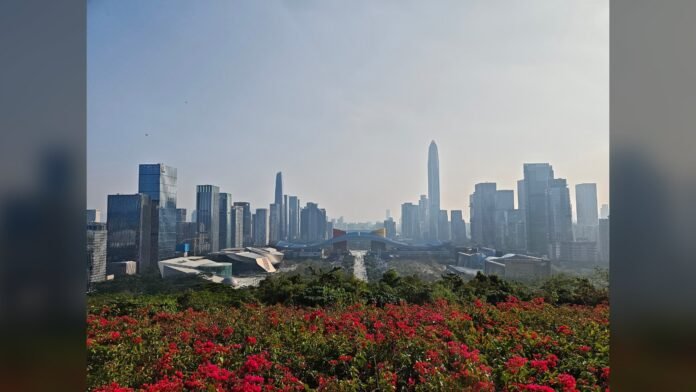
Shenzhen Civic Centre and the Futian business district, seen from Lianhuashan Park. Image: Pathfinbird, CC BY-SA 4.0, via Wikimedia Commons. Photo source · Licence
Sources
- Ministry of Foreign Affairs of China: Xi Jinping to attend the 33rd APEC Economic Leaders’ Meeting and related events
- Ministry of Foreign Affairs of China: Regular press conference, November 13, 2026
- Ministry of Foreign Affairs of China: Regular press conference, November 12, 2026

The International Desk covers world and Asian affairs, diplomacy and conflict, with a focus on what they mean for India. Stories are checked against at least two credible sources before publication.