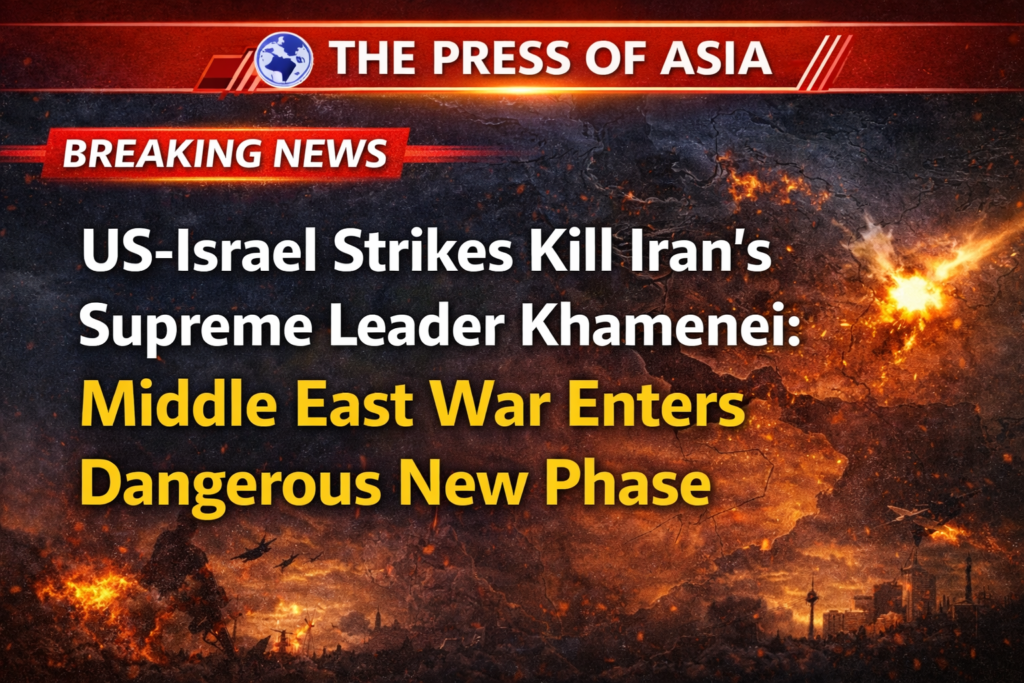
In a dramatic escalation of Middle East tensions, the United States and Israel launched coordinated military strikes on Iran on February 28, 2026, killing Iranian Supreme Leader Ayatollah Ali Khamenei and triggering a full-scale regional war.
The joint US-Israel operation, codenamed ‘Operation Roaring Lion’, targeted Iran’s missile capabilities, naval forces, and nuclear facilities. The death of Khamenei — Iran’s most powerful political and religious authority — marks an unprecedented turning point in the history of the Middle East.
US President Donald Trump confirmed the strikes, stating: “We are dismantling Iran’s missile capabilities continuously.” He added that Iran would “never acquire a nuclear weapon” under his watch. Trump suggested the war could last “four to five weeks” but later refused to rule out an extended timeline.
The conflict has already claimed over 555 lives in Iran, at least 11 in Israel, and six in Gulf states. Four US military personnel have also been killed in action. The US has deployed additional troops to the region as fighting spreads into Lebanon, where Israeli forces struck Hezbollah targets.
Iran retaliated by launching missile strikes on Israel, including hitting the city of Beersheba, while also deploying drones across the Persian Gulf. Iranian-backed forces struck a US embassy in Riyadh and targeted Saudi Aramco’s oil refinery, sending global oil prices soaring.
The Strait of Hormuz — through which nearly 20% of the world’s oil passes — has been effectively closed, sending shockwaves through global markets. Oil prices surged over 6%, with Brent crude crossing $82 per barrel.
The United Nations Secretary-General has called for an immediate ceasefire, urging all parties to seek a “way out” of the conflict. Japan, India, and European nations have urged Iran to pursue diplomatic solutions.
India has placed its security forces on high alert following Khamenei’s death, with Home Ministry issuing strict directives to all states to monitor pro-Iran and anti-Iran groups. Prime Minister Narendra Modi chaired an emergency Cabinet Committee on Security (CCS) meeting to discuss the safety of Indians stranded in the Middle East.
As the conflict enters its fifth day, the world watches anxiously, fearing a broader war that could destabilize global energy supplies, economy, and international security.