

US-Iran War 2026: India’s Economy Faces Its Biggest Energy Crisis in Decades
The world changed on February 28, 2026, when the United States and Israel launched large-scale airstrikes on Iran, resulting in the death of Supreme Leader Ali Khamenei. What began as a geopolitical conflict thousands of miles away has rapidly turned into a full-blown economic emergency for India — affecting everything from household cooking gas to billion-dollar export industries.
Why India Is Uniquely Vulnerable
India depends heavily on the Gulf region for its energy needs. The Strait of Hormuz — a narrow waterway through which more than 20% of the world’s oil passes daily — is now partially disrupted due to the ongoing war. With limited domestic oil reserves and a highly import-dependent energy structure, India finds itself in a precarious position. The country currently holds only 25 days’ worth of strategic oil reserves, which experts say is dangerously low for a crisis of this magnitude.
Crude Oil Prices Skyrocket
Brent crude oil has surged to between $110 and $120 per barrel since the war began — a level that directly threatens India’s import bill and current account deficit. The US Treasury issued a 30-day exemption on March 6, allowing India to purchase “stranded” Russian oil as a temporary measure. However, analysts warn this is only a short-term fix. If the conflict continues for more than four months, India could face structural damage to its energy supply chain that will take years to repair.
LPG Shortage: Crisis in Every Indian Kitchen
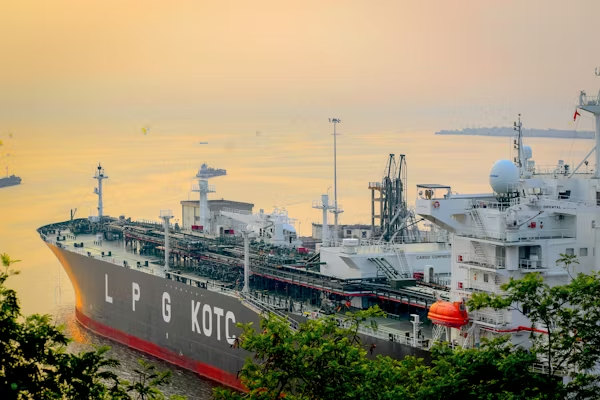
India imports approximately 91% of its LPG requirements, the vast majority of which comes from the Gulf region. The war has severely disrupted these supply lines, leading to shortages and price spikes across multiple Indian states. The Indian government has set up 24/7 helplines and control rooms to manage citizen complaints and ensure emergency distribution. For millions of low-income families who rely on subsidized LPG cylinders, this shortage is not just an inconvenience — it is a daily hardship.
Sector-by-Sector Damage to the Indian Economy
The ripple effects of the US-Iran War are being felt across virtually every major sector of India’s economy:
Fertilizers: Gas supplies to Indian fertilizer plants have dropped to just 70% of normal capacity, directly impacting urea production and pushing up the government’s subsidy burden.
Power Generation: Gas-based power plants are operating below 65% capacity, raising the spectre of rolling power cuts across industrial and residential areas.
Basmati Rice Exports: The Middle East — including Saudi Arabia, Iran, Iraq, and UAE — buys 70% of India’s basmati rice exports. The Indian Rice Exporters Federation has advised members to halt new Gulf shipments until the situation stabilises.
Tea Exports: Iran alone accounted for 15–20% of India’s tea exports. Banking sanctions have now frozen the rial-rupee trade mechanism, leaving warehouses in Kolkata and Kochi overflowing with unsold stock.
Pulses: The weakening rupee has made imports of lentils and pulses from Canada and Africa 10–15% more expensive, putting further pressure on food inflation.
Private Sector Growth at Three-Year Low
India’s private sector growth has slumped to its lowest level in three years as a direct consequence of the war. Business confidence has dropped, new orders are being deferred, and many companies are adopting a wait-and-watch approach before committing to investments. The Indian rupee has also weakened significantly against the US dollar, making imports costlier and hurting businesses with dollar-denominated liabilities.
What Is the Indian Government Doing?
The government has taken several emergency steps:
- Activated 24/7 helpline and control rooms for citizens affected by the energy crisis
- Secured a temporary 30-day exemption to purchase Russian oil
- Initiated diplomatic talks with the US and Gulf nations
- Exploring alternative energy supply routes from Central Asia and Africa
- Reviewing strategic petroleum reserve policies to extend coverage beyond 25 days
The Road Ahead
The US-Iran War of 2026 is arguably India’s most serious external economic shock since the 1973 oil crisis. From the factory floor to the family kitchen, every Indian is feeling the heat. The government must act swiftly and decisively — not just with short-term fixes, but with a long-term energy independence strategy that reduces India’s vulnerability to such global disruptions in the future.