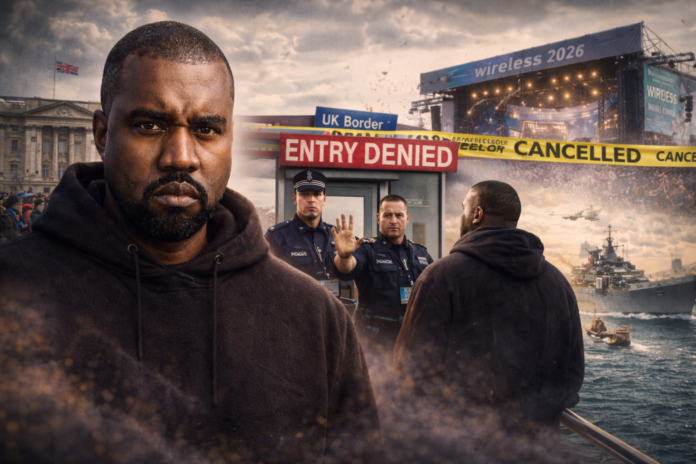

London, April 8, 2026 — The United Kingdom’s Home Office has officially denied US rapper Kanye West, who legally goes by the name Ye, permission to travel to the country, citing concerns that his presence “would not be conducive to the public good.” The decision, announced on April 7, has prompted the organizers of the annual Wireless Festival in London to cancel the entire event, just months before Ye was set to headline all three nights at Finsbury Park from July 10 to 12.
The ban marks a significant development in the growing international controversy surrounding the rapper, who has faced widespread condemnation for a series of antisemitic, racist, and extremist statements and actions over the past several years. The Home Office’s decision to deny the Electronic Travel Authorisation (ETA) application reflects the UK government’s firm stance on protecting the Jewish community and combating hate speech.
Wireless Festival Cancelled: Thousands of Tickets Refunded
Festival Republic, the organization promoting the Wireless Festival, confirmed the cancellation of the entire event in a statement released shortly after the Home Office’s decision. The statement said: “As a result of the Home Office banning Ye from entering the United Kingdom, Wireless Festival has been forced to cancel. All ticket holders will receive an automatic full refund.”
Ye had been announced as the headliner for all three nights of the festival, which was scheduled to take place at Finsbury Park in north London. His booking had immediately triggered a major public backlash, with several prominent sponsors withdrawing their support. Pepsi, the main sponsor of the event (which was officially promoted as “Pepsi presents Wireless”), pulled out of the festival. Diageo, the global beverage giant whose brands Captain Morgan and Johnnie Walker whisky had been listed as festival partners, also withdrew its sponsorship in response to the controversy.
Not only did corporate sponsors pull out, but a number of MPs, Jewish community organizations, and artists also called on the UK government to prevent Ye from entering the country. Prime Minister Keir Starmer stated that the booking was “deeply concerning” and expressed support for the Jewish community, saying: “This government firmly supports the Jewish community, and we will continue our efforts to confront and eradicate the scourge of antisemitism.”
Ye’s History of Controversy: Antisemitism and Hate Speech
The decision to ban Ye from the UK comes in the context of a long and troubling pattern of controversial statements and behavior. The rapper, born Kanye West, has been widely condemned for a series of antisemitic outbursts beginning in 2022, when he made repeated public statements promoting antisemitic conspiracy theories. In 2025, he released a song titled ‘Heil Hitler’ that was universally condemned by Jewish groups, civil rights organizations, and government officials worldwide.
Ye also sold T-shirts on his Yeezy fashion platform bearing a swastika symbol, which were later taken down after significant public pressure. His defense and promotion of Nazi ideology led to the loss of major commercial partnerships, including his longstanding collaboration with Adidas, and drew widespread condemnation from public figures across the political spectrum.
Despite the controversy, Ye had maintained a public presence and fanbase that made him a high-profile booking for major music events. When Wireless Festival announced him as headliner in early April 2026, the reaction was swift and overwhelming. Cultural commentators, politicians, music industry figures, and members of the public all questioned the decision, arguing that platforming such a figure at a major public event sends a deeply troubling message.
Implications for Free Speech vs. Public Safety Debate
The UK government’s decision to ban Ye has reignited the ongoing debate about the balance between freedom of expression and the need to protect communities from hate speech. Critics of the ban, though a minority, argued that banning an artist from entering a country over his speech sets a troubling precedent for artistic freedom. However, the overwhelming public consensus was that the Home Office’s decision was justified given the severity and persistence of Ye’s harmful rhetoric.
Legal experts pointed out that the UK has well-established legal grounds for denying entry to individuals whose presence is deemed not to be in the public interest. The Home Office cited this exact provision in its denial of Ye’s ETA application. Under the UK’s immigration rules, the Home Secretary has broad discretionary powers to exclude individuals who pose a threat to public order, community cohesion, or national values.
The controversy has also raised questions about the responsibility of music festival organizers in curating their lineups. Critics argued that Festival Republic should have anticipated the backlash before announcing Ye as a headliner. Festival Republic and the broader live music industry will likely come under increased scrutiny regarding their due diligence processes when booking artists with controversial public profiles.
For the thousands of fans who had purchased tickets to the festival, the cancellation came as a disappointment, though most expressed understanding for the government’s decision. Full refunds are being processed automatically by the ticket provider, according to the organizers.
The UK ban also has potential implications for Ye’s ability to tour internationally. Several other countries may now be watching closely and considering whether to impose their own restrictions on the rapper’s ability to perform on their soil. Human rights organizations and Jewish community groups have called on other nations to follow the UK’s example.