
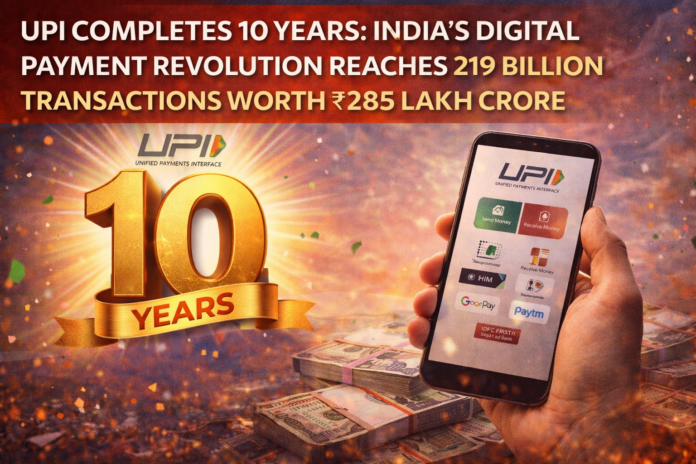

Mumbai, April 14, 2026: India’s Unified Payments Interface (UPI) marks a historic milestone today, completing 10 years since its launch on April 11, 2016. What started as an ambitious experiment to digitize India’s cash-dominated economy has transformed into a global model for real-time digital payments, revolutionizing how over 1.4 billion Indians transact. From a modest 17.86 million transactions worth ₹6,952 crore in FY17, UPI has exploded to 218.98 billion transactions amounting to nearly ₹285 lakh crore in FY26, representing a staggering 12,000x rise in transaction volume and over 4,000x growth in value.
The Journey: From 18 Million to 219 Billion Transactions
When the National Payments Corporation of India (NPCI) launched UPI on April 11, 2016, few could have predicted its meteoric rise. The platform was designed to enable instant, 24/7 interbank money transfers using just a mobile phone number or virtual payment address (VPA), eliminating the need to remember complex bank account numbers and IFSC codes. The initial uptake was slow, with only 21 banks participating and minimal consumer awareness.
However, demonetization in November 2016 proved to be a turning point, accelerating India’s shift toward digital payments. By FY18, UPI processed 915.2 million transactions, and the growth has been exponential ever since. In January 2026 alone, UPI processed 21.70 billion transactions, accounting for 81% of all retail digital transactions in India.
Key Milestones in UPI’s 10-Year Journey
2016: UPI launch with 21 participating banks. Initial transactions were negligible as consumer awareness was low. 2017-2018: Post-demonetization surge led to rapid adoption. Government incentives and cashback offers by payment apps like Paytm, PhonePe, and Google Pay drove usage. 2019: UPI crossed 1 billion transactions per month for the first time. 2020-2021: COVID-19 pandemic accelerated contactless payments, with UPI emerging as the preferred mode for person-to-merchant (P2M) and person-to-person (P2P) transfers. 2022: UPI internationalization began, with Singapore and UAE accepting UPI payments. 2023-2024: UPI penetration in rural India increased significantly, with over 50% of transactions originating from Tier 2 and Tier 3 cities. 2026: UPI now supports 691 banks, up from 216 in 2021, creating a truly unified payments infrastructure.
How UPI Transformed India’s Payment Ecosystem
UPI’s success lies in its simplicity, interoperability, and zero transaction charges for consumers. Unlike card-based payment systems that require expensive point-of-sale (POS) machines, UPI works on smartphones, enabling even small roadside vendors to accept digital payments via QR codes. The platform’s 24/7 availability and instant settlement have made it indispensable for everyday transactions, from paying for groceries to splitting restaurant bills.
The introduction of features like UPI AutoPay for recurring payments, UPI 123Pay for feature phones, and UPI Lite for small-value offline transactions has further expanded its reach. UPI has also integrated seamlessly with government welfare programs, enabling direct benefit transfers (DBT) and subsidy payments to millions of beneficiaries.
Global Recognition and International Expansion
UPI’s architecture has garnered global attention, with several countries expressing interest in adopting similar real-time payment systems. Singapore’s PayNow and Thailand’s PromptPay have integrated with UPI, enabling cross-border payments without hefty foreign exchange charges. The UAE, Bhutan, Nepal, and Sri Lanka have also begun accepting UPI payments, making it easier for Indian tourists and expatriates to transact abroad.
International financial institutions, including the International Monetary Fund (IMF) and the World Bank, have praised UPI as a model for financial inclusion and digital innovation. Countries like Brazil, Nigeria, and Indonesia are studying India’s UPI framework to develop their own instant payment systems.
Challenges and the Road Ahead
Despite its phenomenal success, UPI faces challenges. The platform experienced several outages in 2024 and 2025 due to surging transaction volumes, raising concerns about infrastructure scalability. Cybersecurity threats, including phishing scams and fraud, remain persistent risks. The Reserve Bank of India (RBI) and NPCI have implemented stricter security protocols, including multi-factor authentication and transaction limits, to mitigate these risks.
Another challenge is revenue sustainability for payment service providers. While UPI is free for consumers, payment apps and banks bear the infrastructure costs. The NPCI has been exploring merchant discount rate (MDR) models to ensure long-term viability without burdening consumers.
Looking ahead, NPCI plans to enhance UPI’s capabilities with advanced features like voice-activated payments, AI-driven fraud detection, and integration with central bank digital currencies (CBDCs). The goal is to make UPI even more inclusive, reaching the last mile of India’s unbanked and underbanked populations.
Conclusion
As UPI celebrates its 10th anniversary, it stands as a testament to India’s digital transformation. From revolutionizing how Indians pay for goods and services to becoming a global benchmark for instant payments, UPI has redefined financial inclusion. With 219 billion transactions and counting, the platform has not just digitized money but also empowered millions with seamless, secure, and inclusive financial access. As India marches toward a cashless economy, UPI remains at the forefront, driving innovation and setting new standards for digital payments worldwide.