
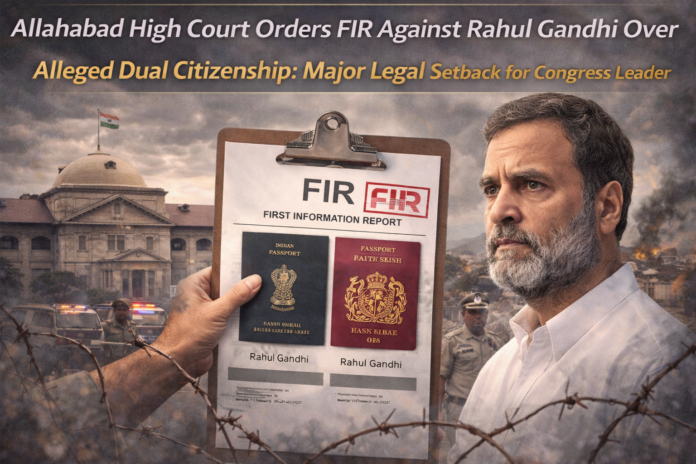

Lucknow, April 18, 2026: In a major legal blow to Congress leader and Leader of the Opposition in Lok Sabha Rahul Gandhi, the Lucknow bench of the Allahabad High Court on April 17, 2026, ordered the registration of a First Information Report (FIR) against him over allegations of holding dual citizenship. The court’s directive has reignited a politically sensitive controversy that could have significant implications for Gandhi’s parliamentary status and the broader political landscape ahead of the 2029 general elections.
The order was passed by Justice Subhash Vidyarthi on a petition filed by S. Vignesh Shishir, a Bharatiya Janata Party (BJP) worker from Karnataka, who challenged a January 28, 2026, order by a special MP/MLA court in Lucknow that had rejected his plea for an FIR against Gandhi. The High Court observed that the allegations “require investigation” and directed the Uttar Pradesh government to either probe the matter or hand it over to a central investigating agency.
Background of the Case: Allegations of British Citizenship
The controversy surrounding Rahul Gandhi’s citizenship status is not new, but the High Court’s intervention has given it fresh legal and political momentum. The petitioner, Shishir, has alleged that Gandhi holds British citizenship in addition to his Indian citizenship, which, if proven true, would disqualify him from being a Member of Parliament under the Indian Constitution.
Article 9 of the Indian Constitution clearly states that a person who voluntarily acquires citizenship of a foreign state shall cease to be a citizen of India. Furthermore, Article 102(1)(d) of the Constitution bars a person who is not an Indian citizen from being a member of Parliament. If Gandhi is found to possess British citizenship, it could potentially lead to the loss of his parliamentary membership and his position as Leader of the Opposition.
The petition alleges violations under multiple legal provisions, including the Bharatiya Nyaya Sanhita (BNS), the Official Secrets Act, the Foreigners Act, and the Passport Act. Shishir claims that Gandhi concealed material information about his citizenship status, which amounts to fraud and misrepresentation.
High Court’s Observations and Directions
Justice Vidyarthi’s bench examined the evidence and arguments presented and concluded that the allegations are serious enough to warrant a formal investigation. The court noted that the special MP/MLA court had earlier declined jurisdiction, stating it was not competent to adjudicate citizenship issues. However, the High Court disagreed, emphasizing that the registration of an FIR is a procedural step that does not require judicial determination of citizenship at the outset.
The court directed the Uttar Pradesh police to register an FIR and commence an investigation. It also left open the possibility for the state government to seek assistance from a central agency, such as the Central Bureau of Investigation (CBI) or the Enforcement Directorate (ED), given the national importance and political sensitivity of the case.
Legal experts note that this is a significant development, as it moves the matter from the realm of political allegations to formal legal proceedings. The registration of an FIR means that investigative agencies will now have the authority to summon Gandhi, collect evidence, and examine records related to his citizenship status.
Political Reactions: BJP Hails Verdict, Congress Calls It Vendetta
The High Court’s order has triggered sharp political reactions across the spectrum. The BJP has welcomed the decision, describing it as a vindication of their long-standing allegations against Gandhi. Senior BJP leaders have demanded that Gandhi immediately resign from his parliamentary position and cooperate with the investigation.
BJP spokesperson Sambit Patra stated in a press conference: “This is a historic judgment that exposes the lies and hypocrisy of the Gandhi family. If Rahul Gandhi indeed holds British citizenship, he has been sitting in Parliament illegally and misleading the nation. He must resign immediately and face the law.”
The Congress party, on the other hand, has condemned the court order, calling it part of a politically motivated witch-hunt aimed at silencing the opposition. Senior Congress leader Jairam Ramesh issued a statement asserting that Gandhi is “a proud Indian citizen” and that the allegations are “baseless and politically motivated.”
Congress President Mallikarjun Kharge accused the Modi government of “misusing” the judiciary to target opposition leaders. “This is a new low in Indian democracy. The BJP is afraid of Rahul Gandhi’s growing popularity and his fearless opposition to their anti-people policies. They are using every possible tool to harass and intimidate him,” Kharge said.
Rahul Gandhi himself has not issued a detailed public statement yet, but sources close to him indicate that he will contest the allegations vigorously and cooperate with any legitimate investigation. Gandhi’s legal team is expected to file an appeal or seek clarification on the High Court’s order.
Legal and Constitutional Implications
The case raises important legal and constitutional questions about citizenship, parliamentary eligibility, and the rights of elected representatives. Legal scholars are divided on the potential outcomes and implications.
One key question is whether the mere registration of an FIR can affect Gandhi’s status as an MP. Constitutional experts note that under the Representation of the People Act, 1951, a sitting MP can be disqualified only upon conviction for certain offenses, not merely upon the filing of an FIR or the initiation of an investigation. Therefore, Gandhi’s immediate parliamentary status is unlikely to be affected unless and until he is convicted in a court of law.
However, the political and reputational damage could be significant. The ongoing investigation and legal proceedings will likely dominate media headlines and political discourse, potentially affecting Gandhi’s credibility and the Congress party’s electoral prospects.
Another important aspect is the question of evidence. For the allegations to be proven, investigative agencies will need to establish that Gandhi either applied for or was granted British citizenship at some point. This would require access to records from British authorities, as well as examination of Gandhi’s passport and travel documents.
Historical Context: Gandhi Family and Citizenship Questions
This is not the first time questions have been raised about the citizenship status of the Gandhi family. Similar allegations were made in the past regarding Sonia Gandhi, who was born in Italy and became an Indian citizen by marriage. However, those allegations were never substantiated, and Sonia Gandhi served as a Member of Parliament and Congress President for many years.
Rahul Gandhi, born in Delhi in 1970, is the son of former Prime Minister Rajiv Gandhi and Sonia Gandhi. He completed his schooling in Delhi and later studied at Harvard University and Cambridge University in the United Kingdom. His educational background abroad has occasionally been cited by critics as a basis for speculating about his citizenship status, though no credible evidence of foreign citizenship has been presented publicly until now.
The BJP and its supporters have long questioned Gandhi’s commitment to India, often referring to him as a “part-time politician” with foreign connections. The current legal case provides a new platform for these narratives, which the BJP is likely to exploit in the run-up to the 2029 elections.
Investigation Ahead: What Happens Next?
Following the High Court’s directive, the Uttar Pradesh police are now legally bound to register an FIR and initiate an investigation. The investigation will likely involve multiple steps:
- FIR Registration: The police will formally register the FIR based on the petitioner’s complaint and the court’s order.
- Evidence Collection: Investigators will seek documents related to Gandhi’s citizenship, including birth certificates, passport records, and any applications for foreign citizenship.
- Coordination with Foreign Authorities: If necessary, Indian authorities may seek information from the United Kingdom regarding any citizenship or passport applications by Gandhi.
- Summoning and Questioning: Gandhi may be summoned for questioning as part of the investigation.
- Expert Opinions: The investigation may also involve legal and constitutional experts to interpret citizenship laws and determine the validity of the allegations.
The process could take several months, if not longer, given the complexity of the case and the potential need for international cooperation. Meanwhile, the matter is likely to remain a hot topic in political debates and media discussions.
Impact on 2029 Elections and Opposition Unity
The legal troubles facing Rahul Gandhi come at a crucial time for the opposition, which has been attempting to unite against the BJP ahead of the 2029 general elections. Gandhi’s role as Leader of the Opposition in the Lok Sabha is seen as pivotal in coordinating opposition strategy and holding the government accountable.
If the case continues to drag on or if Gandhi is forced to spend significant time and resources defending himself legally, it could weaken the opposition’s ability to present a united front. Political analysts note that the BJP may use this case as a tool to keep Gandhi on the defensive and distract from other issues such as unemployment, inflation, and agrarian distress.
On the other hand, the Congress and other opposition parties may frame the case as an example of political persecution and rally public sympathy in Gandhi’s favor. The outcome will depend on how the legal proceedings unfold and how effectively the Congress manages the narrative.
Public Opinion and Media Coverage
Public opinion on the case is sharply divided along political lines. BJP supporters view the court order as a necessary step to hold Gandhi accountable, while Congress supporters see it as a politically motivated attack. Neutral observers are calling for a fair and transparent investigation to establish the truth.
Media coverage has been extensive, with news channels, newspapers, and social media platforms buzzing with debates and discussions. Some commentators have raised concerns about the timing of the case, noting that it comes shortly after Gandhi delivered several high-profile speeches in Parliament criticizing the Modi government on issues ranging from the Manipur crisis to the Adani controversy.
Conclusion: A Defining Moment for Indian Politics
The Allahabad High Court’s order to register an FIR against Rahul Gandhi over alleged dual citizenship marks a significant moment in Indian politics. It raises fundamental questions about citizenship, parliamentary eligibility, and the intersection of law and politics in a democracy.
For Rahul Gandhi, this is a major legal and political challenge that could define his career in the coming years. For the Congress party, it is an opportunity to demonstrate resilience and rally support against what it views as political vendetta. For the BJP, it is a chance to keep the opposition on the back foot and shape the narrative ahead of the 2029 elections.
As the investigation proceeds, all eyes will be on how the legal system handles this sensitive case and whether it can maintain its independence and impartiality in the face of intense political pressure. The outcome will have far-reaching implications not just for Rahul Gandhi, but for Indian democracy and the rule of law.