
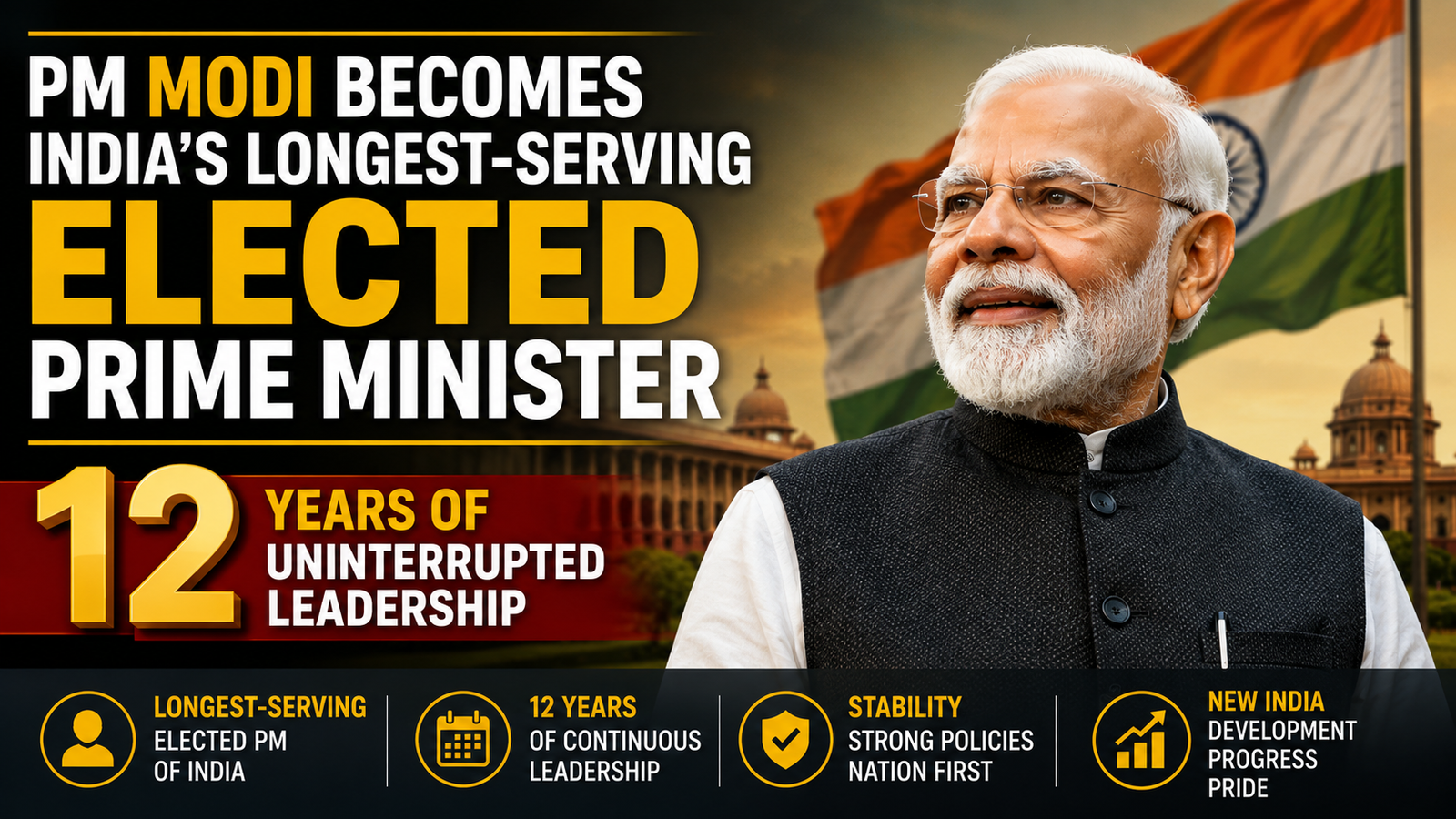
New Delhi, June 14, 2026: In a historic milestone that has been celebrated across the nation and acknowledged by world leaders, Prime Minister Narendra Modi has officially become India’s longest-serving elected Prime Minister in consecutive terms. On June 10, 2026, PM Modi completed 4,399 consecutive days in office — surpassing the record previously held by India’s first Prime Minister, Jawaharlal Nehru. With three consecutive Lok Sabha victories in 2014, 2019, and 2024, Modi’s uninterrupted 12-year tenure marks an unprecedented chapter in Indian democratic history.
Breaking Nehru’s Record: A Historic Achievement
Jawaharlal Nehru served as India’s Prime Minister from August 15, 1947, to May 27, 1964 — a tenure of 6,130 days. However, this period was neither fully democratic in its early stages nor uninterrupted by elections in the modern sense. Narendra Modi, having been elected and re-elected three consecutive times in free and fair democratic elections, surpassed the record of 4,398 consecutive days in office on June 10, 2026. The Union Cabinet met to applaud this achievement, and congratulatory messages poured in from political leaders, diplomats, and heads of state across the world. Indian President Droupadi Murmu and Vice President Jagdeep Dhankhar were among the first to offer their warm felicitations.
Key Achievements of 12 Years in Office
Prime Minister Modi’s 12-year tenure has been marked by transformative policy decisions and landmark infrastructure development. Major milestones include:
- Digital India Revolution: The launch of the Digital India mission transformed the country’s digital landscape, with UPI payments and Aadhaar-linked services becoming the backbone of India’s digital economy, processing billions of transactions monthly.
- Infrastructure Development: Flagship projects such as Vande Bharat Express trains, the Bharatmala highway project, the new Parliament building under Central Vista, Kartavya Path, the Atal Setu sea bridge in Mumbai, and the historic Chenab Rail Bridge in Jammu & Kashmir were completed.
- Welfare and Social Programs: The PM Awas Yojana, Jal Jeevan Mission, Swachh Bharat Abhiyan, Ujjwala Yojana, and Ayushman Bharat health scheme reached hundreds of millions of beneficiaries, significantly improving living standards at the grassroots level.
- Defence Modernisation: India saw significant strides in indigenous defence manufacturing under the Make in India initiative, including the commissioning of INS Vikrant — India’s first homemade aircraft carrier — and the development of the Tejas light combat aircraft.
- Foreign Policy: Modi pursued an active foreign policy, strengthening ties with major powers including the United States, Japan, France, and Australia through platforms like QUAD, while maintaining strategic partnerships across South Asia and the Global South.
Global Recognition and Modi’s Europe Tou
Coinciding with this historic record, Prime Minister Modi embarked on a high-profile diplomatic tour to Europe in mid-June 2026. His visit to France and Slovakia was aimed at bolstering bilateral ties in the areas of defence technology, artificial intelligence, and economic investments. In Paris, Modi held extensive talks with French President Emmanuel Macron, centering around the Rafale Marine fighter jet deal, joint AI research initiatives, and cooperation on nuclear energy. The visit to Bratislava, Slovakia, further underscored India’s deepening engagement with Central Europe. Modi’s Europe tour concluded with his participation in the G7 Summit in Canada, where he represented India as a special invitee and advocated for the interests of the Global South on the world stage.
Conclusion
Narendra Modi’s 12-year uninterrupted tenure as Prime Minister of India stands as a landmark in the nation’s democratic history. By surpassing Jawaharlal Nehru’s record for consecutive days in office, Modi has entered the history books as the longest-serving elected Prime Minister of India. His tenure has fundamentally transformed India’s economic, social, and foreign policy landscape, setting the stage for the next phase of India’s journey as a rising global power. As India continues on its path toward becoming a developed nation by 2047 — “Viksit Bharat” — the historic milestone underscores the stability, continuity, and vision that have defined the Modi era.