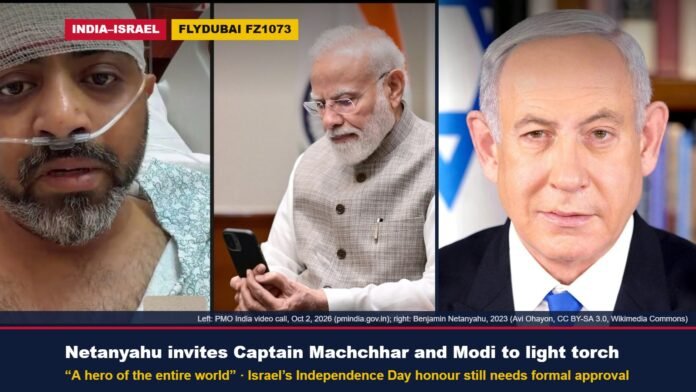
October 4: Israeli Prime Minister Benjamin Netanyahu spoke on Saturday to flydubai’s Indian captain, Smit Machchhar, and invited him and Prime Minister Narendra Modi to light a ceremonial torch at Israel’s next Independence Day celebrations. Netanyahu called the captain a hero of India, Israel and the entire world. Captain Machchhar was injured on September 30 when his co-pilot attacked him in the cockpit of flight FZ1073 from Dubai to Tel Aviv. The reports we read did not record any response from the Indian government to the invitation.
Follow-up (October 5): Australian counter-terrorism police are examining the co-pilot’s years in Melbourne, and the UAE has described the attack as an attempted “terrorist act”. Read: flydubai cockpit attack: co-pilot’s Australia links probed.
Key highlights
- The conversation: took place on Saturday, October 3. It was described variously as a video call and a phone call, lasting about six minutes.
- The invitation: Netanyahu invited both the captain and Modi, whom he called his dear friend, to light the torch at the next Independence Day ceremony.
- The honour: Netanyahu said it is the highest honour Israel bestows on Independence Day and is usually given to Israeli citizens.
- The process: The prime minister does not choose torch-lighters alone; a government advisory committee and ministerial approval are required.
- The captain’s account: Machchhar told Netanyahu how the attack happened and how he managed to open the cockpit door.
What Netanyahu said
Netanyahu told the captain he was a true hero to the people of India and Israel, and “a hero of the entire world”, before extending the invitation. Netanyahu said it was Israel’s highest honour, given on Independence Day and usually reserved for Israeli citizens. He said he was amazed by the captain’s courage and his clear-headed decisions in impossible circumstances, and that the captain had saved many lives, and perhaps something even bigger.
Netanyahu ended the conversation by saying he hoped to see the captain in Israel very soon, in a visit that would be memorable and historic. Netanyahu called the co-pilot who carried out the attack an “Islamist extremist”. That is Netanyahu’s characterisation; we could not independently confirm investigators’ findings on the motive.
What the captain described
Captain Machchhar told Netanyahu the flight was normal and the co-pilot had said he wanted to pray. Then he was suddenly struck hard on the back of the head. The captain said he tried to stop the attacker but could barely see because of the first blows.
The captain said he opened the cockpit door once, but the co-pilot shut it and he fell to the floor. He then felt he had one more chance and opened the door again; people outside were ready to come in. The captain said he had one last fight left in him and would have died if he had not done it.
The captain gave the same account to Prime Minister Modi on Friday, in a conversation whose video the Prime Minister’s Office released. Full story: what Captain Smit Machchhar told PM Modi.
The torch-lighting honour and how it is decided
At Israel’s official Independence Day ceremony, selected people light torches every year. Netanyahu told the captain the honour usually goes to Israeli citizens. Netanyahu does not have sole authority to appoint torch-lighters: names are decided through a government advisory committee and ministerial approval, which is currently the responsibility of Likud minister Miri Regev. So formal approval is still needed after the invitation. The reports did not give a date for the next Independence Day or any travel plans for the two.
The story so far
| Date | What happened | Source |
|---|---|---|
| September 30 | The co-pilot attacks the captain in the cockpit of flydubai flight FZ1073 from Dubai to Tel Aviv; the plane drops about 16,000 feet in two minutes and lands safely at Tabuk, Saudi Arabia. The co-pilot is reported to be an Omani national. | Public record |
| September 30 | 180 people on board, all safe (earlier reports gave 174 passengers and 8 crew) | Public record |
| October 1–2 | The UAE opens an investigation; on October 2, PM Modi speaks to the captain by video call. | Our reports |
| October 3 | Netanyahu speaks to the captain and invites him and Modi to light the torch. | Public record |
| October 5 | Australian counter-terrorism police examine the co-pilot’s Melbourne years; the UAE calls it an attempted terrorist act. | Our follow-up |
What to watch
- Whether India’s government responds to the invitation.
- Whether Israel’s advisory committee and minister formally approve the torch-lighters.
- The findings of the UAE and Australian investigations into the co-pilot.
What it means
The invitation turns a personal act of courage into a diplomatic gesture. By naming Modi alongside the captain, Netanyahu has linked the story to India–Israel ties, at a time when the attack’s motive is still under investigation. Whether the honour goes ahead depends on an Israeli approval process and on how New Delhi chooses to respond.
This article was first published in Hindi and has been translated. Netanyahu’s remarks are paraphrased from English-language reports except where quoted. The Press of Asia now publishes in English only.

The International Desk covers world and Asian affairs, diplomacy and conflict, with a focus on what they mean for India. Stories are checked against at least two credible sources before publication.