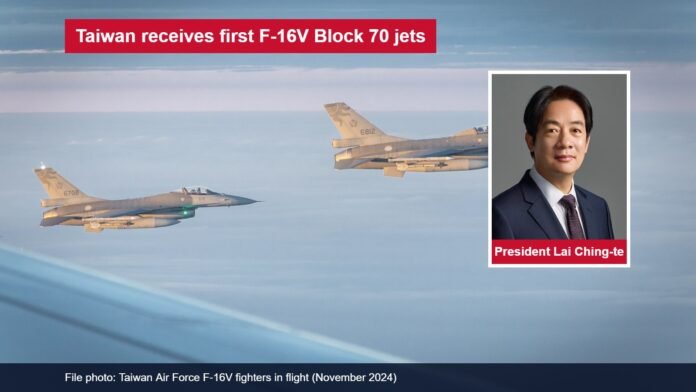
October 4: Taiwan has taken delivery of its first two newly built F-16V Block 70 fighter jets from the United States, seven years after the order was approved. The two aircraft landed at Chihhang Air Base in Taitung County at around noon on Friday, October 2. They are the first of 66 jets bought for about $8 billion. President Lai Ching-te called the arrival “an important milestone in strengthening Taiwan’s air defense capabilities”.
Key highlights
- What arrived: Two F-16V Block 70 jets with the tail numbers 6727 and 6728.
- The order: 66 aircraft, approved by Washington in 2019. 56 are single-seat and 10 are two-seat jets.
- The delay: Delivery was first planned to start in 2023. The two jets also waited in Hawaii for about six weeks before flying on.
- What next: Defence Minister Wellington Koo said more than two jets will be delivered this year.
- Still on hold: A separate US arms package worth $14 billion remains paused.
The journey to Taitung
The jets left the US mainland on August 17 and reached Hawaii on August 21. They stayed there for roughly six weeks. No explanation was given for the stay in Hawaii, which came while US President Donald Trump prepared for his late-September meeting with Chinese President Xi Jinping. They then flew to Guam and on to Taiwan, about a month later than the end-of-August arrival that had been expected.
No official reason has been given for the wait. The delivery had been held up for months as Beijing repeatedly asked Washington to stop arming Taiwan. For the outcome of that summit, read: Trump-Xi summit ends with a farm deal, but Taiwan and chips stay unresolved.
The new jets will be flown by the 7th Tactical Fighter Wing, which was set up on December 1, 2023. Koo said eastern Taiwan is important for preserving combat capability, but declined to give operational details.
Why the programme is late
The sale was approved in August 2019, during Trump’s first term. The delays have been attributed to the relocation and restart of the F-16 production line, supply chain disruptions and software issues. The jets are also reported to have arrived without their Viper Shield electronic warfare system, which is still in testing.
The programme cost is put at NT$247.22 billion (about US$7.75 billion). Koo said later deliveries will come in stages on a schedule agreed with the United States. The remaining jets are expected in 2027 and 2028.
What the F-16V adds
The Block 70 is the newest production version of the F-16. It carries the AN/APG-83 active electronically scanned array (AESA) radar, conformal fuel tanks and strengthened landing gear. Its upgraded avionics, weapons and radar are meant to help Taiwan counter China’s J-20 stealth fighters.
Once all 66 are delivered, Taiwan’s F-16 fleet will number more than 200 aircraft. The United States remains unwilling to sell Taiwan its most advanced fighters, the F-22 and F-35.
What Washington and Taipei said
A US State Department spokesperson said: “We continue standing with friends and allies across the Indo-Pacific to advance our shared prosperity, security, and values — that includes Taiwan,”.
Koo told reporters that “there will be more than two jets delivered this year”. There is growing concern in Taiwan about how committed the Trump administration is to arming the island. Beijing had not publicly reacted to the delivery.
The bigger picture
China claims Taiwan as its own territory and opposes all US arms sales to the island. Taiwan’s air force scrambles almost daily in response to Chinese military activity. The government in Taipei rejects Beijing’s claim.
The two jets are a small part of a large order. The separate $14 billion package was paused by the Trump administration after objections from Beijing.

The International Desk covers world and Asian affairs, diplomacy and conflict, with a focus on what they mean for India. Stories are checked against at least two credible sources before publication.