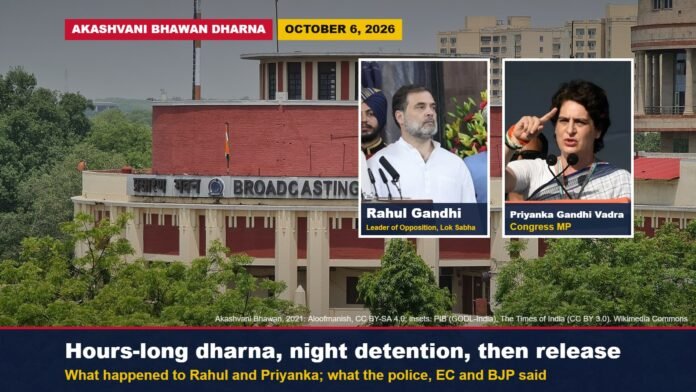
October 7: Leader of the Opposition in the Lok Sabha Rahul Gandhi and Congress MP Priyanka Gandhi Vadra sat on a dharna for hours on Tuesday at the Akashvani Bhawan complex in New Delhi, demanding to meet Chief Election Commissioner (CEC) Gyanesh Kumar. At around 8 pm, Delhi Police removed them and other leaders and took them to New Police Lines, Kingsway Camp. Both were let go at 10:20 pm. Police say no permission had been taken for the march. The Election Commission said no party had sought an appointment until 4 pm.
Update (October 8, evening): In connection with Wednesday’s protest, Delhi Police registered three more FIRs against Rahul Gandhi and Priyanka Gandhi Vadra, alleging they pushed police personnel and obstructed public servants in their duty. On Thursday, opposition MPs held a dharna at Rajghat.
Update (October 7, night): On Wednesday, Delhi Police registered an FIR over the alleged unauthorised entry of Rahul Gandhi, Priyanka Gandhi Vadra and other INDIA bloc MPs into the Akashvani Bhawan complex. Details of the sections invoked were not yet available. No arrest has been reported. The Congress called it proof of the government’s desperation, Divya Himachal reported. An FIR marks the start of an investigation, not proof of guilt.
Key highlights
- The dharna was held under a tree near the reception gate of Akashvani Bhawan. Accounts put its length at about 8 to 9 hours.
- Reports use the word “detention”. None of the reports we read mentioned a formal arrest of any leader or a case being registered at the time. (Update: an FIR was registered on Wednesday; see above.)
- Reports differ on the number detained: about 250 to 260.
- The Election Commission says it offered to send its most senior officer to receive a memorandum, which the MPs did not accept.
- The BJP called it “drama”. Congress president Mallikarjun Kharge questioned the forcible removal of the Leader of the Opposition.
- A day earlier, the Supreme Court had refused an interim plea to suspend the CEC but issued notice on the petitions.
The day, hour by hour
The sequence below is built from public accounts of the day. Where accounts give different times, both are shown.
| Time | What happened | Source |
|---|---|---|
| 11 am | The opposition MPs’ march set out from Parliament towards Nirvachan Sadan. | Public record |
| Shortly after | Police stopped the march with barricades near the NITI Aayog office on Parliament Street. Rahul Gandhi and Trinamool Congress MP Abhishek Banerjee climbed the barricade carrying the tricolour. Priyanka Gandhi Vadra was put in a police bus. | Public record |
| Between 12:20 pm and 1 pm | Rahul Gandhi, Priyanka Gandhi Vadra and Deepender Hooda sat on a dharna under a tree near the reception gate of Akashvani Bhawan, from about 12:20 pm or 1 pm, according to different accounts. | Public record |
| 3:25 pm | Rahul Gandhi alleged that police were removing journalists from the spot. | Public record |
| About 4 pm | Delhi Police told the Election Commission that about 240 MPs led by Rahul Gandhi wanted to meet the Commission. | EC statement |
| 4:24 pm | Rahul Gandhi asked to be told where they could sit: at India Gate or Jantar Mantar. | Public record |
| 5:41 pm | Rahul Gandhi said they would stay until they met the CEC. | Public record |
| Between 8 pm and 8:46 pm | Police ended the dharna. Deepender Hooda, Pawan Khera and Charanjit Singh Channi were taken first, then Mahua Moitra and Derek O’Brien, and finally Priyanka Gandhi Vadra and Rahul Gandhi. | Public record |
| After that | The leaders were taken to New Police Lines, Kingsway Camp. | Public record |
| 9:09 pm | The Election Commission issued its statement. | Public record |
| 10:20 pm | Rahul Gandhi and Priyanka Gandhi Vadra were let go after about two hours. | Public record |
How many were detained
Reports differ: one put the number detained at about 260, including 10 MPs; another at about 250 people, including roughly 50 MPs. The total number of MPs was also reported differently: about 240 in the Election Commission’s statement, while Rahul Gandhi said about 300. Leaders named in reports include K.C. Venugopal, Pawan Khera, K. Suresh, Amarinder Singh Raja Warring, Imran Pratapgarhi, Samajwadi Party president Akhilesh Yadav and the Trinamool Congress’s Abhishek Banerjee and Derek O’Brien.
What Rahul Gandhi and the opposition said
Rahul Gandhi said during the dharna: “I don’t care what the BJP says. I am standing here to protect democracy” (translated from Hindi). He also said: “The Election Commission is 50 yards from here. They are not letting us go there” (translated from Hindi). He said they only wanted to meet Gyanesh Kumar and the other two election commissioners and ask them questions, because crores of people had voted for the opposition.
After his release, Rahul Gandhi wrote on X that what was left of democracy had been dragged away to protect “traitors of democracy”, and that there would be a reckoning in which no traitor would be spared (paraphrased from Hindi).
Congress president Mallikarjun Kharge wrote on X that Rahul Gandhi had been sitting peacefully on a dharna seeking a meeting with the Commission, and that forcibly detaining the Leader of the Opposition raised serious questions about the Constitution and democratic rights. Samajwadi Party president Akhilesh Yadav said the Election Commission should work impartially, not at the BJP’s behest. Both statements were.
The police’s side
Delhi Police said no formal application for permission for the march had been received by the Deputy Commissioner of Police, New Delhi district, and no permission had been granted. Police said the gathering violated prohibitory orders in force under Section 163 of the Bharatiya Nagarik Suraksha Sanhita (BNSS), and that the detentions were necessary to maintain law and order and prevent the situation from escalating. Police also said the leaders had entered the complex without permission.
The Election Commission’s side
In a statement issued at night, the Commission said no political party had sought an appointment through its representatives until 4 pm. The Commission learned from Delhi Police at about 4 pm that about 240 MPs wanted to meet it at the Parliament House Annexe. The Commission called the request unusual, since under set procedure such meetings take place at its office.
According to the statement, the Commission nonetheless offered to send its most senior officer on duty to receive a memorandum, a step it called unprecedented, but the MPs did not accept the offer. The Commission also said any party could request a meeting at any time and that it fixes a date based on availability. The reports we read did not include a formal Congress response to this statement.
The BJP’s response
Union Parliamentary Affairs Minister Kiren Rijiju said repeated attacks on constitutional bodies would neither help democracy nor win back public support for the Congress, and called it daily drama. BJP MP Ravi Shankar Prasad accused Rahul Gandhi of spreading anarchy, and Union minister Shivraj Singh Chouhan said the Congress was attached to fake votes.
On Wednesday, BJP spokesperson Sudhanshu Trivedi said the Commission’s press statement had made clear that Rahul Gandhi’s claim through the day was false, because neither the INDIA bloc nor the Congress had sent any request for a meeting.
Who said what, at a glance
| Side | Main point | |
|---|---|---|
| Rahul Gandhi | Only wanted to meet the CEC and the two election commissioners; police did not let them reach the Commission. | |
| Congress president Kharge | Forcibly removing the Leader of the Opposition from a peaceful dharna raises questions about democratic rights. | |
| Delhi Police | Permission for the march was neither sought nor given; Section 163 was in force; detentions were for law and order. | |
| Election Commission | No one sought time until 4 pm; a demand to meet 240 MPs at the Parliament Annexe was unusual; the offer to send an officer was turned down. | |
| BJP | It is daily drama; the Commission’s statement proved Rahul Gandhi’s claim false. | Public record |
What Section 163 is, and how detention differs from arrest
Section 163 of the BNSS is the provision that was Section 144 of the Code of Criminal Procedure (CrPC) before July 1, 2024. According to an explainer in Outlook, it allows a district magistrate, sub-divisional magistrate or authorised executive magistrate to ban assemblies, processions or protests in an area by written order. Such an order usually lasts up to two months, and the state government can extend it to a maximum of six months. The same explainer cites the Supreme Court’s 2018 Mazdoor Kisan Shakti Sangathan judgment, in which the court said regulation cannot be turned into a complete ban.
The leaders were detained and let go a few hours later; some international coverage described them as “briefly arrested”. In law, arrest is different: under Article 22(2) of the Constitution, an arrested person must be produced before a magistrate within 24 hours. No such step or any case was reported at the time.
What is happening in court
On Monday, October 5, a Supreme Court bench led by Chief Justice Surya Kant refused to suspend Gyanesh Kumar through an ex parte interim order. The bench said the other side must be heard first. The court issued notice to the Centre, the Election Commission, the CEC and the two election commissioners. The Chief Justice also said compliance with the law was mandatory and that the court would set aside any violation it found, and made clear that the Supreme Court had not approved the amended Form 6. No date for the next hearing was announced.
What to watch
- The Aam Aadmi Party may join a protest at the office of Delhi’s Chief Electoral Officer on Wednesday.
- The Congress and allies in Telangana have announced a gherao of Lok Bhavan on October 8.
- A big protest has been announced in Delhi for November 1.
- The next hearing of the petitions in the Supreme Court.
What it means
There are two different stories about Tuesday, and the gap between them will shape the politics ahead. The opposition says representatives of crores of voters were not allowed to reach the Commission. The Commission says no formal appointment was sought, and that when a request did reach it through the police, it was to meet 240 MPs inside the Parliament complex, which falls outside its procedure. The question now is whether the opposition formally seeks an appointment and sends a smaller delegation, or keeps to the streets.
The second point is the court. The Supreme Court has for now refused to suspend the CEC, but it has not dismissed the petitions and has clarified its position on Form 6, so the legal decision on the dispute will be made there, not on the street. The third is opposition unity:, Congress leader Jairam Ramesh said Biju Janata Dal MPs had also joined, although the party is not formally part of the alliance.
This article was first published in Hindi and has been translated. Quotes from Hindi sources are our translations. The Press of Asia now publishes in English only.

The National Desk covers India's politics, governance, security and public-interest news. Stories are checked against at least two credible sources before publication.