
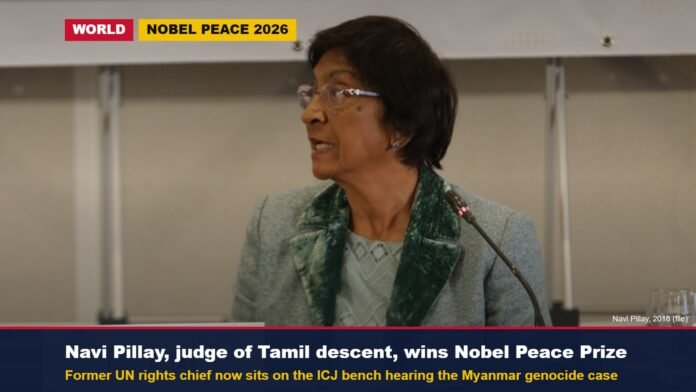
October 10: Navi Pillay, the 85-year-old South African jurist of Indian Tamil descent who led the UN human rights office from 2008 to 2014, has won the 2026 Nobel Peace Prize “for her efforts to promote peace and international law”, Norwegian Nobel Committee chair Jørgen Watne Frydnes announced in Oslo on Friday, TIME reported. Pillay, who now sits as one of two judges ad hoc in the Rohingya genocide case against Myanmar at the International Court of Justice, said she would dedicate the prize to “all of the survivors of international crimes”, Al Jazeera reported.
Key highlights
- This is the 125th Nobel Peace Prize. The committee received 287 nominations, and the prize is worth 12 million Swedish kronor, about $1.2 million, Al Jazeera reported. It will be presented in Oslo on December 10.
- Pillay is the fifth South African to win the prize, according to Al Jazeera.
- The committee credited her work at the Rwanda tribunal in establishing that rape and sexual violence can constitute crimes against humanity and genocide.
- Frydnes said the system of international law “is under tremendous pressure, and its institutions are under attack”, The National reported.
- Pillay was in the historic courtroom in Nuremberg, Germany, when the announcement was made, according to Al Jazeera.
- Israel’s foreign ministry condemned the choice, and US President Donald Trump said the committee had “demeaned” the prize, Al Jazeera reported.
What the Nobel committee said
Frydnes said Pillay’s “commitment to universal legal principles and her firm moral compass are constants in a long career”, and that “a common thread runs from her early work defending Nelson Mandela and others who stood up against apartheid” to her later work as a judge, TIME reported. The committee called her “one of the great defenders of international legal principles in our time” and praised her “judicial rigour, personal integrity and considerable courage”, according to Al Jazeera.
The committee singled out her time at the International Criminal Tribunal for Rwanda, which tried those accused over the 1994 genocide. That court established that rape and sexual violence could constitute a crime against humanity as well as genocide, and it was also the first time a defendant was charged with incitement to genocide based solely on spreading propaganda, the committee said, as reported by Al Jazeera. “Whenever might overtakes right, it undermines stability, trust and peaceful coexistence,” Frydnes said, according to The National.
What Pillay said
Speaking in the Nuremberg courtroom where Nazi leaders were tried, Pillay said: “Perhaps it was meant to be that I was in this historic courtroom … when the announcement was made”, Al Jazeera reported. Referring to her last UN assignment, a commission of inquiry that called what is happening in Gaza genocide, she said: “Why would you need courage to speak the truth?” She also told world leaders: “You are under legal obligation … to protect human rights and refrain from war”, The National reported. To applause, she joked: “If you clap a little bit more, I may share this prize with Trump”, according to Al Jazeera.
From Durban to The Hague: a career timeline
Pillay was born into an Indian Tamil family in Durban under apartheid, The National and TIME reported. The table below is compiled from South African History Online, Al Jazeera, The National and the International Court of Justice.
| Year | Milestone | Source |
|---|---|---|
| 1967 | Opens her own law practice in Natal, the first woman there to do so; defends anti-apartheid activists | South African History Online, Al Jazeera |
| 1973 | Wins the right of political prisoners to have access to lawyers | South African History Online |
| 1982 and 1988 | Master of Law, then Doctor of Juridical Science, at Harvard University | South African History Online, The National |
| 1995 | Acting judge of the High Court of South Africa, the first woman of colour on that bench | South African History Online, Al Jazeera |
| 1995–2003 | Judge of the International Criminal Tribunal for Rwanda; its president from 1999 | South African History Online |
| 2003–2008 | Judge in the Appeals Division of the International Criminal Court | South African History Online |
| 2008–2014 | UN High Commissioner for Human Rights | Al Jazeera |
| To 2025 | Chairs the UN commission of inquiry on the Occupied Palestinian Territory, which concluded that Israel is responsible for genocide in Gaza | Al Jazeera |
| Now | Judge ad hoc at the International Court of Justice in The Gambia v. Myanmar, the Rohingya genocide case | ICJ order of July 22, 2022; Al Jazeera |
| 2026 | Nobel Peace Prize | Norwegian Nobel Committee, via TIME |
By our count, her working life now spans 59 years, from the 1967 law practice to the 2026 prize. She has served on three international benches, the Rwanda tribunal, the International Criminal Court and the International Court of Justice, and has also led the UN human rights office.
The Asia connections
The prize has several links to Asia. The most direct is Myanmar. In 2019, The Gambia took Myanmar to the International Court of Justice under the Genocide Convention over the treatment of the mostly Muslim Rohingya minority. An ICJ order dated July 22, 2022, lists “Judges ad hoc Pillay, Kress” on the bench, on the same day the court ruled that it had jurisdiction and that the case was admissible. A judge ad hoc sits only for a particular case, alongside the court’s permanent judges.
| Link | What it is | Why it matters |
|---|---|---|
| Myanmar | Pillay is one of two judges ad hoc in The Gambia v. Myanmar at the ICJ | The case is still before the court; the prize draws attention to the bench hearing it |
| India and Tamil heritage | Pillay was born into an Indian Tamil family in Durban | Her family background links the prize to the Indian diaspora in South Africa |
| Japan | ICC President Tomoko Akane, a Japanese judge, welcomed the prize | Akane said the award had special significance amid “profound challenges to the international legal order”, Al Jazeera reported |
| Philippines | The International Criminal Court is preparing to try former president Rodrigo Duterte | The prize praises the kind of court work that Asian governments are now dealing with directly |
Our earlier reports: ICC finds Rodrigo Duterte fit to stand trial and Anwar and Min Aung Hlaing hold talks in Putrajaya.
Reactions
- United Nations: Secretary-General António Guterres said: “Today’s prize is a tribute to all those working to uphold and defend international law”, Al Jazeera reported. UN human rights chief Volker Türk said the award reaffirmed that human rights, the rule of law and accountability are fundamental to peace.
- South Africa: President Cyril Ramaphosa called it a “profound tribute to the veteran jurist’s courage, integrity and lifelong commitment to justice”, according to Al Jazeera.
- International Criminal Court: President Tomoko Akane said the award carries special significance amid “profound challenges to the international legal order”.
- Israel: The foreign ministry called it “the grotesque weaponisation of an award to legitimise anti-Israel hatred and prejudice”, and Israel’s UN ambassador in Geneva, Daniel Meron, called the decision “disgraceful”, Al Jazeera and The National reported.
- United States: Trump said on Truth Social that the committee had “demeaned” the prize, Al Jazeera reported. The leaders of Cambodia, Israel and Pakistan had said they nominated Trump, The National noted.
- Researchers: Ashok Swain of Uppsala University called the choice the best possible one and said it could also be read as a message to Trump, Al Jazeera reported.
What to watch
- The Nobel Memorial Prize in Economic Sciences on Monday, October 12, the last award of this year’s Nobel week.
- The award ceremony in Oslo on December 10.
- Next steps in The Gambia v. Myanmar at the International Court of Justice, where Pillay sits as a judge ad hoc.
- Whether Washington responds beyond Trump’s comment. The Trump administration sanctioned ICC officials last year, Al Jazeera noted.
What it means
The committee has chosen a judge rather than a peacemaker who ended a war, and it has said why: in its view, courts and international law are under attack. For Asia, the choice is not abstract. A Myanmar genocide case is pending at the ICJ with Pillay on the bench, and a former Philippine president faces trial at the ICC. Governments in the region that have criticised these courts now face a Nobel committee that has openly sided with them. The prize does not change any case, and Pillay’s role as a judge ad hoc means she is one of several judges deciding the Myanmar case. But it raises the profile of international courts at a time when the committee itself says they need defending.
Sources
- Al Jazeera: 2026 Nobel Peace Prize awarded to Navi Pillay
- Al Jazeera: Who is Navi Pillay, winner of the 2026 Nobel Peace Prize?
- The National: ‘Why would you need courage to speak the truth’: Navi Pillay wins Nobel Peace Prize
- TIME: Navanethem ‘Navi’ Pillay wins the 2026 Nobel Peace Prize
- South African History Online: Navanethem (Navi) Pillay
- International Court of Justice: Order of 22 July 2022, The Gambia v. Myanmar
- Opinio Juris: The Gambia v Myanmar at the International Court of Justice

The International Desk covers world and Asian affairs, diplomacy and conflict, with a focus on what they mean for India. Stories are checked against at least two credible sources before publication.