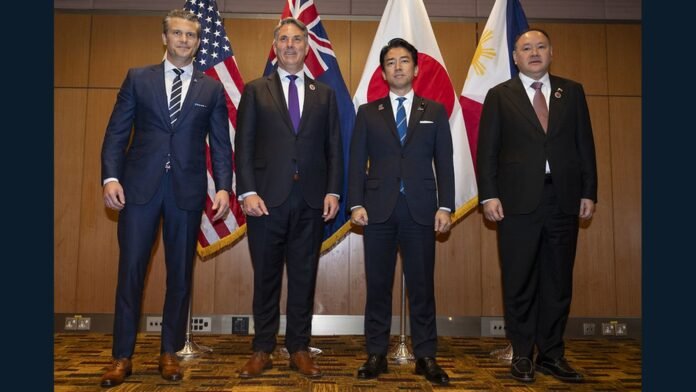
October 29: Defence leaders from Japan, Australia, the Philippines and the United States agreed to advance policy consultations and joint exercises after meeting in the Philippines on October 28, Japan’s Defence Ministry said in a release published on October 29.
Key highlights
- Shinjiro Koizumi met Richard Marles, Gilberto Teodoro and Pete Hegseth.
- Japan proposed further strengthening policy consultations.
- The ministers agreed to advance several forms of defence cooperation.
- The four-country meeting is a different grouping from the India-inclusive Quad.
Who took part
| Country | Defence leader identified in Japan’s release |
|---|---|
| Japan | Shinjiro Koizumi |
| Australia | Richard Marles, Deputy Prime Minister and Defence Minister |
| Philippines | Gilberto Teodoro, National Defense Secretary |
| United States | Pete Hegseth, Secretary of War |
Japan said Koizumi was visiting the Philippines for the 13th ASEAN Defence Ministers’ Meeting Plus. The four-country discussion took place alongside that wider regional gathering.
What the ministers agreed
According to Japan’s account, Koizumi proposed stronger policy consultations. The ministers agreed to advance cooperation, including consultations and joint exercises, building on activities undertaken over the preceding year. The release framed those steps as support for regional peace and stability.
The published four-country summary does not set out a new exercise calendar, troop commitment, spending total or treaty. Those would require their own announcements. It is therefore more accurate to describe the outcome as a commitment to further cooperation than as a newly operational military arrangement.
How this fits the regional diplomacy
A separate October 28 Japan–Philippines joint statement also identified the Australia–Japan–Philippines–United States framework as an area of multilateral cooperation. That statement expressed the two governments’ concerns about coercive activity and unilateral changes to the status quo in regional waters. Those are the stated positions of the two governments, rather than independent findings by this publication.
The distinction between meetings matters. A bilateral discussion, a four-country consultation and the wider ASEAN-led forum can occur during the same visit while producing different statements. An announcement from one should not automatically be attributed to all participants in another.
This four-country framework includes the Philippines. The grouping commonly called the Quad includes India instead of the Philippines. Keeping the membership explicit helps readers avoid confusing separate diplomatic and defence tracks.
What consultations and exercises can demonstrate
Policy discussions can establish how partners assess a problem and where their priorities overlap. Exercises can test practical coordination. Neither label alone tells readers what forces were committed, which capabilities were involved or whether a specific operation has been authorised.
The details to examine in a subsequent exercise announcement would include the participants, location, dates and stated purpose. A procurement decision would require a different set of facts, such as the equipment, contractual status and delivery schedule.
What to watch
Further ministry releases and any published exercise plans will show how the October commitment is implemented. The immediate confirmed development is that the four defence leaders met and agreed to advance cooperation; the short public summary leaves the operational details for later announcements.
Sources
- Japan Ministry of Defense: Japan–Australia–Philippines–United States meeting
- Japan and Philippines: Defense ministerial joint press statement, October 28

The International Desk covers world and Asian affairs, diplomacy and conflict, with a focus on what they mean for India. Stories are checked against at least two credible sources before publication.