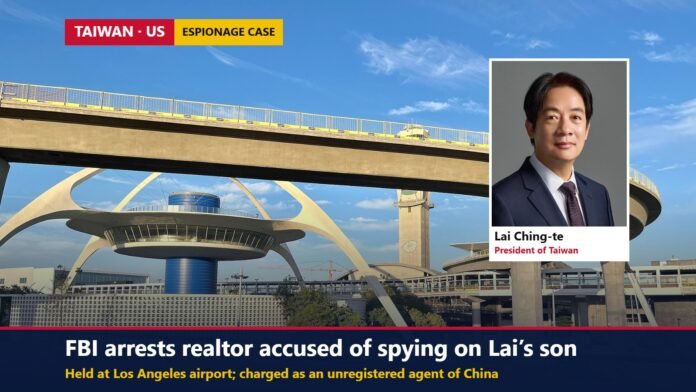
October 7: The FBI has arrested a California real estate agent on a charge of acting as an unregistered agent of China, alleging that she travelled to the Seattle area to film the home, family and cars of the son of Taiwan’s President Lai Ching-te. Wanying Zhang, 34, of Irvine, who also uses the name Heather Zhang, was arrested on Sunday at Los Angeles International Airport before a planned flight to China, the US Department of Justice said. A bail hearing was set for Wednesday afternoon in Los Angeles. Taiwan’s Presidential Office called the case “transnational repression”. The Chinese Embassy in Washington did not comment publicly.
Update (October 8): On Wednesday, US Magistrate Judge Steve Kim ordered Zhang held in custody until trial, agreeing with prosecutors that she is a flight risk. Details: Judge orders woman accused of spying on Taiwan President Lai’s son held until trial.
Key highlights
- The charge is one count of acting as an agent of the People’s Republic of China without notifying the US Attorney General. It carries up to 10 years in prison, the Justice Department said.
- The department’s statement does not name the family. The FBI identified the target on X as Ting-Yu Lai, the president’s elder son, an engineer who lives in the Seattle area.
- Prosecutors say Zhang met Chinese officials in China in June 2025 and carried out the surveillance on September 1, 2025.
- Zhang is a naturalised US citizen and has held a real estate licence since 2016, according to AP. She has not been indicted.
- The Justice Department notes that a criminal complaint is only an allegation and that defendants are presumed innocent until proven guilty in court.
What the complaint alleges
The following sequence comes from the Justice Department’s statement and the FBI complaint.
| Date | Allegation | Source |
|---|---|---|
| June 2025 | Zhang travels to China and meets Chinese officials, who task her with surveillance. The meeting was in Changsha and that she was introduced through a former classmate. | Justice Department |
| August 29, 2025 | Zhang and an associate fly from Orange County, California, to Las Vegas. | Justice Department |
| September 1, 2025 | They fly to the Pacific Northwest. She sends an official the message “Boarding now” with a photo of her boarding pass. | Justice Department |
| September 1, 2025 | At the family’s home she sends: “Saw him, young male, it’s the young one”, records video and passes on the number plates of cars parked there. The material went by WeChat. | Justice Department |
| October 4, 2026 | She is arrested at Los Angeles International Airport before a flight to China. | Justice Department |
| October 5, 2026 | First court appearance in Los Angeles. The judge says she does not qualify for a public defender and must hire a lawyer. | Public record |
Security footage showed Zhang “appearing to film” the family as they arrived home, and the complaint quotes a further message: “I am videorecording.” In the complaint, FBI Special Agent Kevin Holt explained why such material matters: “If the PRC wish to obtain leverage over the President of Taiwan during any potential conflict, the location and pictures of the close relatives of a high-ranking Taiwanese government official, including pictures of their homes and cars, could be useful to the PRC.”
Who was watched
Lai Ting-yu is an engineer in his thirties who studied in the United States, works for the Dutch electronics company Philips and has a young child. Prosecutors say the surveillance covered him, his wife and their child.
What US officials said
“Ms. Zhang is charged with acting at the direction of Chinese government officials to spy on the family,” First Assistant US Attorney Bill Essayli said in the Justice Department statement. Assistant Attorney General John A. Eisenberg called the alleged surveillance “deeply troubling”, and FBI Assistant Director Roman Rozhavsky described it as a “brazen plot directed by the Chinese government to conduct a covert surveillance mission”.
FBI Director Kash Patel said the Chinese government had allegedly “sent an operative to the U.S. to surveil the family of Taiwan’s president”. A State Department spokesperson said: “We are committed to safeguarding our sovereignty, keeping our communities safe, and defending individuals from the overreach of foreign governments.” Senator Marsha Blackburn accused China of “trying to export its repressive surveillance to America”, the agency reported.
The FBI’s Los Angeles field office investigated the case, and it is being prosecuted by the Justice Department’s National Security Division and the US Attorney’s Office for the Central District of California.
Taiwan’s response, and China’s silence
Presidential Office spokesperson Karen Kuo said Taiwan “strongly condemned” what she called a “typical case of transnational repression”. She described such acts as “barbaric” and said “such behavior should not be tolerated in the civilized world”. The office thanked US law enforcement and said Taiwan would work with democratic partners against transnational repression.
The Chinese Embassy in the United States has not commented publicly on the case.
Why it matters for Asia
If the allegation is proved, it shows pressure on Taiwan’s leadership reaching beyond the island and beyond military signalling, to the private lives of relatives who live abroad. The FBI agent’s own reasoning in the complaint is about leverage in “any potential conflict”, which ties a quiet residential street near Seattle to the central security question in East Asia.
It also arrives at a sensitive point in relations across the Pacific. Washington is still arming Taipei: Taiwan received its first two F-16V Block 70 jets only days ago. A criminal case that names the Chinese government as the director of a surveillance operation on US soil gives American lawmakers a fresh argument for a harder line, as the senators’ comments show. For other Asian governments whose officials have family in the United States, Europe or Australia, the practical lesson is about the security of relatives overseas.
What to watch
- The outcome of Wednesday’s bail hearing and whether a grand jury returns an indictment.
- Whether prosecutors charge the associate who is said to have travelled with Zhang.
- Any response from Beijing.
- Whether Taipei or Washington announces new protection for officials’ relatives abroad.
Sources

The International Desk covers world and Asian affairs, diplomacy and conflict, with a focus on what they mean for India. Stories are checked against at least two credible sources before publication.