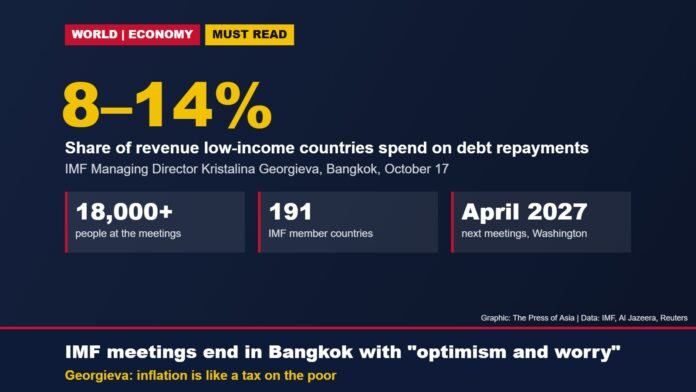
Bangkok, October 17: The annual meetings of the International Monetary Fund and the World Bank closed in Bangkok on Saturday with IMF Managing Director Kristalina Georgieva describing a mood of “optimism and worry”. She warned that high inflation, debt payments and the spillovers of war are hurting low-income countries the most. “Inflation is like a tax on the poor,” she told reporters.
The IMF’s steering committee, the International Monetary and Financial Committee (IMFC), issued a chair’s statement that called the global economy resilient but warned there is “no room for complacency”. The meeting was also marked by a walkout of delegates while Russia’s finance minister was speaking.
The week-long meetings drew more than 18,000 people. We covered the agenda when the meetings opened: IMF and World Bank meetings open in Bangkok.
Key highlights
- Georgieva: low-income countries now spend 8 to 14% of their revenue on debt repayments, up from previous years.
- She pointed to the “dynamism of Asia” as a source of optimism, and pledged a “relentless pursuit of more resources for low-income countries”.
- IMFC chair Mohammed Al-Jadaan, Saudi Arabia’s finance minister, said the economy shows “remarkable resilience” but warned of wars, high debt and risks from rapid AI development.
- Many delegates, nearly half by one account, walked out while Russian Finance Minister Anton Siluanov spoke.
- The next meetings are expected in April 2027 in Washington.
What Georgieva said
Prices have risen since February, when the United States and Israel launched a war on Iran and retaliatory strikes disrupted oil and gas flows from the Middle East. Georgieva said the discussions in Bangkok showed both “optimism and worry”, citing the dynamism of Asia on the positive side and the strain on low-income countries on the other.
She said members showed heightened anxiety about growing divergence between economies, and that many lower-income countries outside the artificial intelligence value chain fear falling further behind. She also said the IMF intends to support Iraq “very firmly” with a requested loan programme and that talks with Lebanon are progressing.
The chair’s statement
Because members have been unable to agree a full communique since Russia’s 2022 invasion of Ukraine, the IMFC again issued a chair’s statement. Al-Jadaan said all members had agreed to it. Its main points:
| Issue | What the IMFC chair’s statement says |
|---|---|
| Outlook | The economy has weathered recent shocks “better than expected”, but “resilience cannot be taken for granted”; risks are tilted to the downside |
| Conflict and energy | Escalating conflicts could disrupt trade routes, raise commodity prices, including refined energy products, and worsen energy and food insecurity |
| Inflation | Central banks stay committed to price stability; “central bank independence remains essential” |
| Debt | Fiscal vulnerabilities “should be urgently addressed”; better debt restructuring, including under the Common Framework, and more transparency from all creditors |
| Low-income countries | Concern that low-income and fragile states are “at risk of falling further behind” |
| Artificial intelligence | AI is boosting investment and could lift productivity, but its economic effects are uncertain |
| IMF resources | Members urged to finalise approval of the quota increase under the 16th General Review of Quotas |
Our calculation: if a low-income country spends 8 to 14% of its revenue on debt repayments, then out of every $100 its government collects, $8 to $14 goes to creditors before a single school or clinic is paid for. At the top of that range, that is one dollar in seven.
The walkout
Many delegates left the room when Anton Siluanov addressed the committee in Russian. Bundesbank President Joachim Nagel said nearly 50% of delegates took part and called it “a very strong signal about solidarity and values”. Al-Jadaan said the walkout did not change the outcome.
The Asia angle
Asia was the bright spot in the IMF’s message. Earlier in the week the IMF forecast that emerging Asia will grow 5.1% in 2026, with India at 7%, as we reported in IMF sees emerging Asia growing 5.1%. The host country also left its mark: the chair’s statement welcomed the “Bangkok Blueprint” on safeguards for digital finance. India’s Finance Minister Nirmala Sitharaman used the meetings to urge the World Bank to judge private finance by the jobs and productivity it creates, as we reported.
The worry for Asia is the same as everywhere: oil and gas prices tied to the war, which weigh most on energy-importing economies in South and Southeast Asia that are also carrying heavy debts.
What to watch
- Whether members complete approval of the IMF quota increase before the April 2027 meetings in Washington.
- New IMF lending, starting with the loan programme Iraq has requested and the talks with Lebanon.
- Oil prices and shipping routes in the Middle East, the main channel through which the war reaches Asian economies.
What it means
Bangkok ended with Asia held up as the world economy’s strongest region and with a warning that the poorest countries are being squeezed by debt payments and prices they cannot control. For Asian importers of energy, how long the war in the Middle East keeps oil prices high matters more than anything agreed on paper.

The Business Desk covers markets, the economy, companies and personal finance. Stories are checked against at least two credible sources before publication.