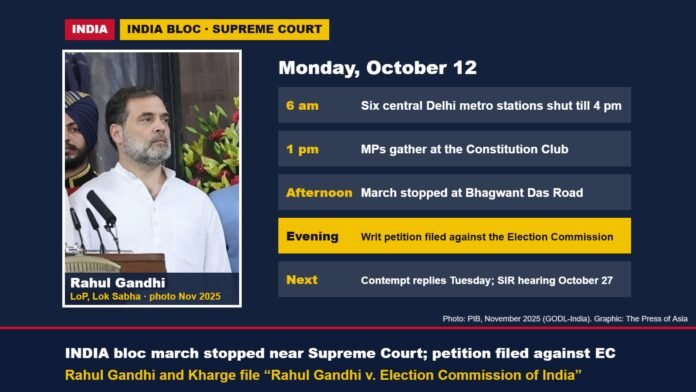
October 12: Delhi Police stopped the INDIA bloc’s “Chalo Dilli – March for Democracy” at Bhagwant Das Road near the Supreme Court on Monday, as opposition MPs and hundreds of supporters marched to demand the resignation of Chief Election Commissioner Gyanesh Kumar over alleged “vote theft” in the Special Intensive Revision (SIR) of electoral rolls. Rahul Gandhi and Mallikarjun Kharge, the leaders of the opposition in the Lok Sabha and Rajya Sabha, then filed a writ petition in the Supreme Court titled “Rahul Gandhi v. Election Commission of India”, just before the filing counter closed for the day.
Key highlights
- The march set off from the Constitution Club, where Rahul Gandhi had asked opposition MPs to gather at 1 pm.
- On Sunday, Chief Justice of India Surya Kant had declined to meet the bloc’s leaders and advised them to file a petition, because the issues are already before the court.
- The court allowed a delegation of 10 to 15 leaders into the filing counter. The details of what the petition seeks have not been made public.
- Delhi Chief Minister Rekha Gupta said the “credibility of India’s democracy cannot be made hostage to the opposition’s political convenience”, and cited an open letter from 124 former civil servants defending the Election Commission.
- Six central Delhi metro stations were closed from 6 am to 4 pm for security reasons, the Delhi Metro said. A Supreme Court hearing on petitions about the SIR is listed for October 27, according to Outlook.
Monday, hour by hour
| When | What happened | Source |
|---|---|---|
| 6 am | Delhi Metro closes entry and exit at Patel Chowk, Janpath, Rajiv Chowk, Mandi House, Central Secretariat and Barakhamba Road until 4 pm; traffic police announce diversions | Public record |
| Morning | Reports that Chief Justice Surya Kant has declined to meet the bloc’s leaders | Public record |
| 1 pm | Rahul Gandhi asks opposition MPs to gather at the Constitution Club for the march | Outlook |
| Afternoon | Police stop the march at Bhagwant Das Road near the Supreme Court | Public record |
| Before the filing counter closes | Rahul Gandhi and Kharge file a writ petition, Rahul Gandhi v. Election Commission of India, through Advocate on Record S. Prasanna; 10 to 15 leaders allowed into the filing counter | Public record |
Rahul Gandhi, Kharge, Priyanka Gandhi Vadra, Shashi Tharoor, Sachin Pilot, D Raja of the CPI, M.A. Baby of the CPI(M), Tejashwi Yadav of the RJD, Supriya Sule of the NCP (SP), Sanjay Raut of the Shiv Sena (UBT), Dipankar Bhattacharya of the CPI(ML) Liberation, Sagarika Ghosh of the Trinamool Congress and activists Yogendra Yadav and Nandita Narayan were among those at the march. The Cockroach Janta Party (CJP), whose weekend protests led to mass detentions according to petitioners in the Supreme Court, said its team would take part.
How the protests built up
| Date | What happened | Source |
|---|---|---|
| October 6 | Opposition MPs march from Parliament towards the Election Commission; most are detained, and some Congress leaders hold a sit-in at Akashvani Bhawan | Outlook |
| October 7 | Rahul Gandhi released from detention | Outlook |
| October 8 | Congress calls nationwide protests | Outlook |
| October 10 | Police deny the CJP permission to protest at Jantar Mantar; CJP founder Abhijeet Dipke and spokespersons Saurav Das and Ashutosh Ranka detained on arrival at Delhi airport; four former chief ministers, including Mamata Banerjee and Arvind Kejriwal, detained; the INDIA bloc announces Monday’s march | Public record |
| October 11 | In a special Sunday sitting, the Supreme Court directs that peaceful protesters not be detained except under the procedure set by law, and that metro, rail and internet services run normally; it issues contempt notices over the closure of metro stations | Supreme Court hearing |
| October 12 | INDIA bloc march stopped near the Supreme Court; writ petition filed against the Election Commission | Public record |
| October 13 | Replies due from the Union Home Secretary, Delhi Police Commissioner and Delhi Metro chief in the contempt case | Supreme Court hearing |
| October 27 | Supreme Court hearing on petitions about the SIR | Outlook |
Petitioners told the Supreme Court on Sunday that about 7,000 people had been detained during Saturday’s protests, a figure for which there is no official number, while the Solicitor General said 47 of Delhi Metro’s 303 stations had been closed or restricted that day. By our calculation, Monday’s closure of six stations was about one-eighth of Saturday’s.
The two sides
| Opposition | Government side | |
|---|---|---|
| Main claim | The SIR of electoral rolls amounts to “vote theft”, and the Chief Election Commissioner should resign | The Election Commission’s integrity is being questioned for political convenience; Delhi CM Rekha Gupta backed the SIR |
| Support cited | Opposition parties across states, student groups and the CJP | An open letter from 124 former IAS, IFS and allied officers defending the Election Commission |
| Next step | Writ petition against the Election Commission | Contempt replies on Tuesday; the SIR petitions on October 27 |
What to watch
- When the Supreme Court lists the new writ petition, and what relief it seeks.
- The replies of the Home Secretary, Delhi Police Commissioner and Delhi Metro chief in the contempt case on Tuesday.
- Whether the CJP gets a new date for its Jantar Mantar protest.
- The October 27 hearing on the SIR petitions.
What it means
Monday was the point at which the opposition’s campaign moved from the streets into the courtroom. Stopped short of the Supreme Court, the leaders did what the Chief Justice had suggested a day earlier and filed a formal petition. That gives the dispute a legal track with dates, rather than a cycle of marches and detentions. The government side has its own argument ready: that the Election Commission is being attacked for political reasons. With the SIR hearing on October 27 and the contempt case on Tuesday, the court will now shape what happens next more than the police or the protesters.
This article replaces our earlier Hindi report on the march. The Press of Asia now publishes in English only.

The National Desk covers India's politics, governance, security and public-interest news. Stories are checked against at least two credible sources before publication.