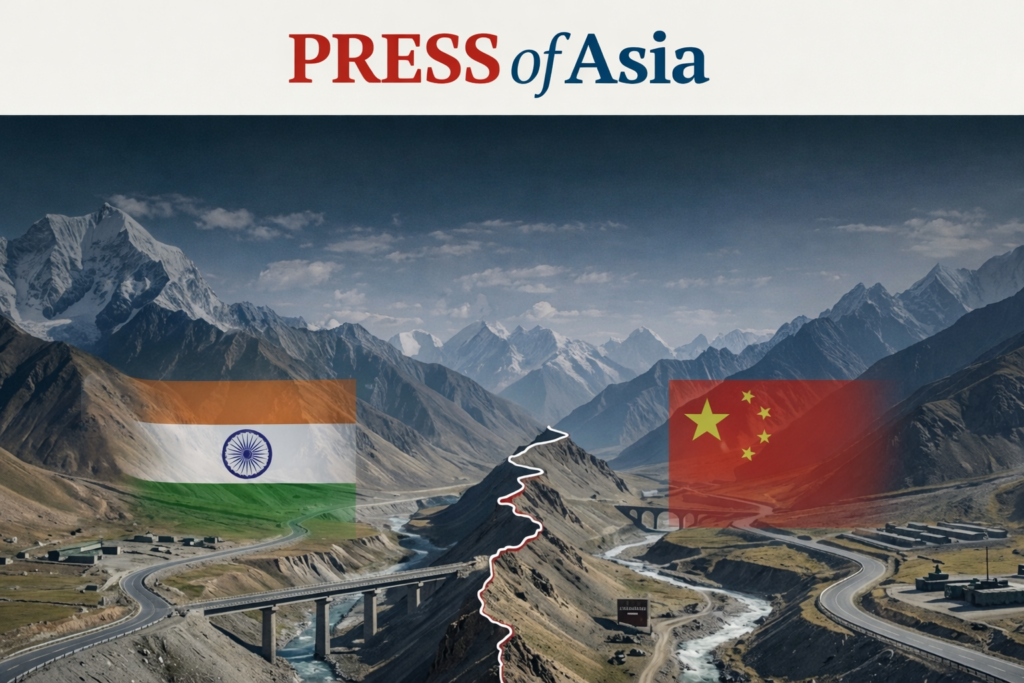
More than a year after India and China reached a landmark disengagement agreement in October 2024, the situation along the Line of Actual Control (LAC) remains cautiously stable but strategically competitive. As of March 2026, both nations are engaged in a silent but intense infrastructure race along the 3,488-kilometre contested border, even as diplomatic channels remain open and military commanders continue to meet regularly.
The October 2024 Agreement and Its Aftermath
The historic agreement between India and China restored patrolling rights in the Depsang Plains and Demchok areas of eastern Ladakh, areas where troops had been locked in a tense face-off since the Galwan Valley clash of June 2020, which killed 20 Indian soldiers and at least four Chinese troops. The disengagement was seen as a significant diplomatic breakthrough, paving the way for improved bilateral ties.
Following the deal, Indian and Chinese military commanders held their 23rd round of talks at the Chushul-Moldo border meeting point in October 2025. Both sides agreed to continue using existing mechanisms to resolve ground-level disputes and maintain stability. However, analysts note that while the standoff has ended, the underlying territorial dispute remains unresolved.
Infrastructure Race Accelerates
In early 2026, India launched construction on the 1,840-kilometre Arunachal Frontier Highway, a massive infrastructure project designed to run parallel to the LAC. The highway is intended to provide all-weather access to remote border areas and support troop mobilisation in case of future tensions. This follows years of India accelerating road, bridge, and tunnel construction in Ladakh and Arunachal Pradesh.
China, meanwhile, has continued to expand its military infrastructure on the Tibetan Plateau, including airfields, logistics depots, and villages near disputed areas. Satellite imagery analysed by defence experts shows continued construction activity in areas adjacent to the LAC, suggesting Beijing has not wound down its strategic posture.
Diplomacy and Economic Ties Improve
On the diplomatic front, India and China have resumed several bilateral mechanisms that were suspended during the border crisis. Trade between the two countries has partially recovered, and direct flights have resumed on certain routes. Prime Minister Narendra Modi and President Xi Jinping met on the sidelines of international forums, signalling a willingness to stabilise relations.
However, India remains cautious. New Delhi has continued to deepen its partnerships with the United States, Japan, and Australia under the Quad framework, viewing it as a strategic hedge against Chinese assertiveness. India has also diversified its defence procurement away from Russia and towards Western suppliers.
Looking Ahead
As of March 15, 2026, the India-China border remains peaceful but not normalised. Patrolling has resumed in most friction areas, but buffer zones established during the standoff remain in place. India and China are expected to hold further diplomatic talks in the coming months to address the broader boundary dispute, which dates back to the 1962 war.
Experts caution that the fragile peace depends on sustained political will from both sides and that any incident along the LAC could quickly escalate into a new crisis. With both nations investing heavily in border infrastructure and military capabilities, the Himalayan frontier remains one of Asia’s most sensitive strategic flashpoints.