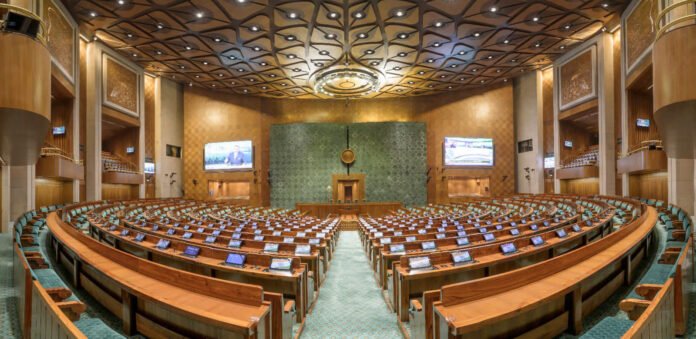
November 29, 2026 — India’s government is due to bring a revised delimitation package to the Lok Sabha when a special sitting begins on November 30. The proposals would redraw parliamentary and assembly constituencies, expand the number of seats and put women’s reservation into effect after the first delimitation under the new framework.
Two numbers describe the proposed Lok Sabha expansion. India currently has 543 parliamentary constituencies. A projection shared by Law and Justice Minister Arjun Ram Meghwal shows 816 seats, while the draft constitutional amendment would set the maximum at 850. As of November 29, these are proposals awaiting parliamentary consideration.
What is delimitation?
Delimitation decides the geographic area represented by an elected member. A commission can redraw a parliamentary or assembly constituency by moving wards, villages or other areas between seats. The aim is to make representation more comparable as populations change, while taking account of boundaries and local conditions.
Three decisions are involved. Seat allocation sets how many MPs each state or Union Territory sends to the Lok Sabha. Boundary drawing decides which areas each MP or MLA represents. Reservation determines which constituencies are reserved for specified groups under the applicable law. A state’s overall share of the Lok Sabha can stay broadly stable even as many of its constituency boundaries change.
What does the Constitution provide today?
Article 81 governs the Lok Sabha’s composition. Article 82 provides for readjustment after a census in the manner Parliament determines by law. Article 170 contains parallel provisions for state legislative assemblies. The Election Commission lists four national delimitation commissions, constituted in 1952, 1963, 1973 and 2002.
The 84th Amendment kept the allocation of Lok Sabha seats among states and the size of state assemblies tied to the 1971 Census until publication of the relevant figures from the first census taken after 2026. The 87th Amendment allowed constituency boundaries to be adjusted using the 2001 Census while retaining those seat totals. The constitutional trigger depends on publication of the relevant figures, so the end of 2026 alone brings no automatic change to the map.
How would the November 2026 package work?
The draft Constitution (132nd Amendment) Bill sets the Lok Sabha ceiling at 815 representatives from states and 35 from Union Territories. It would also raise the maximum size of a state assembly from 500 to 650. The proposed first delimitation would increase seat allocations by 50% over existing numbers under the framework described in the bills.
The draft would keep the resulting seat allocations and constituency divisions in place until 2051. The plan uses the existing seat distribution as the starting point for expansion. For the boundaries themselves, the government’s parliamentary memorandum specifies the latest census figures published when the proposed law comes into force. The 2011 Census is the latest completed national census as of this writing. The wording ties the choice of data to the published figures available at commencement.
Meghwal’s November 28 presentation gives examples of what the seat expansion could look like. The figures below are projections for selected states and Delhi. They describe seat totals and leave the location of individual constituencies to later decisions.
| State or Union Territory | Current Lok Sabha seats | Government projection |
|---|---|---|
| Uttar Pradesh | 80 | 120 |
| Maharashtra | 48 | 72 |
| Bihar | 40 | 60 |
| Tamil Nadu | 39 | 59 |
| Kerala | 20 | 30 |
| Delhi | 7 | 11 |
| All India | 543 | 816 |
Why the state-by-state debate continues
States with faster population growth can have more residents per MP than states whose populations grew more slowly after 1971. Reallocating seats entirely on a newer population count could shift each state’s share of the House. The government’s proposed percentage increase would broadly preserve current shares, though the number of additional MPs would vary with each state’s starting point.
The projections illustrate the difference. Uttar Pradesh would gain 40 seats, going from 14.7% of the House to about the same share. Tamil Nadu would gain 20, staying close to its current 7.2% share. On November 29, DMK president M. K. Stalin said his party would support the revised package because it addressed his concerns about Tamil Nadu’s seat count and proportional representation.
Congress leaders met Stalin in Chennai and urged him to oppose the package, The Indian Express reported. Rahul Gandhi has called for implementing the quota within the existing 543 Lok Sabha seats and including a sub-quota for Other Backward Classes, according to Moneycontrol.
How would women’s reservation come into effect?
The 106th Constitutional Amendment, enacted in 2023, provides for roughly one-third of directly elected seats in the Lok Sabha, state assemblies and the Delhi assembly to be reserved for women. That includes roughly one-third of the seats already reserved for Scheduled Castes and Scheduled Tribes. The 2023 framework links implementation to delimitation after publication of figures from the first census taken after that amendment comes into force.
The new draft would trigger reservation after the first delimitation under the proposed 132nd Amendment. It also expressly names the assemblies of Puducherry and Jammu and Kashmir alongside Delhi. The government’s parliamentary memorandum says the proposed Delimitation Commission would allot reserved seats for women by rotation. The government has identified the 2029 Lok Sabha election as its target. The timing depends on passage of the package and completion of the delimitation.
What has to happen before the map changes?
The constitutional amendment needs a majority of the total membership of each House and at least two-thirds of the members present and voting in each House. An earlier constitutional amendment bill fell short of the required majority in the Lok Sabha in April 2026.
If the package is enacted and brought into force, the government would constitute the Delimitation Commission. Its work would translate the seat-allocation rules into constituency boundaries and determine where reserved seats go. The last nationwide exercise published draft proposals and invited objections before the final orders. For voters, the equivalent milestones in the new exercise will be the published proposals and final orders showing whether a neighbourhood changes constituency or whether a seat is reserved.
Related coverage India’s Cabinet clears new women’s reservation and delimitation proposals
Sources
- Constitution of India, including Articles 81, 82, 170 and 368
- Election Commission of India — delimitation history
- Election Commission of India — constituency publication and consultation procedures
- Gazette of India — Constitution (106th Amendment) Act, 2023
- Lok Sabha — draft Constitution (132nd Amendment) Bill, 2026
- Lok Sabha — withdrawal memorandum explaining the Delimitation (Second) Bill
- Akashvani — the November 30 legislative agenda
- Moneycontrol — Meghwal’s projection and state-level seat figures
- The Indian Express — the DMK and Congress positions on November 29
- Hindustan Times — projected seat totals and the 2029 target

The National Desk covers India's politics, governance, security and public-interest news. Stories are checked against at least two credible sources before publication.