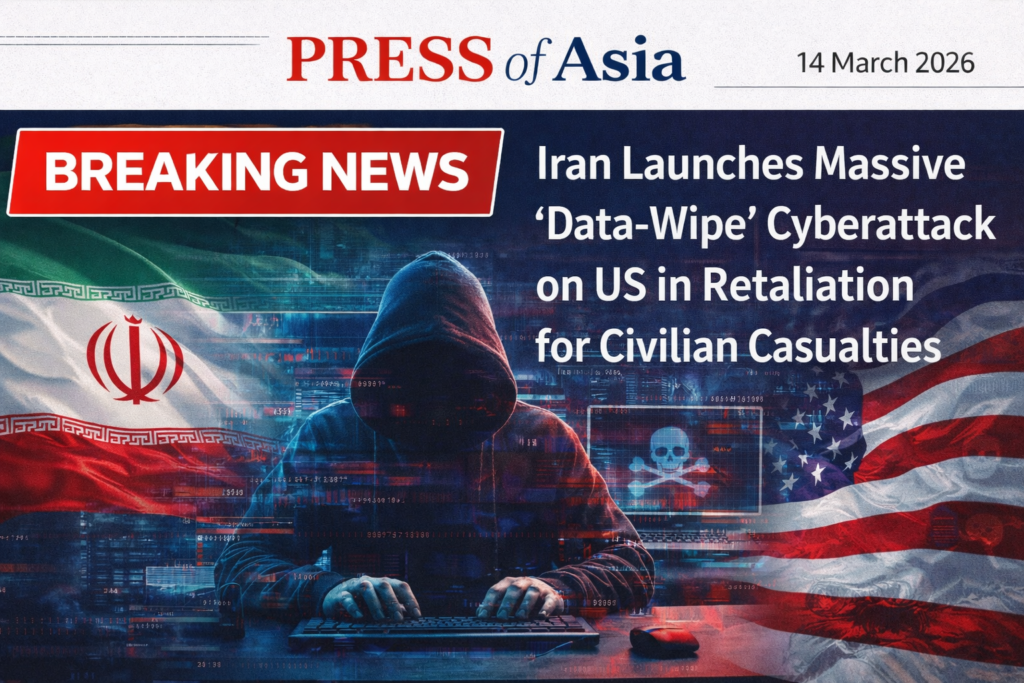
Iran Launches Massive ‘Data-Wipe’ Cyberattack on US Systems in Retaliation for Civilian Casualties
By The Press of Asia | March 14, 2026
Washington/Tehran: The escalating geopolitical conflict in the Middle East has officially expanded into the digital realm. In a significant escalation of hybrid warfare, Iran’s Cyber Command has executed what officials in Tehran are calling a massive “data-wipe” cyberattack against critical United States government and financial systems.
The Iranian government claims this digital offensive is in direct retaliation for recent US-Israeli strikes that resulted in heavy civilian casualties, specifically citing a tragic attack on a school in the southwestern Iranian city of Minab that killed dozens of children. The coordinated cyber operation has targeted several US federal agencies, financial institutions, and critical infrastructure networks, putting global cybersecurity agencies on maximum alert.
What is a Data-Wipe (Wiper) Attack?
To understand the severity of this incident, it is crucial to distinguish between traditional hacking and a “wiper” attack.
A data-wipe cyberattack (utilizing destructive malware) is designed with a single, malicious intent: permanent destruction. Unlike ransomware, where hackers encrypt files and demand a financial payout (ransom) to unlock them, wiper malware completely overwrites the storage sectors of a hard drive. It deliberately destroys the master boot record and file systems, making data completely unrecoverable without extensive, offline backup restoration.
When deployed against critical infrastructure, these attacks can be catastrophic. They have the potential to paralyze power grids, crash financial clearing systems, wipe hospital patient records, and disrupt air traffic management systems. By choosing a wiper attack, Iran’s cyber units are aiming to cause maximum operational downtime and economic damage to the US.
The US Response and Retaliation Warnings
The situation has triggered an emergency response in Washington. The US Cybersecurity and Infrastructure Security Agency (CISA) confirmed that multiple federal networks and associated critical infrastructure sectors experienced “anomalous disruptions.” However, citing national security protocols, CISA declined to provide specific details about the exact scope of the damage or which specific financial institutions were compromised.
US President Donald Trump addressed the nation in a brief but stern statement, confirming the attacks. He warned Tehran that the United States considers destructive cyberattacks on critical infrastructure as acts of war. The President stated that any further digital aggression would be met with “overwhelming and decisive retaliation,” utilizing both kinetic (military) and advanced digital cyber-command capabilities.
While US cyber defenses are widely considered among the most sophisticated in the world, cybersecurity experts note that the sheer scale and coordination of state-sponsored wiper attacks can occasionally overwhelm even the most capable ‘zero-trust’ architectures.
Global Cybersecurity Implications and India’s Alert
This development marks a dangerous new chapter in the US-Iran conflict, demonstrating how modern warfare operates simultaneously on physical and digital battlefields. The immediate concern for the international community is the “spillover effect.”
Cyber analysts warn that Iranian-aligned Advanced Persistent Threat (APT) groups may not restrict their targets strictly to the US mainland. Allied nations and organizations could also find themselves in the crosshairs. This includes:
- Financial institutions and clearing houses in Europe.
- Energy and oil companies operating in the Gulf region.
- Government databases in countries publicly supporting the US military position.
Impact on India: Recognizing the gravity of the situation, India’s nodal cybersecurity agency, CERT-In (Computer Emergency Response Team – India), has reportedly been placed on high alert. Indian banks, power grids, and aviation networks have been advised to instantly patch vulnerabilities, strictly monitor incoming traffic from high-risk IP blocks, and ensure that offline, immutable data backups are fully functional.
The Minab retaliation episode underscores an urgent reality for 2026: all major economies must rapidly strengthen their national cyber defenses and develop international rapid-response protocols to survive the new era of state-sponsored destructive cyber warfare.