November 28, 2026 — Japan’s government adopted a timetable on Friday for a secondary-capital system intended to keep key national functions running if a major disaster disrupts Tokyo. The plan envisages applications as early as June 2027 and operation of the system around April 2028.
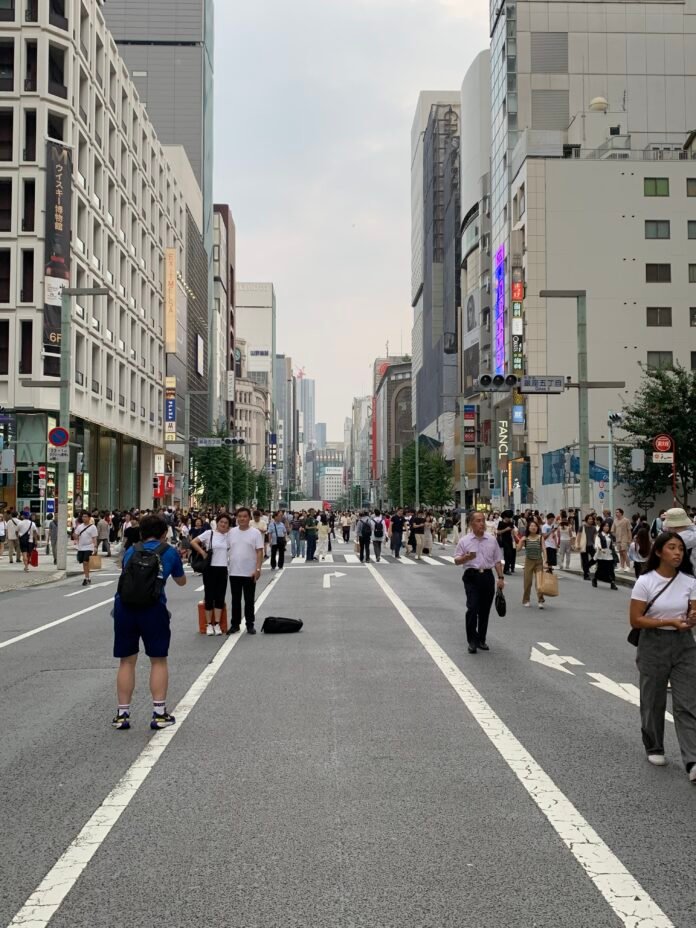
File photo: Pedestrians on a car-free street in Ginza, Tokyo, July 6, 2024. ARandomName123, Wikimedia Commons, CC BY-SA 4.0.
Key highlights
- The Cabinet Secretariat published its approach to prefectural designation on November 27.
- The schedule envisages choosing more than one prefecture in autumn 2027.
- The location-specific development policies are expected in spring 2028.
What a secondary capital would do
The system is designed to maintain continuity when Tokyo cannot carry out key functions normally. It would designate prefectures able to back up those functions and prepare the arrangements in advance. The November timetable covers applications, designation and the start of operation.
In a disruption, continuity depends on more than nominating a city. The responsible institutions need staff, facilities and coordination arrangements that can work away from the usual centre. The plan sets a sequence for developing those arrangements with local governments.
How the timetable works
Jiji Press, published by Nippon.com, reported that applications could begin in June 2027 and that multiple prefectures could be named at the same time in October or November. Development policies, including possible budget and tax measures, are due in spring 2028.
Jiji reported that Hokkaido, Aichi, Osaka and Fukuoka meet the existing requirements and are seeking designation. The Cabinet Secretariat’s document sets out the approach and prospective schedule. A prefecture’s interest or apparent eligibility precedes a government designation.
Why the local plans will matter
The nationwide timetable provides an operating target. The practical responsibilities will be clearer once each designated prefecture has its own development policy. Those plans can show which functions are intended to relocate temporarily and what work is needed for local facilities and intergovernmental coordination.
A system covering multiple prefectures also makes it important to specify what each location would do. The November materials leave those operational details for the designation and implementation phases.
| Stage | Indicative timing |
|---|---|
| Application window | As early as June 2027 |
| Prefectural designations | October or November 2027 |
| Development policies and intended start | Spring 2028 |
Related coverage: Tokyo core inflation rises to 2.9% in November.
What to watch
Watch for the opening of applications and the final shortlist. The region-specific plans will show how the announced timetable translates into arrangements that can be used during a disruption.
Sources
- Japan Cabinet Secretariat timetable in Japanese
- Jiji Press reporting on the adopted plan
- The Japan Times on the planned designation timetable

The International Desk covers world and Asian affairs, diplomacy and conflict, with a focus on what they mean for India. Stories are checked against at least two credible sources before publication.