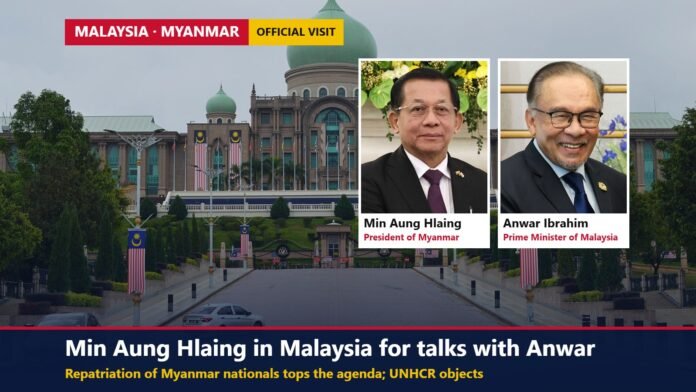
October 7: Myanmar’s President Min Aung Hlaing, the general who led the 2021 coup, arrived in Malaysia on Wednesday for a two-day official visit. He landed at the Bunga Raya Complex of Kuala Lumpur International Airport at 12:30 p.m. and was received with a guard of honour. He is to meet Prime Minister Anwar Ibrahim in Putrajaya on Thursday. Malaysia’s Foreign Ministry says the return of Myanmar nationals who are in Malaysia without papers will be a main subject. The UN refugee agency and rights groups have opposed those returns.
Update (October 8, evening): After the talks, Myanmar agreed to take back a large number of its nationals from Malaysia, and Malaysia said the meeting does not mean recognition of Myanmar’s government. Details: Myanmar agrees to take back its nationals as Anwar hosts Min Aung Hlaing.
Update (October 8): Anwar welcomed Min Aung Hlaing at Perdana Putra in Putrajaya on Thursday morning, followed by a private meeting and delegation-level talks. No agreement had been announced by mid-morning. Our Asia Briefing for October 8 has the latest.
Key highlights
- Nearly 1,500 Myanmar nationals were sent back from Malaysia in the past few days, and about 5,000 have agreed to return in stages.
- Malaysia has not said how many of those returned were Rohingya.
- Anwar told Parliament on Tuesday that he and two ministers “will raise issues towards a solution” during the visit.
- Malaysia is the fifth ASEAN member Min Aung Hlaing has visited, after Laos, Thailand, Vietnam and Cambodia.
- ASEAN has kept Myanmar’s leaders out of its top-level meetings since the coup of February 2021.
The programme
| When | What |
|---|---|
| Wednesday, Oct 7, morning | Leaves Naypyitaw’s military airport |
| Wednesday, Oct 7, 12:30 p.m. | Arrives at Kuala Lumpur International Airport; guard of honour mounted by the First Battalion, Royal Malay Regiment; received by Investment, Trade and Industry Minister Johari Abdul Ghani |
| Thursday, Oct 8 | Official welcome at the Perdana Putra complex, Putrajaya; meeting with Prime Minister Anwar Ibrahim; official luncheon |
| During the visit | Business dialogue between the two sides |
What Malaysia says the visit is for
Wisma Putra, the Malaysian Foreign Ministry, said in announcing the visit that the talks would cover “the voluntary, dignified and safe repatriation of Myanmar nationals of all ethnic groups who had been in Malaysia illegally”. Other subjects are ASEAN’s mechanisms on Myanmar, peace and reconciliation, and humanitarian access. The ministry described the visit as in line with the decision of the 48th ASEAN Summit in May to continue engaging with Myanmar.
“During the visit of the President of Myanmar to Malaysia in the next few days, the foreign minister, the home minister, and I will raise issues towards a solution,” Anwar told Parliament on Tuesday. Anwar met Min Aung Hlaing twice in 2025, when Malaysia chaired ASEAN, and that Foreign Minister Mohamad Hasan has travelled to Myanmar three times since April 2025.
The numbers behind the dispute
| Figure | What it is | Source |
|---|---|---|
| Nearly 1,500 | Myanmar nationals returned from Malaysia in the first group; reports give their arrival as October 3 or Sunday, October 4. | Public record |
| About 5,000 | Myanmar nationals who have agreed to return in stages, under a plan Malaysia announced in July | Public record |
| More than 3,500 | Approved for the second phase of returns | September 30 |
| 11,804 | Myanmar nationals held in Malaysian immigration detention as of August 2026 | Public record |
| About 126,000 | Rohingya refugees registered in Malaysia | UNHCR figures |
| 215,600 | All registered refugees and asylum seekers in Malaysia | UNHCR figures |
Why the returns are contested
The UN High Commissioner for Refugees and rights groups have opposed the repatriation. Their concern is who is being sent back and to what. Malaysia has not disclosed how many Rohingya were in the first group, and rights advocates fear that people who fled the military’s 2017 crackdown could be among those returned. Myanmar is still at war with itself.
Malaysia’s position, as set out by Wisma Putra, is that the returns are voluntary and concern people who were in the country illegally.
What it means
Each side gets something different from the visit. For Min Aung Hlaing it is recognition. ASEAN as a bloc still keeps Myanmar’s leaders away from its summits, more than five years after the coup, but its members have been receiving him one by one, and Malaysia, which chaired the group last year and led its Myanmar diplomacy, is the most significant host so far.
For Anwar the gain is practical. Nearly 12,000 Myanmar nationals were in Malaysian immigration detention in August, and returns need a government in Naypyitaw willing to take people back. The cost is the criticism he is already facing: that returns arranged with the authorities people fled from cannot be called safe while the war continues, and that Rohingya may be caught up in them.
For the region the visit shows a two-track policy hardening into habit: exclusion at the summit table, engagement in bilateral meetings. That matters to Myanmar’s other neighbours, including Bangladesh, Thailand and India, which all deal with people displaced by the conflict. We reported Malaysia’s approval of a second group of returns in the Asia Briefing of 6 October.
What to watch
- Thursday’s meeting in Putrajaya and any joint statement, in particular what it says about how returns are checked and monitored.
- Whether Malaysia says how many Rohingya have been or will be returned.
- The response from UNHCR and from other ASEAN members.

The International Desk covers world and Asian affairs, diplomacy and conflict, with a focus on what they mean for India. Stories are checked against at least two credible sources before publication.