
The Modi-Putin BRICS meeting is expected in New Delhi on Friday, one day before the BRICS leaders’ summit begins, according to Kremlin spokesperson Dmitry Peskov.
The summit is scheduled for September 12-13. Peskov announced the planned meeting during an online interaction with India-based journalists, presenting it as an opportunity for the two leaders to review bilateral ties and discuss sensitive international issues.
What is expected to be discussed
Peskov said the agenda would include trade and economic cooperation. India and Russia have expanded commerce in recent years, especially in energy, while also facing the practical effects of Western sanctions on payments, shipping and insurance.
The Kremlin spokesperson said Russia conducts about 90 per cent of its payments with BRICS member countries in national currencies. That figure was presented by the Russian side and was not accompanied by a detailed public breakdown during the interaction.
Defence cooperation is also likely to be part of the conversation. Peskov said Russia intends to meet its obligations concerning the S-400 air-defence system and referred to ongoing discussions about advanced military technology. No new agreement was announced.
Trade, energy and payment questions
Energy remains central to the economic relationship, but higher trade volumes do not remove operational constraints. Businesses must still manage settlement channels, shipping availability, insurance rules and exposure to sanctions. A useful bilateral outcome would therefore need more than headline trade figures: it would require practical arrangements that companies can use, clarity about compliance and measurable progress on the long-running imbalance in the flow of goods between the two countries.
Ukraine and the wider diplomatic agenda
On the Russia-Ukraine war, Peskov said Moscow welcomed attempts by India and the United States to contribute to a negotiated settlement. His comments reflected the Kremlin’s position. India has maintained dialogue with both Moscow and Kyiv and has repeatedly called for diplomacy.
The issue of Indian citizens serving with the Russian military may also be raised. Peskov said work was under way to identify Indians on the battlefield and arrange their return. Any progress will need confirmation from Indian authorities and the affected families.
Why the meeting matters for BRICS
The bilateral meeting comes as BRICS members try to manage differences over conflicts, trade rules and financial arrangements. Peskov described BRICS as a flexible grouping spanning political, security, economic and cultural cooperation rather than an alliance directed against another bloc.
The expanded group gives emerging economies a larger forum, yet expansion also makes consensus harder. Members have different security partnerships, exposure to sanctions and priorities for the global financial system. For India as host, the task is to identify areas where cooperation can produce practical gains without implying that every member shares the same position on wars, rival power blocs or relations with the West.
Disagreement among members over the conflict in West Asia may complicate negotiations on the summit declaration. That makes the language adopted in New Delhi an important test of whether the expanded group can produce consensus while its members hold different strategic positions.
What to watch in New Delhi
The most meaningful outcomes would be specific announcements on trade, energy, payment mechanisms, defence deliveries or the return of Indian nationals. Until a joint statement is issued, comments made before the meeting should be treated as an outline of Russia’s expectations rather than a concluded bilateral agreement.
The meeting will also be assessed alongside Modi’s engagements with other BRICS leaders. India’s challenge as host is to advance practical cooperation while preserving room for independent relationships with Russia, the United States, Europe and partners across Asia.
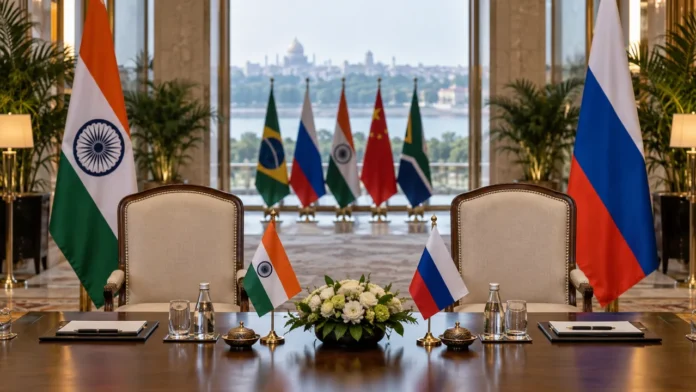
Reporting basis: remarks by Kremlin spokesperson Dmitry Peskov reported by The Indian Express on September 9, 2026. Featured image is an AI-generated editorial illustration and does not depict the actual meeting.