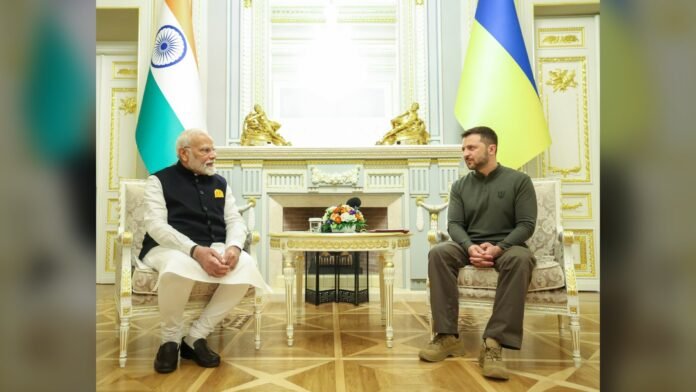
November 10: Prime Minister Narendra Modi has reiterated India’s willingness to help efforts towards a peaceful resolution of the Russia–Ukraine conflict, following a telephone conversation with President Volodymyr Zelenskyy on November 9. The two governments’ accounts place diplomacy, humanitarian concerns and bilateral cooperation at the centre of the call, while Ukraine’s statement also identifies food security as a possible area for Indian involvement.
Key highlights
- India reaffirmed dialogue and diplomacy as the route to ending the conflict.
- Ukraine said the leaders discussed food security and Black Sea grain shipments.
- The Ukrainian presidency described preparations for a meeting in Abu Dhabi.
- Neither account announces a concluded ceasefire or a signed peace agreement.
What India’s account says
The Prime Minister’s Office said Zelenskyy shared his perspective on recent developments in the conflict. Modi restated India’s human-centred approach and readiness to contribute to peaceful-resolution efforts. The leaders also discussed strengthening cooperation across different sectors.
The Indian readout is a statement of diplomatic intent. It does not publish a negotiated settlement, name a new mediation mechanism or provide a timetable for ending the fighting. Those distinctions matter when assessing headlines suggesting that a phone call has already produced a peace breakthrough.
What Ukraine adds
In its separate November 9 statement, the Ukrainian presidency said Zelenskyy briefed Modi on diplomatic developments and preparations for a meeting in Abu Dhabi. It also said the leaders discussed Russia’s blocking of Black Sea grain exports and that India was ready to mediate on food corridors. That more specific description is attributed to Kyiv; the shorter Indian account does not set out those operational details.
Ukraine said the two teams would remain in contact. The public statements reviewed for this report do not establish an agreed corridor’s route, start date, security guarantees or inspection arrangements. Any such development would require further confirmation.
At a glance: two official accounts
| Issue | What is publicly stated |
|---|---|
| Date of conversation | November 9, 2026 |
| Indian position | Dialogue, diplomacy and support for peaceful resolution |
| Ukrainian emphasis | Diplomatic preparations and possible food-corridor efforts |
| Follow-up | Continued contact between the teams, according to Kyiv |
| Ceasefire agreement | Not announced in the readouts |
Why food security is an Asia issue
A food corridor is more than a political declaration. For cargo to move reliably, shippers need workable arrangements for access, vessel safety, insurance and delivery. A statement of readiness to assist should therefore be assessed separately from evidence that commercial shipments have resumed under an agreed framework.
For Asian food importers, the relevant developments would be dependable supply and transport terms. This call alone cannot demonstrate a change in grain prices, freight charges or delivery schedules. Those outcomes depend on implementation and market conditions as well as diplomacy.
The longer bilateral context
Modi and Zelenskyy met in Kyiv on August 23, 2024. The Indian government’s contemporary account recorded four agreements covering agriculture and food, medical-product regulation, humanitarian development projects and cultural cooperation. That visit provides background to the relationship; it should not be confused with a new in-person meeting in November 2026.
What to watch
The next meaningful signals will be follow-up statements from the two governments, concrete arrangements on food shipments and any independently documented diplomatic outcome. Until then, the confirmed news is renewed contact and stated willingness to help, rather than an agreement whose terms have been settled.
Sources
- Prime Minister of India: PM speaks with President Volodymyr Zelenskyy
- President of Ukraine: Diplomatic process discussed with the Prime Minister of India
- Government of India: Prime Minister’s meeting with the President of Ukraine, August 23, 2024

The International Desk covers world and Asian affairs, diplomacy and conflict, with a focus on what they mean for India. Stories are checked against at least two credible sources before publication.