
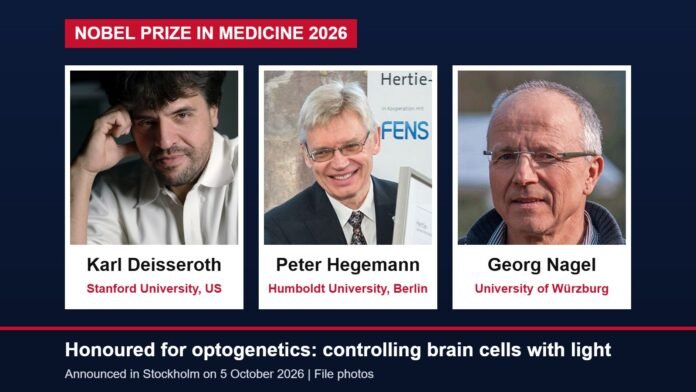
October 6: The 2026 Nobel Prize in Physiology or Medicine was awarded in Stockholm on Monday to Karl Deisseroth of Stanford University and the German scientists Peter Hegemann and Georg Nagel, “for their discoveries concerning light-gated ion channels and optogenetics”. Their work lets researchers switch individual nerve cells on and off with pulses of light, and it is now being tested as a way to give some sight back to people who have gone blind.
Key highlights
- Winners: Karl Deisseroth (Stanford University and the Howard Hughes Medical Institute), Peter Hegemann (Humboldt University, Berlin) and Georg Nagel (University of Würzburg).
- Prize: 12 million Swedish kronor, about $1.2 million, shared between the three.
- The science: A light-sensitive protein from algae is put into nerve cells, which can then be controlled with light.
- Medicine: A gene therapy for the eye disease retinitis pigmentosa is under review by the US Food and Drug Administration.
- Left out: Several early contributors, among them Ed Boyden and Zhuo-Hua Pan. The prize can go to three people at most.
What optogenetics is
In the early 1990s Hegemann and Nagel found channelrhodopsin, a protein in the green alga Chlamydomonas that opens a channel in the cell’s membrane when light falls on it. In 2005 Deisseroth’s laboratory put the gene for that protein into nerve cells and showed that blue light could make them fire. By 2007 his team was switching nerve cells on and off in the brains of living mice.
“We’re using light to turn cells on or off with that millisecond precision and the cellular resolution that is essential to brain function,” Deisseroth said, according to the health news site STAT.
“Optogenetics provides opportunities for mapping the brain in a way that we could once only dream of,” said Per Svenningsson, who chairs the Nobel committee. Researchers use it to work out which cells and circuits are involved in memory, sleep and behaviour, and in neurological and psychiatric disorders.
From the lab to the eye clinic
The first medical use is in the eye. Nanoscope Therapeutics has developed a single injection that delivers a light-sensitive protein to cells in the retina of people with retinitis pigmentosa. The US regulator accepted its application in September and a decision is expected in the first half of 2027, the trade publication R&D World reported. In the company’s trial, treated patients kept an average improvement of about three lines on a standard eye chart after three years. Ray Therapeutics and the French company GenSight Biologics are testing similar approaches.
One of the winners is cautious. Nagel told CNN he knew “of only one patient who has benefited from it” and thought it was “too early for a medicine prize”, R&D World reported.
Who was left out
Nobel rules allow at most three winners, and more than three people helped to create optogenetics. STAT lists four notable omissions: Ed Boyden of MIT, who was first author of Deisseroth’s 2005 paper; Zhuo-Hua Pan of Wayne State University; the Austrian scientist Gero Miesenböck, who made nerve cells respond to light by genetic means in 2002; and Ernst Bamberg, who is named in the committee’s own background material. The committee’s chair declined to comment on how the three were chosen, STAT reported.
Deisseroth acknowledged the wider group. “We have so many collaborators, colleagues, and students and postdoctoral fellows in the lab over the years,” he said.
The Asia angle: the scientist who got there first
Zhuo-Hua Pan began his research career in China and moved to the United States in the 1980s for his doctorate. In February 2004 he made nerve cells from the retina respond to light using channelrhodopsin, about six months before Boyden ran the experiment that led to the 2005 paper, according to a 2016 investigation by STAT that was republished by Scientific American. Pan’s paper was turned down by three journals and appeared in April 2006, eight months after the Stanford paper.
Pan is a vision scientist, and his experiment was done in cells of the retina, the tissue in which the first therapy is now being tested. The second author of the 2005 Stanford paper was Feng Zhang, who later became known for his work on the gene-editing tool CRISPR.
Timeline
| When | What happened |
|---|---|
| Early 1990s | Hegemann and Nagel identify channelrhodopsin in green algae |
| 2002 | Miesenböck makes nerve cells sensitive to light by genetic means |
| February 2004 | Pan gets retinal nerve cells to respond to light using channelrhodopsin |
| August 2004 | Boyden runs the channelrhodopsin experiment in Deisseroth’s laboratory |
| August 2005 | The Stanford paper is published in Nature Neuroscience |
| April 2006 | Pan’s paper is published in Neuron |
| 2007 | Deisseroth’s team controls nerve cells in living mice |
| September 2026 | The US regulator accepts the first application for an optogenetic therapy |
| 5 October 2026 | Nobel Prize awarded |
Compiled by The Press of Asia from STAT, GEN, R&D World and Scientific American.
What comes next
The remaining Nobel prizes are being announced through 12 October, with the Peace Prize on Friday in Oslo, Bloomberg reported. The prizes are handed over on 10 December.
References
- STAT: 2026 Nobel Prize in Medicine awarded for brain research tool called optogenetics
- Bloomberg via The Spokesman-Review: Trio share Medicine Nobel for brain-mapping breakthroughs
- GEN: 2026 Nobel Prize for Physiology and Medicine goes to optogenetics, light-gated ion channels
- R&D World: Optogenetics just won the Nobel Prize, its first therapy is already under FDA review
- Scientific American (from STAT, 2016): He may have invented one of neuroscience’s biggest advances, but you’ve never heard of him

The International Desk covers world and Asian affairs, diplomacy and conflict, with a focus on what they mean for India. Stories are checked against at least two credible sources before publication.