October 27: Singapore is moving to another phase of geothermal research after a geophysical survey identified substantial underground heat potential. The Energy Market Authority’s October 26 announcement offers an important qualification: a large technical resource estimate is not the same as a proven, commercially recoverable electricity supply.
Key highlights
- EMA says the initial resource estimate exceeds 60 times Singapore’s current annual electricity use.
- Surbana Jurong and GLJ will examine technical, safety and commercial feasibility.
- The next study is expected to begin at the end of 2026 and take about 15 months.
- Earlier NTU-led drilling found 122°C at 1.76 kilometres in Sembawang.
What EMA has announced
The authority said a 2024–2026 non-invasive survey was conducted by a consortium involving Chevron, Metatek Group and Surbana Jurong. Higher-temperature resources at depth could have electricity applications, while shallower, lower-temperature heat may support heating or cooling systems.
EMA’s next phase will examine how much energy can actually be extracted, suitable technologies and costs. It has not announced a commercial power station, a production start date or a guaranteed contribution to household electricity.
Why “60 times” is not 60 years of ready-to-use power
A resource estimate describes a potential store of energy; an operating power plant delivers energy at a particular rate over time. Converting one into the other requires evidence about temperatures, drilling, sustained extraction, equipment and economics. It would therefore be misleading to turn the announcement into a claim that Singapore has secured six decades of electricity.
A useful comparison is the difference between identifying heat underground and proving a system that can continuously bring usable heat to the surface. The new study is intended to narrow that gap. The size of the initial estimate makes investigation worthwhile, but it does not remove the need for testing.
At a glance: evidence versus next steps
| Item | What is established or planned |
|---|---|
| 2024–2026 survey | Initial underground heat-resource assessment |
| Northern Singapore boreholes | Measured temperatures reported by the NTU-led team |
| End-2026 study | Technology, safety and commercial assessment |
| Commercial deployment | No final decision or start date announced in the release |
What the earlier boreholes showed
In July 2025, NTU Singapore reported research with TUMCREATE and Surbana Jurong that measured 122°C at 1.76 kilometres in Sembawang. Earlier measurements in Admiralty had found 70°C at 1.12 kilometres. These are observations at different locations and depths, not a uniform temperature map of the entire island.
The research team said further assessment was needed to understand the reservoir’s extent, longevity and suitable applications. Those questions remain central to judging whether the resource can become a dependable part of the energy system.
The technology question
The US Department of Energy explains that conventional geothermal resources require heat, fluid and permeability. Enhanced geothermal systems can create a reservoir where the natural combination is insufficient. This background explains why a country can have hot rock without already having a conventional geothermal power industry; it does not establish which technology Singapore will select.
What to watch
The next meaningful milestones are the study’s start, evidence on recoverable energy and a published assessment of cost and safety. Claims about plant capacity, lower bills or a specific deployment year should wait for those decisions.
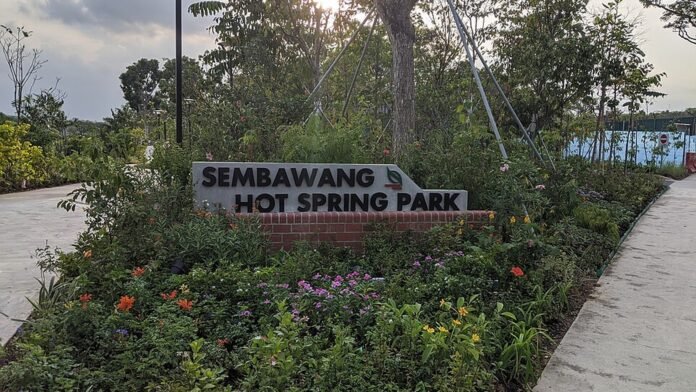
File photo: the entrance to Sembawang Hot Spring Park in Singapore, January 13, 2020. Credit: TheGreatSG’rean; CC BY-SA 4.0. Cropped/resized to 1600×900. The park is not an announced geothermal power-plant site. Image source; Image-use terms. Adaptation shared under the same licence.
Sources
- EMA: Next Phase of Geothermal Studies After Positive Survey Findings
- NTU Singapore: Strong geothermal potential discovered in northern Singapore
- US Department of Energy: Enhanced Geothermal Systems

The Tech Desk covers technology, artificial intelligence and cybersecurity. Stories are checked against at least two credible sources before publication.