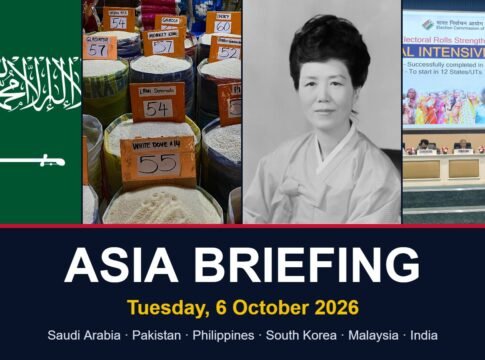
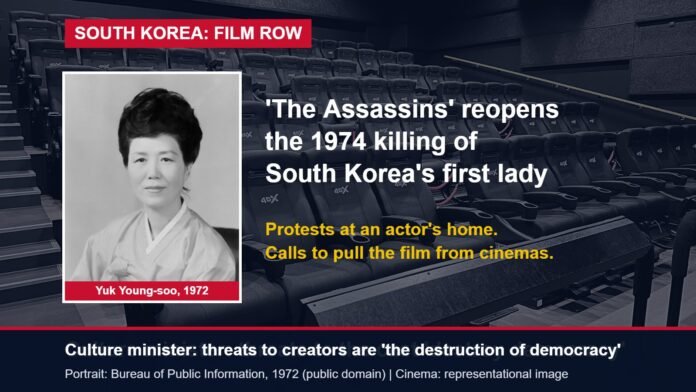
October 6: South Korea’s culture minister has asked the police to protect the cast and makers of “The Assassins”, a film about the 1974 killing of first lady Yuk Young-soo, after protesters gathered outside the home of one of its actors and conservative groups demanded that cinemas stop showing it. Minister Choi Hwi-young said criticism of a film is free but that threatening the people who made it “destroys democracy”.
Key highlights
- The film: “The Assassins”, directed by Hur Jin-ho, opened on 23 September and has drawn more than 2 million viewers in 11 days.
- The subject: The shooting of Yuk Young-soo, wife of President Park Chung-hee, during an attempt on his life in 1974.
- The protests: About 50 demonstrators gathered outside actor Yoo Hae-jin’s home in Seoul on 4 October.
- The demand: The opposition People Power Party and two memorial foundations want screenings suspended.
- The government: The culture minister has asked the National Police Agency for safety measures and opposes any ban.
What the minister said
“I have strongly requested relevant authorities, including the National Police Agency, to take safety measures,” Choi said, in the English translation published by the broadcaster SBS. “While critiques of a film are free, threatening the personal safety of creators destroys democracy.”
He rejected calls for the government to stop screenings, describing them as “a dangerous demand to return to the era of ‘prior censorship'”, and said disputes about the film’s content belong in the courts. The reports we reviewed mention no court ruling on the film so far.
Why the film is disputed
The film follows people investigating the shooting and adds fictional elements, including the idea that intelligence officials may have been involved, SBS reported. Critics say this distorts history and lends weight to a conspiracy theory that Park Chung-hee himself was behind his wife’s death.
The People Power Party, the Park Chung Hee Presidential Memorial Foundation and the Yuk Young-su Memorial Foundation have demanded that screenings be suspended. Director Hur Jin-ho has said he did not start from the assumption that Park was involved. The production company, Hive Media Corp, said the film was not made “to newly establish a specific historical conclusion” and asked audiences to see it “purely as a product of creation”.
Protests, a cancelled screening and a warning
About 50 demonstrators gathered outside Yoo Hae-jin’s home in Seoul’s Seongbuk district on 4 October, The AsiaN reported. SBS described the organisers as a conservative civic group that wants an apology from the actor, and said a separate rally calling for a boycott of products he advertises was also planned.
Yoo’s agency said on 5 October that it would “take all possible measures to protect the rights and safety” of the actor against acts that invade his privacy or threaten his safety.
The fallout has reached the film’s promotion. Hive Media Corp cancelled stage greetings and festival appearances and ended a social media promotion early, citing safety, and the Busan Film Commission cancelled a public screening planned for 5 October, according to SBS and Star News Korea.
The film industry’s response
- Producers Guild of Korea: The debate “is going beyond criticism of the work and expanding into threats”. It appealed to people to “stop slandering and threatening individuals”.
- Korean Society of Cinematographers: “Empathy, regret, and different perspectives are all part of meaningful dialogue,” it said, while warning that attacks on creators could discourage risk-taking.
- Filmmakers Association of Korea: The body, which has 19 member organisations, drew a line between criticising a film and threatening individuals.
Background: the 1974 shooting
Yuk Young-soo was shot dead in 1974 during an attempt to kill her husband, Park Chung-hee, who ruled South Korea from 1961 until he was assassinated in 1979. Their daughter, Park Geun-hye, later served as president. The Park era is still argued over in South Korean politics.
Analysis: a test of how far the argument goes
Analysis by the International Desk. The government has drawn a clear line: argue about the film as much as you like, but do not threaten the people in it, and do not ask the state to ban it. The harder question is what happens next at the box office and on the street. The cancelled events show that pressure can have an effect without any ban. How the police handle protests at private homes will show whether the minister’s words change anything.
References
- SBS News: Culture Minister Choi Hwi-young calls for strict law enforcement against illegal acts targeting “The Assassins” actors
- SBS News: Yoo Hae-jin’s agency warns of strict action amid protests and threats
- SBS News: Controversy grows over movie “The Assassins” as film industry urges halt to attacks on creators
- Star News Korea: Culture minister on threats to “The Assassins” cast
- The AsiaN: AJA Newsbites, 6 October 2026

The International Desk covers world and Asian affairs, diplomacy and conflict, with a focus on what they mean for India. Stories are checked against at least two credible sources before publication.