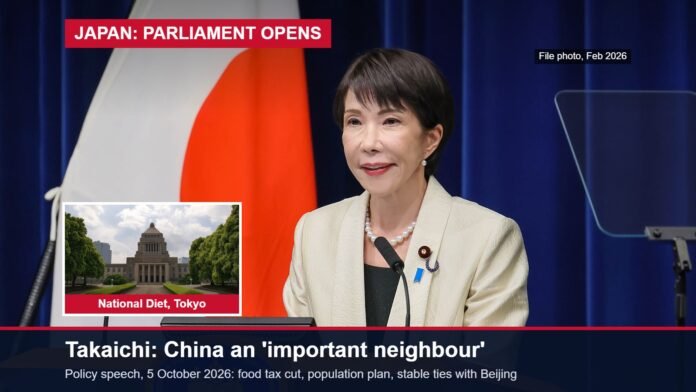
October 5: Japan’s Prime Minister Sanae Takaichi told parliament on Monday that China is an “important neighbour” and that Tokyo wants a “constructive and stable relationship” with Beijing, in a policy speech that opened a 69-day extraordinary session of the Diet. She also promised to cut the consumption tax on food for two years without issuing new deficit bonds, and to produce a national strategy on population decline by the end of the year.
Key highlights
- China: Takaichi called China “an important neighbour” and pledged a “constructive and stable relationship”, while saying Japan would “firmly assert” its positions.
- Tax: The consumption tax on food and beverages would fall from 8% to 1% for two years from April, with cash payments for middle- and lower-income households.
- Funding: She said the money would be found “without relying on” deficit-covering bonds.
- Population: A comprehensive strategy is promised by year-end. Japan’s population has fallen below 120 million for the first time in 42 years, according to figures from July.
- Session: The extraordinary Diet session runs until December 12.
What she said on China
“China is an important neighbour, and despite difficulties, we have built up a long-standing relationship over the years,” Takaichi said, in the AFP news agency’s translation of the speech. She said her government would “work to ensure communication on shared challenges, promote dialogue to safeguard our national interests, and build a constructive and stable relationship”.
In the same passage she said Japan would “firmly assert our country’s positions” and “strongly call for responsible behaviour”. Kyodo News translated that line as a pledge to “say what must be said and strongly urge responsible actions”.
Relations have been strained since November 2025, when Takaichi suggested Japan could intervene militarily if Taiwan were attacked. China, which regards Taiwan as its territory, then warned its citizens against travelling to Japan and imposed trade restrictions that have reportedly left Japanese companies short of rare earth minerals, AFP reported. Taiwan has since received its first F-16V Block 70 jets from the United States.
How Beijing has responded
The reports we reviewed carried no formal reply from the Chinese government on Monday. Last week China’s top diplomat said ties were “waiting to be normalised again” when he met a former Japanese foreign minister who was leading a trade delegation, according to AFP.
Chinese state media was more critical. In an opinion piece published on Monday, CGTN commentator Xu Ying wrote that “the gap between its words and deeds is becoming increasingly difficult to ignore” and that Japan should “make its actions match its words”.
The tax cut and the rest of the agenda
At home, the centrepiece is the food tax. Takaichi said the consumption tax on food and beverages would be cut from 8% to 1% for two years starting in April, alongside cash benefits for middle- and lower-income households. “To ensure market confidence, we will secure funds without relying on (the issuance of) deficit-covering bonds,” she said, in Kyodo’s translation. Kyodo’s report of the speech does not say where the money will come from. Several opposition parties oppose the plan and argue that it does not give households enough immediate relief, Kyodo reported.
She also pledged support for the International Criminal Court after the United States placed sanctions on its Japanese president, Tomoko Akane, in August, AFP reported.
At a glance: what Takaichi promised
| Area | Pledge |
|---|---|
| China | A “constructive and stable relationship”; Japan will “firmly assert” its positions |
| Consumption tax | Food and beverages from 8% to 1% for two years from April, plus cash benefits |
| Public finances | No deficit-covering bonds for the tax cut; a “proactive and responsible fiscal policy” |
| Investment | A five-year domestic investment action plan by year-end |
| Population | A comprehensive strategy by year-end |
| Parliament | A bill to cut 45 lower house seats from the proportional representation blocks |
| Security and resources | Bills on diversifying resource supplies and on land purchases linked to national security |
| Constitution | Hopes for “constructive and active cross-party debates” on revision |
| International law | Support for the International Criminal Court |
Compiled by The Press of Asia from Kyodo News and AFP reports of the speech.
Analysis: what it means for Asia
Analysis by the International Desk. The speech softens the tone on China without changing Japan’s stated positions: the warm words came together with a pledge to “firmly assert” them. The practical test is whether Beijing eases its travel warning and its trade restrictions, and nothing reported on Monday shows that happening yet. For the region’s markets, the promise to pay for a tax cut without new bonds matters as much as the diplomacy, because AFP lists market concern over Japan’s debt among the main pressures on Takaichi a year into her term. More regional context is in our Asia Briefing for 5 October.
References
- Kyodo News via Japan Today: Takaichi pledges consumption tax cut without new bond issuance in Diet speech
- AFP via The Korea Times: Japan PM calls China “important neighbor”, pledges stable relationship
- AFP via Philstar: Japan prime minister calls China “important neighbor”
- CGTN (opinion): Japan’s diplomatic hypocrisy is fooling no one

The International Desk covers world and Asian affairs, diplomacy and conflict, with a focus on what they mean for India. Stories are checked against at least two credible sources before publication.