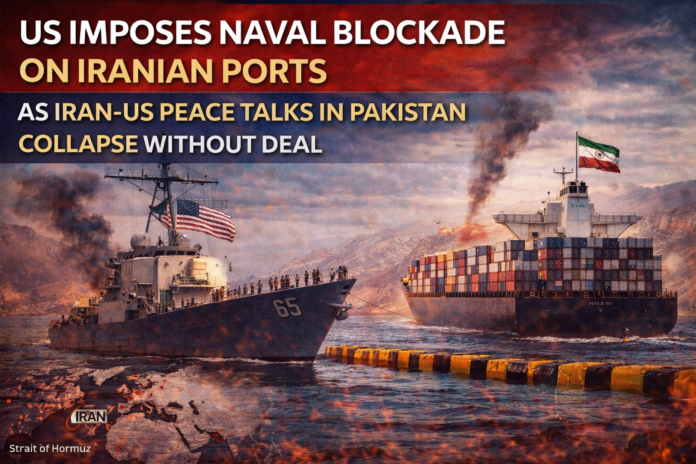

Washington / Islamabad / Tehran, April 14, 2026 — The geopolitical and energy crisis triggered by the Iran war entered a dangerous new phase this week as the United States formally imposed a naval blockade on Iranian ports and peace talks between Washington and Tehran collapsed after a marathon 21-hour negotiating session in Islamabad, Pakistan, without producing a ceasefire agreement. The twin developments have sent shockwaves through global energy markets, pushed crude oil prices above $103 per barrel, and raised serious fears about a prolonged disruption to the Strait of Hormuz — the world’s most critical oil and gas transit chokepoint.
US President Donald Trump ordered the US Navy to begin blocking all maritime traffic entering and exiting Iranian ports, a move described by analysts as one of the most aggressive acts of economic warfare deployed against Iran since the Islamic Revolution of 1979. The blockade prevents roughly two million barrels of Iranian crude oil per day from reaching global markets and threatens to entangle Chinese, Russian, and other Asian-flagged tankers that have been purchasing discounted Iranian oil in defiance of Western sanctions. A US-sanctioned tanker linked to China made a dramatic attempt to pass through the Strait of Hormuz, becoming a flashpoint in the escalating standoff between Washington and Beijing over the enforcement of the naval blockade.
The Islamabad Talks: 21 Hours, No Deal
The collapse of the Islamabad peace talks marked a significant setback for diplomatic efforts to end the Iran war. The negotiations, brokered by Pakistan’s Prime Minister Shehbaz Sharif and held in the Pakistani capital, brought together the highest-level US-Iran delegations since the Islamic Revolution. The US side was led by Vice President JD Vance, while Iran’s delegation included Parliamentary Speaker Baqer Qalibaf and Foreign Minister Abbas Araghchi. The talks lasted an extraordinary 21 hours, a reflection of the complexity of the issues at stake and the degree of mistrust between the two sides.
Despite the length of the negotiations, fundamental differences proved insurmountable. Iran had entered the talks with a 10-point peace proposal that included demands for Iranian sovereignty over the Strait of Hormuz, the withdrawal of all US and coalition combat forces from the Middle East, and a cessation of all military operations against Iranian-allied armed groups across the region. The United States was unwilling to accept these terms. Vice President Vance, speaking to reporters upon leaving Islamabad, acknowledged that Iran had shown “some movement” toward the US position but said it was not sufficient. He stated that the failure was “more damaging for Iran than for the United States.”
Iranian President Masoud Pezeshkian said his country was prepared to continue discussions within a framework of international law, leaving a diplomatic door slightly ajar. Trump officials were reported to be discussing the possibility of another round of in-person talks, potentially also in Pakistan. However, Iran’s hardliners remained deeply skeptical about negotiations with Washington, pointing to what they described as repeated ceasefire violations by Israel as evidence that Washington could not be trusted to honour agreements.
The Hormuz Blockade: A Legal and Geopolitical Minefield
The US naval blockade of Iranian ports has been described by legal experts as highly controversial under international maritime law. The Strait of Hormuz, through which approximately one-fifth of the world’s daily oil and natural gas supplies transit, is subject to the principle of innocent passage under the UN Convention on the Law of the Sea, which grants all nations the right to transit international straits. The US blockade, which Trump justified as necessary to prevent Iranian oil revenues from funding its military operations, risks being characterised as an act of war under international law and has been widely condemned by countries that depend on free passage through the strait.
China reacted with particular sharpness, calling the US blockade “dangerous and irresponsible” and urging all parties to honour the fragile ceasefire that had been in place. Beijing hosted Russian Foreign Minister Sergey Lavrov for discussions on the crisis, and Chinese President Xi Jinping used his meetings with foreign leaders in Beijing on April 14 to push for a diplomatic resolution. Saudi Arabia, one of the most important US allies in the Gulf, was also reported to be pressing Washington to drop the blockade, with Riyadh worried that Iran could retaliate by attempting to close the Bab al-Mandeb strait — the critical chokepoint at the southern end of the Red Sea that would trap Gulf oil exports if shut.
Oil Markets React: Brent Above $103, Asia Markets Rally on Hope
Global oil markets reacted violently to the blockade announcement, with Brent crude prices surging above $103 per barrel — an increase of more than 4 per cent in a single session. WTI crude climbed nearly 3 per cent simultaneously. The price surge reflected deep market anxiety about the potential for a prolonged disruption to Hormuz traffic that would squeeze global supplies at a time when demand remains robust. Analysts warned that if the blockade led to sustained supply disruptions, Brent could spike further toward $120 or even $130 per barrel, levels that would constitute a severe economic shock for oil-importing nations across Asia, Europe, and the developing world.
However, markets partially recovered on April 14 as reports emerged of potential further talks between the US and Iran. Asia’s main stock markets surged, and Brent fell back below $100 as traders priced in a possibility of diplomatic progress. The volatile market movements underscored just how fragile the current situation was: any credible signal of diplomatic progress was enough to ease prices, but any sign of escalation could send them soaring once more. For nations like India, Japan, South Korea, and China — which collectively account for a large share of global oil imports — the stakes could not be higher.
What Happens Next: Multiple Scenarios
The situation in the Strait of Hormuz presents the world with a number of critical scenarios. In the best case, a second round of US-Iran talks produces a framework agreement that ends the blockade, leads to a verified ceasefire, and allows oil flows to resume normally — bringing prices back down and relieving pressure on the global economy. In an intermediate scenario, the blockade continues for weeks or months, oil prices remain elevated, and a patchwork of sanctions waivers and diplomatic accommodations allows some oil to flow while the fundamental conflict remains unresolved. In the worst case, Iran attempts to counter the blockade by threatening to close the strait entirely, prompting a direct military confrontation between US naval forces and the Iranian Revolutionary Guard Corps with potentially catastrophic consequences for the global economy. The world is watching the Strait of Hormuz as never before, aware that the decisions made in the coming days and weeks will shape the trajectory of the global economy and geopolitics for years to come.