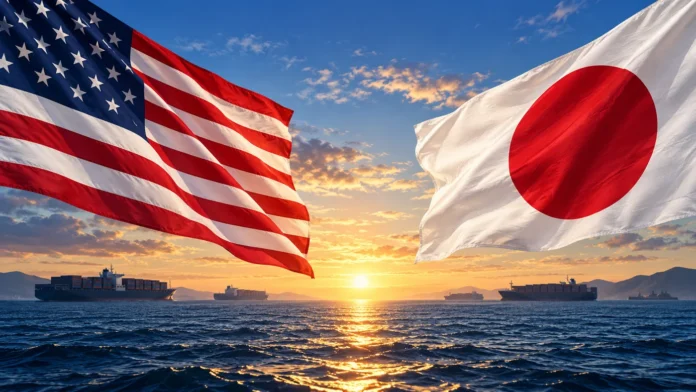
Tokyo, October 13, 2026: The United States and Japan have reaffirmed their commitment to the complete denuclearization of North Korea during a diplomatic dialogue in Tokyo. The October 12 meeting also addressed regional partnerships and economic security.
Japan’s Senior Deputy Minister for Foreign Affairs Hiroyuki Namazu met US Under Secretary of State for Political Affairs Allison Hooker. Japan’s Foreign Ministry confirmed the talks and said the officials agreed to continue exchanging views regularly.
What the US Japan talks established
The Japanese account says the two officials reaffirmed the denuclearization goal and the immediate resolution of the abductions issue. They also agreed to strengthen coordination through partnerships involving South Korea, Australia, India and the Philippines.
This was a reaffirmation of diplomatic objectives, not an announcement that North Korea had accepted disarmament terms. The statement does not describe a new agreement with Pyongyang or a timetable for negotiations.
Security and supply chains on the agenda
Yonhap’s report, citing the US State Department, identifies the meeting as the second US–Japan Free and Open Indo-Pacific dialogue. It says the officials discussed critical-mineral supply chains, energy security and maritime cooperation in Southeast Asia and the Pacific Islands.
The US account also noted progress in defense industrial cooperation and Japan’s growing cooperation with NATO. These subjects show that the dialogue extends beyond one security dispute to the resilience of the region’s economic and strategic networks.
Japan’s updated Indo-Pacific approach
Namazu explained the updated Free and Open Indo-Pacific approach that Prime Minister Sanae Takaichi announced in May. Japan’s ministry says the two sides compared their regional approaches and agreed to pursue initiatives that strengthen resilience and countries’ freedom to make their own decisions.
For Indian readers, the reference to Japan–Australia–India–US coordination is relevant. However, a bilateral discussion about that grouping should not be presented as a new decision jointly taken by all four countries.
What remains to be seen
The immediate outcome is continued policy coordination. Concrete follow-up would require separately announced projects, arrangements or meetings. Neither official account cited here provides a complete public implementation timetable.
The wider lesson is to distinguish a shared objective from an achieved result: affirming denuclearization is a diplomatic position; verified changes to North Korea’s weapons program would require different evidence. Likewise, discussion of supply-chain cooperation does not by itself establish a new trade agreement.

The International Desk covers world and Asian affairs, diplomacy and conflict, with a focus on what they mean for India. Stories are checked against at least two credible sources before publication.