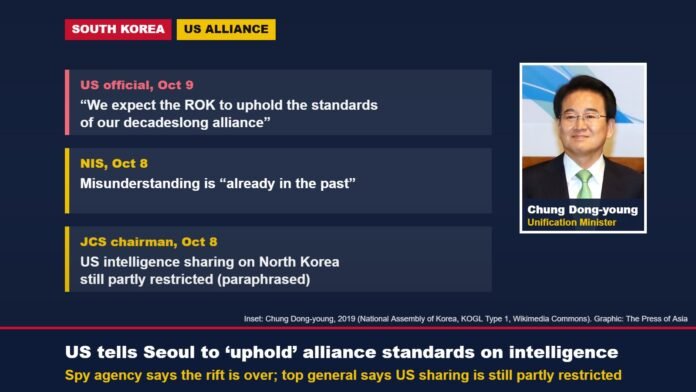
October 10: A senior US administration official has said Washington expects South Korea “to uphold the standards of our decadeslong alliance”, in particular on matters of intelligence and counterintelligence, in a written statement on Friday. The remarks came a day after South Korea’s spy agency said a misunderstanding with Washington was “already in the past”, while the country’s top military officer told lawmakers that US sharing of intelligence on North Korea remains partly restricted.
Key highlights
- The US statement answered a media question about bilateral intelligence cooperation. The White House sent a similar reply to a separate inquiry on October 9.
- The friction dates back to March, when Unification Minister Chung Dong-young publicly named Kusong in North Korea as a site of a uranium enrichment facility. Chung says he used only public information.
- Washington then appears to have restricted Seoul’s access to some North Korea-related intelligence. In April, Seoul’s national security adviser said it was “difficult to either confirm or deny” whether sharing had been curbed.
- In June, South Korea’s National Intelligence Service (NIS) was left out of a trilateral meeting with the US and Japan on North Korean cyber threats; local media said this was at Washington’s request.
- A US visa for Jung Chung-rae, a former leader of the ruling Democratic Party, has been delayed ahead of a planned parliamentary audit trip to the US.
Two accounts from Seoul
| Who | When | What they said |
|---|---|---|
| National Intelligence Service | October 8 | There had been “some misunderstanding several months ago”, but it was “already in the past”; “there is currently no misunderstanding between the South Korean and U.S. intelligence authorities” |
| Gen. Jin Young-seung, Chairman of the Joint Chiefs of Staff | October 8, to the National Assembly | US sharing of intelligence on North Korea remains partly restricted (paraphrased) |
| Senior US administration official | October 9 | “We expect the ROK to uphold the standards of our decadeslong alliance”, in particular on intelligence and counterintelligence |
The US reply suggests Washington’s concerns over Seoul’s handling of intelligence are not fully resolved, and can be read as an indirect warning about disclosures. There was no formal response from the South Korean government to Friday’s statement.
How the rift developed
| Date | Event |
|---|---|
| March 2026 | Unification Minister Chung Dong-young publicly names Kusong as a North Korean uranium enrichment site; he says the information was already public |
| After March | US appears to restrict Seoul’s access to some North Korea-related intelligence, reportedly including satellite intelligence |
| April 24, 2026 | Vice Foreign Minister Jeong Yeon-doo meets US Under Secretary Allison Hooker in Washington; on “normalization” he says: “That is what we are trying to do” |
| April 2026 | A senior Trump administration official says the US “expects all our partners to safeguard sensitive U.S. information that has been shared in private channels” |
| June 2026 | NIS left out of the fifth US–South Korea–Japan working group meeting on North Korean cyber threats in Washington |
| 2026, date not given | US visa for Rep. Jung Chung-rae delayed; he says it is under review and urges others to avoid remarks that could harm the alliance |
| October 8, 2026 | NIS says the misunderstanding is in the past; JCS chairman tells lawmakers sharing is still partly restricted |
| October 9, 2026 | Senior US official: Seoul must uphold alliance standards on intelligence and counterintelligence |
By our count, the dispute has now lasted about seven months, and the US has stated its position on the record at least twice: in April and again this week.
Why it matters
South Korea relies heavily on US satellite and signals intelligence to track North Korea’s nuclear and missile programmes. Any limit on that flow matters most during a crisis, when minutes count. For Washington, the issue is trust: it treats information shared in private channels as something an ally should not make public, even when similar details exist in open sources. The episode also comes as the two allies negotiate other sensitive issues, including Seoul’s $350 billion investment package.
What to watch
- Whether Seoul’s presidential office or foreign ministry responds formally to the US statement.
- Whether South Korea is invited to the next trilateral meeting on North Korean cyber threats.
- The outcome of Rep. Jung Chung-rae’s visa review and his parliamentary audit trip.
- Any change in the role of Unification Minister Chung Dong-young, whose disclosure started the dispute.
What it means
The gap between what South Korea’s spy agency says and what its top general told parliament is the clearest sign that the problem is not settled. Washington chose to put its expectation on the record in two written replies to Korean media in a single day, which is unusual for a dispute between close allies. For now, this is a dispute over trust rather than a break in the alliance, but it shows that the Lee Jae Myung government’s approach to North Korea, and how openly its ministers speak about intelligence, has become a test for its ties with the Trump administration.

The International Desk covers world and Asian affairs, diplomacy and conflict, with a focus on what they mean for India. Stories are checked against at least two credible sources before publication.