November 14: Tuberculosis killed about 1.1 million people in 2025, 35% fewer than in 2015, the World Health Organization said in its Global Tuberculosis Report 2026, released on Thursday. India’s Health Ministry said the report shows India’s TB deaths fell 38% over the same period, faster than the global decline. But the WHO warned that new cases are falling far too slowly, with 10.6 million people falling ill last year.
Key highlights
- People who fell ill with TB in 2025: about 10.6 million worldwide.
- Deaths in 2025: about 1.1 million, down 35% from 2015.
- New cases: the incidence rate fell only 14% since 2015, against a 50% milestone for 2025.
- India: TB deaths down 38% since 2015, and a 94% treatment success rate for drug-susceptible TB, the Health Ministry said.
- Missing cases: 8.4 million people were diagnosed, leaving about 2.2 million undiagnosed or unreported.
- Money: domestic TB funding rose 14% to $5.6 billion in 2025, partly offsetting a fall in international financing.
The global picture
The WHO said the world has now reached the first mortality milestone of its End TB Strategy, five years later than planned, and that treatment has saved an estimated 86 million lives since 2000. WHO Director-General Tedros Adhanom Ghebreyesus called the continued decline in cases and deaths “very encouraging”, but added that “more than one million people still die each year”.
Drug-resistant TB remains a weak point. About 370,000 people developed rifampicin-resistant TB in 2025, and only 42% of them were treated. Just 59% of newly diagnosed patients were tested with a WHO-recommended rapid test, against a target of 100% by 2027. Thirty countries account for 88% of all people who develop TB.
How the regions compare
| WHO region | Change in TB incidence, 2015–2025 |
|---|---|
| Europe | −42% |
| Africa | −30% |
| South-East Asia (includes India) | −18% |
| Eastern Mediterranean | −6.6% |
| Western Pacific | 0% |
| Americas | +13% (rising for a fifth year) |
What India reported
Union Health Minister J.P. Nadda said the TB Mukt Bharat Abhiyaan has screened more than 25 crore people, with over 11 crore chest X-rays and 3 crore molecular tests. The campaign has detected 48.64 lakh TB cases, including nearly 15 lakh people who had no symptoms. The ministry credited AI-enabled diagnostics, nutritional support under the Ni-kshay Poshan Yojana and community volunteers known as Ni-kshay Mitras. The WHO’s South-East Asia regional office said India is “making a significant contribution” to reducing TB deaths in the region.
Our calculation
| Question | Answer | How we got it |
|---|---|---|
| TB deaths per day worldwide in 2025 | About 3,000 | 1.1 million ÷ 365 |
| Share of people with TB not diagnosed or reported | About 21% | 2.2 million ÷ 10.6 million |
| People with drug-resistant TB who were not treated | About 215,000 | 58% of 370,000 |
| India’s fall in TB deaths vs the world’s | 3 percentage points faster | 38% vs 35% since 2015 |
What it means for India and Asia
India carries a large share of the world’s TB, so its progress moves the global numbers. A 38% fall in deaths shows that faster diagnosis and treatment are working. The harder task is the one the WHO highlights worldwide: stopping people from falling ill in the first place. In the South-East Asia region, incidence is down only 18% in ten years, and in the Western Pacific it has not fallen at all.
The funding trend also matters for Asia. With international money shrinking, the WHO’s figures show domestic budgets now carrying more of the load, which favours countries that fund their own TB programmes.
What to watch
- Whether rapid molecular testing reaches every newly diagnosed patient by 2027, the WHO target.
- Treatment coverage for drug-resistant TB.
- India’s next national TB data release.
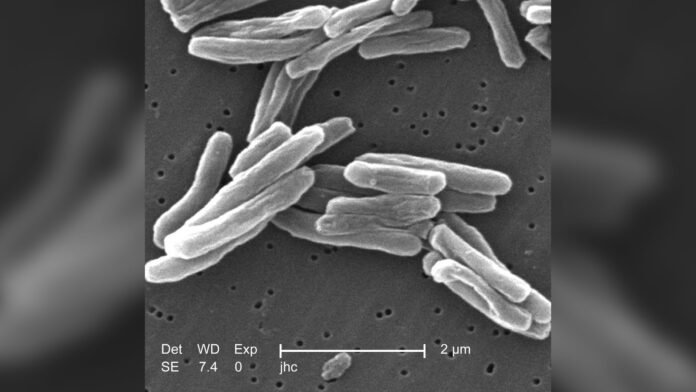
Mycobacterium tuberculosis, the bacterium that causes TB, under a scanning electron microscope. Image: Janice Carr, CDC (content provider: CDC/Dr Ray Butler), Public domain, via Wikimedia Commons. Photo source
Sources
- WHO: Amid challenges, countries increase domestic investment to protect progress against tuberculosis (November 12, 2026)
- WHO: Global tuberculosis report 2026
- PIB (Ministry of Health and Family Welfare): India’s progress in reducing TB mortality

The International Desk covers world and Asian affairs, diplomacy and conflict, with a focus on what they mean for India. Stories are checked against at least two credible sources before publication.