
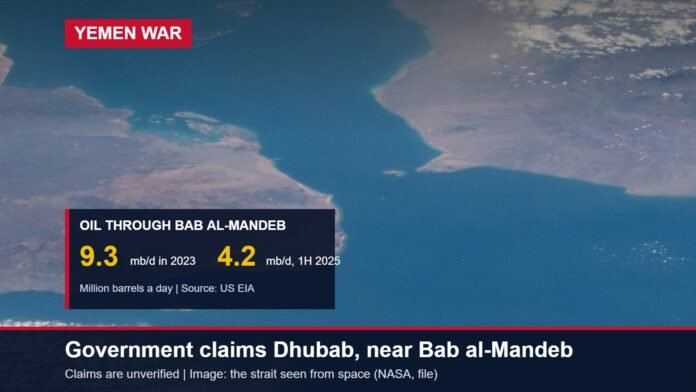
October 5: Yemen’s Saudi-backed government forces said on Monday that they had retaken Dhubab district and key positions near the Bab al-Mandeb strait from the Houthis, a day after the head of the Presidential Leadership Council, Rashad al-Alimi, ordered a nationwide offensive. The Saudi-led coalition said 100 fighter jets were supporting the operation. The battlefield claims have not been independently verified, and reports differ on whether the Houthis have denied them.
Key highlights
- The claim: The army says it took Dhubab district and positions near Bab al-Mandeb, cutting Houthi supply lines.
- Air power: Coalition spokesman Major General Turki al-Maliki says 100 jets are in support and 324 “high-value” targets have been destroyed.
- Sanaa: Government forces have announced a “strategic offensive” on the Houthi-held capital.
- Casualty claim: The army says 1,747 Houthi fighters have been “neutralised”. This is not verified.
- Diplomacy: Pakistan’s foreign minister Ishaq Dar is in Saudi Arabia for talks with Saudi and Turkish officials.
What the government says
An army source told Yemen’s state news agency Saba that government forces “advanced and seized important positions – cutting off supply lines and roads leading to Bab al-Mandeb”. The source said the Houthis lost many fighters and that military equipment was destroyed or damaged.
The UAE-based newspaper The National reported further claims from the government side: that its forces hold Dhubab’s airport and the road linking Dhubab with Mokha, that the Giants Brigades and the Nation’s Shield Forces led the flanking moves, and that hundreds of Houthi fighters were surrounded in Dhubab and urged to surrender, with some leaving by boat.
Al-Alimi announced the offensive on Sunday. “We have instructed the armed forces, security forces and all military formations to begin carrying out their assigned tasks under an approved plan until the country is liberated from the Houthis,” he said. The National reported that he named it Operation Yemen Dawn and said that “Yemen will march towards a new dawn of freedom, peace and stability”.
Military spokesman Colonel Majed al-Nuzaili said 1,747 Houthi fighters had been “neutralised” in 1,122 operations across Saada, al-Jawf and Taiz governorates, and that 364 military and logistics vehicles had been destroyed or disabled. Al Jazeera, which carried the figures, said it could not verify them. Our Asia Briefing for 5 October carried an earlier government claim of more than 1,500 Houthi casualties in 24 hours.
The air campaign
Coalition spokesman Major General Turki al-Maliki said 100 fighter jets were providing support and that the coalition had secured “air protection” over the Bab al-Mandeb strait. The National and The Jerusalem Post both report his figure of 324 “high-value” Houthi targets destroyed. On Sunday the coalition reported 97 strikes around Taiz and the Tor al-Baha front, according to Al Jazeera.
What the Houthis say
Accounts differ. Al Jazeera’s battlefield summary says the Houthis denied losing Dhubab. The National says the Houthi-run Al Masirah TV confirmed strikes on Sanaa but that there was no formal denial of the specific claims.
The Houthis have been advancing elsewhere. Around Taiz they have taken hilltops and are reported to have cut supply routes between Taiz and Aden, Al Jazeera said. Over the weekend their military spokesman Yahya Saree said the group had hit a Saudi Aramco site in Riyadh with “ballistic missiles and drones” and that the strikes “led to fires breaking out”. Al-Maliki called the claim “misleading” and said the Houthis were “chasing imaginary victories”, the AFP news agency reported. An AFP journalist saw flames and smoke at a site south of Riyadh; the reports we reviewed carried no official Saudi account of any damage.
Why Bab al-Mandeb matters
The strait links the Red Sea to the Gulf of Aden and the Arabian Sea, and is the southern gate of the Suez route between Asia and Europe. The Houthis took about 150 km of Red Sea coastline, the port of Mocha and islands in the strait in mid-September, and announced a naval blockade on Saudi ships, according to Al Jazeera and AFP.
| Year | Oil through Bab al-Mandeb (million barrels a day) |
|---|---|
| 2020 | 5.7 |
| 2021 | 6.0 |
| 2022 | 8.0 |
| 2023 | 9.3 |
| 2024 | 4.1 |
| First half of 2025 | 4.2 |
Source: US Energy Information Administration, World Oil Transit Chokepoints (updated 3 March 2026).
Pakistan, Saudi Arabia and Turkey hold talks
Pakistan’s deputy prime minister and foreign minister, Ishaq Dar, has arrived in Saudi Arabia for three-way talks with Saudi and Turkish officials under the Mecca Joint Defence Agreement, which was signed on 7 August 2026, Al Jazeera reported. Dar had said beforehand that the talks would look at “political engagement with the Iran-aligned Houthis as an alternative to the military option”. Yemen’s foreign minister, Afrah al-Zouba, has asked for international support and said a stable Yemen is “in the world’s interest”.
Timeline
- 2014: The Houthis seize Sanaa. A Saudi-led coalition intervenes the following year.
- 2022: A truce takes hold.
- July 2026: The truce collapses and fighting resumes.
- Mid-September 2026: The Houthis take Mocha and islands in the Bab al-Mandeb strait.
- 3 to 4 October: The Houthis claim a strike on an Aramco site near Riyadh. The coalition calls the claim misleading.
- 4 October: Al-Alimi orders the offensive.
- 5 October: The government claims Dhubab and announces an offensive on Sanaa.
More than 100,000 people have been displaced since the truce collapsed, according to Al Jazeera.
Analysis: what to watch
Analysis by the International Desk. Every number in this story comes from one of the warring sides, and none has been checked on the ground. Two things would show whether the government’s account holds: independent confirmation that it controls the coast road at Dhubab, and whether ships start using the strait in larger numbers again. For Asian exporters and oil importers, Bab al-Mandeb is the short route to Europe, and it is now the second chokepoint under pressure after the Strait of Hormuz, where the United States is sending a third aircraft carrier. Pakistan’s part in the Saudi talks also gives a South Asian government a direct role in what happens next.
References
- Al Jazeera: Yemeni forces reclaim Dhubab, key positions near Bab al-Mandeb from Houthis
- Al Jazeera: Yemen war: What’s the latest, as government forces claim advances?
- Al Jazeera: Houthis claim strike on Aramco site as Yemen fighting intensifies
- The National: Yemen government forces claim Bab Al Mandeb gains as Saudi coalition says 100 jets join Houthi offensive
- AFP via The New Arab: Houthi claims of attack on Saudi capital “misleading”
- The Jerusalem Post: Saudi-led coalition, Yemeni government forces launch three-pronged assault on Houthis
- US Energy Information Administration: World Oil Transit Chokepoints

The International Desk covers world and Asian affairs, diplomacy and conflict, with a focus on what they mean for India. Stories are checked against at least two credible sources before publication.