November 14: Sri Lanka will spend more in 2027 to rebuild after Cyclone Ditwah, but plans to bring spending back down from 2028, President Anura Kumara Dissanayake said as he presented the 2027 Budget to Parliament on Thursday in his role as Finance Minister. The speech also confirmed that Sri Lanka’s IMF programme ends in March 2027 and that Colombo wants to expand its free trade agreement with India.
Key highlights
- Presented: November 12, 2026, by President Anura Kumara Dissanayake as Minister of Finance, Planning and Economic Development.
- Spending: primary expenditure to rise temporarily to 13.6% of GDP in 2027 for cyclone reconstruction, then return to 13% from 2028.
- Public investment: 5.12% of GDP in 2027, about Rs 2,000 billion.
- Cyclone Ditwah: damage and losses of about $3.4 billion, according to the post-disaster needs assessment.
- IMF: the Extended Fund Facility is due to end in March 2027.
- Votes: second reading on November 20; final vote on December 14.
The recovery so far
| Indicator | Figure cited in the Budget speech |
|---|---|
| Economic growth, 2025 | 5% |
| Growth, Q1 and Q2 2026 | 5.1% and 4.2% |
| Primary surplus, 2025 | 5.4% of GDP, the highest on record |
| Budget deficit, 2025 | 2.3% of GDP, the lowest in 68 years |
| Government revenue, 2025 | 16.6% of GDP, the highest in 23 years |
| Central government debt, end-2025 | About 95% of GDP |
| Foreign reserves, October 2026 | More than $7 billion |
| Workers’ remittances, 2025 | A record $8.1 billion |
| Inflation, October 2026 | Above 8.3% |
The speech said growth held at 4.2% in the second quarter despite the conflict in the Middle East, while inflation rose this year. Debt is already close to the 95%-of-GDP level that the government targets for 2032.
Paying for Cyclone Ditwah
The post-disaster needs assessment puts the cyclone’s direct damage at about $2 billion and economic losses at about $1.4 billion. Extra money to restore infrastructure and livelihoods is the main reason primary spending rises in 2027. The government says this is temporary.
Trade and energy plans
The speech said a ministerial committee is working on expanding the existing India–Sri Lanka free trade agreement, and that Sri Lanka has applied to join the Regional Comprehensive Economic Partnership (RCEP). Bids for oil and gas blocks in the Mannar basin will be opened on February 2, 2027, and the Sapugaskanda refinery is to be expanded from 50,000 to 100,000 barrels a day through a public-private partnership.
What happens next in Parliament
| Stage | Date |
|---|---|
| Budget speech (second reading moved) | November 12 |
| Second reading debate | November 13–20 (7 days) |
| Second reading vote | November 20, 6 pm |
| Committee stage debate | November 21 – December 14 (19 days) |
| Third reading (final) vote | December 14, 6 pm |
Our calculation
| Question | Answer | How we got it |
|---|---|---|
| Size of the economy implied by the investment figure | About Rs 39 trillion | Rs 2,000 billion ÷ 5.12% |
| Extra primary spending in 2027 above the 13% norm | About 0.6% of GDP, roughly Rs 230 billion | 13.6% − 13.0%, applied to the implied GDP |
What it means for India and Asia
For India, the most important line is the plan to widen the free trade agreement, which has been in force since 2000. India is Sri Lanka’s closest neighbour and a major source of tourists and investment, so a deeper agreement would matter on both sides of the Palk Strait. The bid to join RCEP also signals that Colombo wants closer trade links with East and Southeast Asia.
For other economies coming out of debt crises, Sri Lanka’s numbers are a test case: a primary surplus of 5.4% of GDP and the lowest deficit in 68 years, but also slower growth this year and rising prices.
What to watch
- The second reading vote on November 20.
- Whether Sri Lanka seeks a new IMF arrangement after March 2027.
- The Mannar basin licensing round on February 2, 2027.
Note: this report is based on the Budget speech published by Sri Lanka’s Ministry of Finance in Sinhala. Detailed tax and salary measures are in the separate budget estimates.
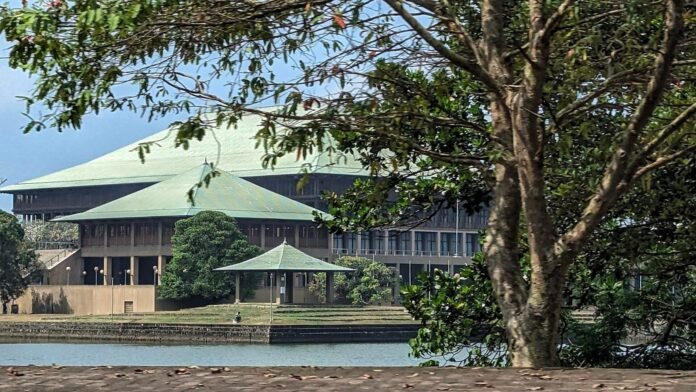
The Parliament of Sri Lanka in Sri Jayawardenepura Kotte. Image: Dennis Sylvester Hurd, CC0, via Wikimedia Commons. Photo source · Licence
Sources
- Ministry of Finance, Sri Lanka: Budget Speech 2027 (PDF)
- Ministry of Finance, Sri Lanka: Budget speeches, 2027
- Parliament of Sri Lanka: Budget 2027 parliamentary programme

The Business Desk covers markets, the economy, companies and personal finance. Stories are checked against at least two credible sources before publication.