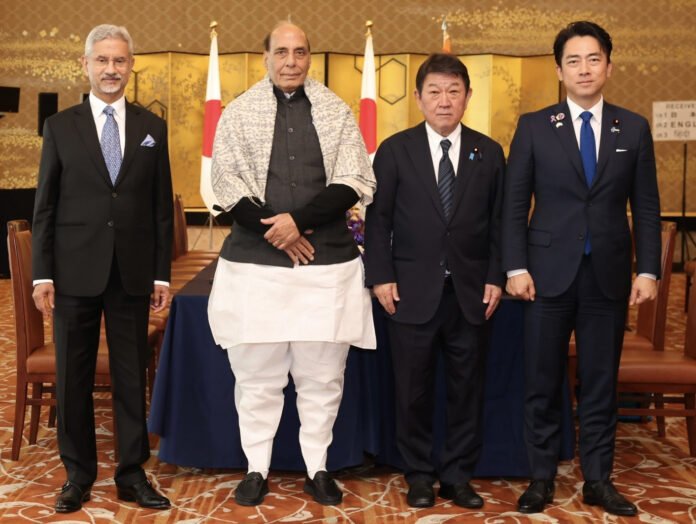
November 19: India and Japan agreed to strengthen cooperation on cybersecurity and space at their fourth foreign and defence ministers’ 2+2 meeting in Tokyo on November 19. The joint statement directs officials to renew their cybersecurity cooperation memorandum and arrange the next cyber dialogue, with attention to AI-related risks and critical infrastructure.
Key highlights
- Rajnath Singh and S. Jaishankar met Japan’s Shinjiro Koizumi and Toshimitsu Motegi.
- The joint statement covers AI-enabled cybersecurity and the security of AI systems.
- Space cooperation includes awareness of activity in orbit and maritime monitoring.
- Follow-up dialogues and implementation arrangements remain the next practical steps.
What the four ministers agreed
India’s Ministry of Defence published the joint statement naming the four participants: Defence Minister Rajnath Singh, External Affairs Minister S. Jaishankar, Japanese Foreign Minister Toshimitsu Motegi and Defence Minister Shinjiro Koizumi. The statement calls for closer coordination under the countries’ strategic partnership.
On cybersecurity, it identifies both AI-enabled threats and the protection of AI systems, particularly where critical infrastructure is involved. On space, it lists space situational awareness, using space capabilities for maritime domain awareness and cooperation on international rules and norms. Officials are to arrange further cyber and space dialogues.
Economic security also features in the wider talks
A separate Japanese foreign ministry readout of the November 19 strategic dialogue between Motegi and Jaishankar identifies five economic-security priorities: semiconductors, critical minerals, information and communication technology, clean energy and pharmaceuticals. That discussion follows the economic-security declaration issued during Prime Minister Sanae Takaichi’s July visit to India.
The ministers also looked towards the 75th anniversary of diplomatic relations in 2027. The two readouts cover connected but distinct meetings. The four-minister security statement and the foreign ministers’ strategic dialogue should not be collapsed into a claim that every item was a newly signed treaty.
What the technical terms mean in practice
Space situational awareness concerns understanding activity and objects in orbit. Maritime domain awareness concerns understanding activity at sea. Linking the two can support a more complete operating picture, but the statement does not by itself demonstrate that a new shared operational system has been deployed.
The same distinction applies to cyber cooperation. A decision to renew a memorandum and hold a dialogue establishes a work programme. Its effectiveness depends on the arrangements that follow, including the scope of information exchange and the organisations responsible. Readers should look for those concrete steps before interpreting the announcement as a completed change in operational capability.
At a glance
| Track | Announced focus |
| 2+2 format | Foreign and defence ministers of both countries |
| Cybersecurity | AI-related risks, AI systems and critical infrastructure |
| Space | Orbital awareness and maritime awareness |
| Economic security dialogue | Five priority industrial and technology areas |
| Next test | Follow-up arrangements and practical delivery |
What to watch
Watch for dates of the next cyber and space dialogues and the renewed cybersecurity memorandum. Future project announcements should identify what will be delivered, by whom and on what timetable.
Sources
- India Ministry of Defence: Fourth India–Japan 2+2 joint statement
- Japan Ministry of Foreign Affairs: 19th Japan–India strategic dialogue

The International Desk covers world and Asian affairs, diplomacy and conflict, with a focus on what they mean for India. Stories are checked against at least two credible sources before publication.