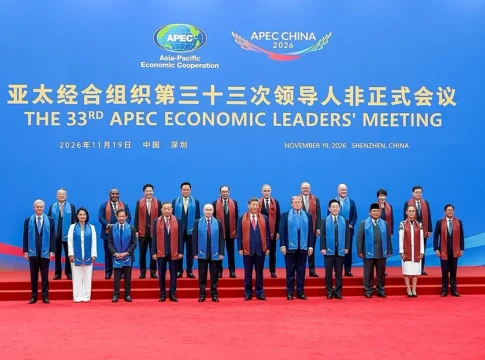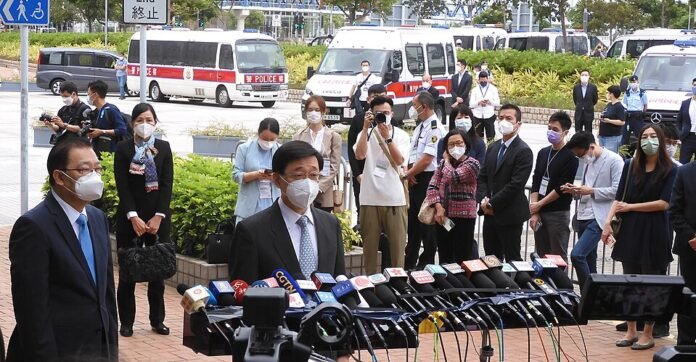
November 19: Hong Kong Chief Executive John Lee promoted trade with Peru and technology cooperation with Singapore during bilateral meetings in Shenzhen on November 19. His government’s account links the talks to an existing Hong Kong–Peru free trade agreement and opportunities for Singaporean firms in Hong Kong’s Northern Metropolis and Hetao innovation area.
Key highlights
- Lee met Peru’s President Keiko Fujimori and Singapore’s Prime Minister Lawrence Wong.
- The Hong Kong–Peru FTA took effect on September 1, 2026.
- The Singapore discussion focused in part on innovation and technology business opportunities.
- The meetings did not announce that Hong Kong had joined RCEP.
Peru discussion builds on an agreement already in force
Hong Kong’s government says Lee recalled witnessing the FTA’s signing in Lima in 2024. It entered into force on September 1 this year. At the November 19 meeting, he encouraged Peruvian businesses to use Hong Kong’s trading platform and professional services to reach mainland China and other Asian markets.
That chronology is important. The development is a discussion about using an existing agreement, not the signing of a new FTA on November 19. The official account presents the city’s role as a connection between markets; it does not announce a specific new investment amount or a list of newly contracted projects.
Singapore talks put innovation in focus
Lee also met Singapore’s Prime Minister and Finance Minister Lawrence Wong. The Hong Kong readout says he encouraged Singaporean technology firms to consider the Northern Metropolis and the Hong Kong Park of the Hetao Shenzhen–Hong Kong cooperation zone. He thanked Singapore for supporting Hong Kong’s early accession to RCEP.
Support for an application is not the same as completed accession. Nothing in this readout establishes that a membership decision has been taken. Likewise, an invitation to businesses to establish operations is an effort to attract investment, rather than proof that firms have already made binding investment commitments.
How to judge the follow-through
For companies evaluating a location, broad political encouragement is only the beginning. The practical questions concern eligible activities, premises, staffing, regulation and the terms of any programme they might use. A summit meeting can open a channel for discussion without settling those business-specific questions.
For readers assessing trade diplomacy, the useful distinction is between access already available under an operative agreement and opportunities the government hopes to develop next. Future announcements can be checked for identifiable companies, contracts and implementation milestones. Those details would show more about delivery than the number of meetings held at a summit.
At a glance
| Meeting | Focus identified by Hong Kong government |
| Peru | Use of the FTA already effective since September 1 |
| Singapore | Technology cooperation and investment opportunities |
| Northern Metropolis and Hetao | Locations promoted to Singaporean technology firms |
| RCEP | Singaporean support acknowledged; no accession announced |
What to watch
Watch for concrete trade or investment follow-up and any separate official RCEP decision. Those would be distinct developments beyond the bilateral readouts.
Sources
- Hong Kong Government: CE attends APEC Economic Leaders’ Meeting
- Hong Kong Government: Lee’s media remarks on APEC outcomes

The Business Desk covers markets, the economy, companies and personal finance. Stories are checked against at least two credible sources before publication.