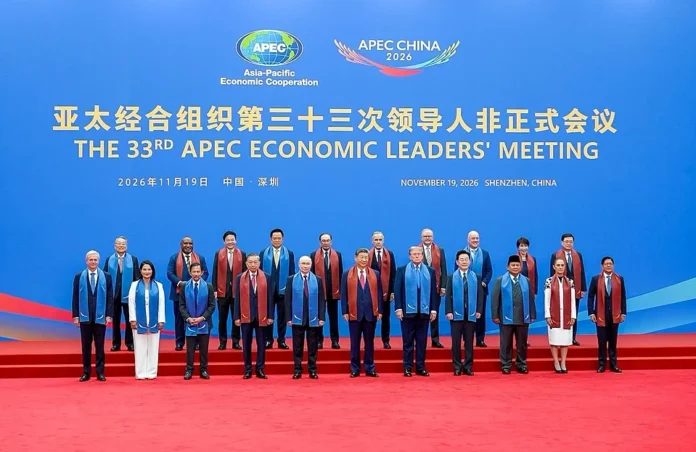
November 19: Donald Trump, Xi Jinping and Vladimir Putin issued a four-point declaration after meeting in Shenzhen on November 19. The text published by China’s foreign ministry addresses nuclear-risk dialogue, refined petroleum supplies, UN reform and the leaders’ position on international criminal jurisdiction. It is not a ceasefire agreement or an announced nuclear-arms reduction treaty.
Key highlights
- The three leaders met on the sidelines of the APEC gathering.
- The declaration reaffirms that nuclear war must never be fought.
- It proposes dialogue on reducing nuclear risks and preventing proliferation.
- No production targets, arms-reduction schedule or conflict settlement appear in the four-point text.
What the published declaration contains
The declaration says the three countries intend to conduct a dialogue on nuclear-risk reduction and preventing the spread of nuclear weapons. It also states that they plan to increase production and supply of refined petroleum products and reaffirms the importance of stable energy flows.
Its other points concern reforming the United Nations and the leaders’ view that state consent and official immunities must be respected in international criminal jurisdiction. That is the governments’ stated position. The declaration itself does not establish a judicial ruling on a particular case or amend a court’s legal powers.
What the document does not resolve
The four points do not specify a schedule for reducing nuclear stockpiles, a verification mechanism or numerical petroleum-production commitments. They also do not announce a ceasefire or set out a settlement of the wars in Ukraine or the Middle East. Calling the document a declaration towards peace should not be taken to mean those conflicts have been resolved.
China’s separate summit readout describes discussions about strategic stability and major-country relations. That account explains the host government’s framing of the meeting, while the declaration supplies the specific shared points published after it. The Russian foreign ministry’s official account also reproduces the declaration.
Why Asia will watch the follow-up
For Asian governments and businesses, stable energy flows and lower strategic risk are consequential subjects. But a diplomatic statement cannot show, by itself, that fuel prices will fall or that a shipping route has become safer. Those outcomes require their own evidence and can be affected by developments outside the meeting.
The useful next indicators are follow-up meetings, named negotiating teams and published arrangements that define responsibilities. Nuclear-risk dialogue can be assessed by whether a process is established and sustained; an energy promise can be assessed against actual measures. Separating an intention from a delivered result gives readers a clearer way to evaluate the summit without overstating a short document.
At a glance
| Subject | What the text says |
| Nuclear risks | Dialogue and opposition to nuclear war |
| Energy | Plans to increase refined-product production and supply |
| UN reform | Commitment to improve its response to global challenges |
| Criminal jurisdiction | Leaders state a position on consent and immunities |
| Not announced | A ceasefire, arms-cut timetable or numerical output target |
What to watch
Watch for official follow-up on nuclear-risk talks and energy measures. Concrete arrangements would provide stronger evidence of implementation than the summit’s diplomatic language alone.
Sources
- China Foreign Ministry: Heads of State Declaration toward Peace
- China Foreign Ministry: Xi chairs the three-country summit
- Russian Foreign Ministry: Official summit account and declaration

The International Desk covers world and Asian affairs, diplomacy and conflict, with a focus on what they mean for India. Stories are checked against at least two credible sources before publication.