
Norway entered a period of national mourning after King Harald V died peacefully at Oslo University Hospital on Friday at the age of 89. His son immediately succeeded him as King Haakon VIII, opening a new reign in one of Europe’s most stable constitutional monarchies.
By The Press of Asia World Desk
OSLO | 29 August 2026
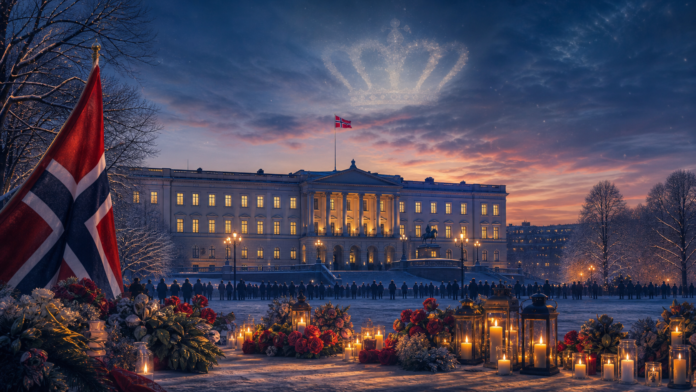
Tens of thousands of people gathered in central Oslo on Saturday, leaving flowers, lighting candles and lining routes associated with the royal family. The mourning was public and deeply personal, but the constitutional transfer itself was orderly: under Norway’s hereditary system, the crown passed at the moment of the king’s death.
The Royal House said Harald died at 6:35 a.m. on 28 August at Rikshospitalet, part of Oslo University Hospital. He had been Norway’s monarch since 1991. The new king, 53-year-old Haakon, later appeared before the government and chose “Alt for Norge”—“All for Norway”—as his motto, the same words used by his father and grandfather.
Key facts
- King Harald V died peacefully in Oslo at age 89 after a 35-year reign.
- Crown Prince Haakon became King Haakon VIII immediately under Norway’s constitutional rules.
- The new monarch is 53 and is married to Queen Mette-Marit.
- Haakon retained the motto “All for Norway,” emphasising continuity.
- Norway’s elected parliament and government retain political power; the monarch’s role is constitutional and ceremonial.
A long reign shaped by national service
Harald ascended the throne in January 1991 after the death of his father, King Olav V. He was the first Norwegian-born heir to the throne in more than five centuries and became a familiar national figure through periods of economic change, social liberalisation and debate about the monarchy’s place in modern life.
His reign coincided with Norway’s growing prosperity as an energy producer, its expanding sovereign wealth fund and its continued role in NATO and European diplomacy. The king did not set government policy, but represented the state at home and abroad, formally opened parliament and carried out ceremonial duties designed to stand above party politics.
Harald and Queen Sonja also came to symbolise a more accessible royal household. The king’s public appearances during national crises and commemorations helped sustain broad support for the institution even as European monarchies faced scrutiny over privilege, relevance and transparency.
How the succession works
Norway is a constitutional monarchy. The constitution assigns formal functions to the king, while democratic authority rests with parliament, the government and the courts. The monarch appoints a government in accordance with parliamentary confidence, signs formal decisions and performs state duties, but does not independently govern.
Because succession is automatic, Norway did not face a vacancy or an election for the head of state. The extraordinary Council of State formally recorded the transition and the new king addressed the country. Later ceremonies will provide ritual and national recognition, but they do not create the legal succession.
The process resembles other European hereditary transitions in its emphasis on continuity. It differs from the election of a spiritual leader such as the pope, a contrast explored in The Press of Asia’s account of leadership change at the Vatican. Both moments draw global attention, but their constitutional and religious mechanisms are distinct.
Haakon VIII and the meaning of continuity
Haakon has spent decades preparing for the crown through military service, public duties and periods as regent when his father was ill or unavailable. He has been associated with youth programmes, environmental concerns, development issues and innovation. As king, he inherits the requirement to remain politically neutral while reflecting a country that is changing demographically and economically.
Keeping the motto “All for Norway” was a deliberate signal that the institution intends to preserve its service-oriented identity. It also connects Haakon VIII to the wartime and postwar memory of his predecessors, for whom the phrase carried strong national meaning.
The new reign will nevertheless face modern tests. Public expectations around royal finances, private business links, health, media scrutiny and the conduct of extended family members are higher than in previous generations. Haakon’s ability to communicate restraint, openness and relevance will help determine long-term confidence in the monarchy.
Why Norway matters internationally
Norway is not a member of the European Union, but it participates closely in Europe’s single market and is a major energy supplier. It is also a NATO member, an Arctic state and a frequent mediator in international diplomacy. A stable succession reassures partners that ceremonial change will not interrupt policy or institutions.
The transition comes as European governments manage war, energy security, Arctic competition and changes in transatlantic relations. The new king will not decide Norway’s response, but he will represent the country during state visits, commemorations and diplomatic occasions. The Press of Asia’s coverage of the G7’s trade and security agenda illustrates the international setting in which Norway continues to operate.
The public response
AP reported that tens of thousands joined Saturday’s memorial gatherings in Oslo. Flowers and candles accumulated near the palace as Norwegians remembered a monarch many had known for their entire lives. The official mourning period will include ceremonies, condolences from foreign leaders and arrangements for the funeral.
For the royal family, the transition combines personal bereavement with immediate public duty. Haakon’s first statements balanced tribute to his father with the constitutional responsibility he now carries. That dual role is a defining feature of hereditary succession: the institution continues at the very moment a family loses its head.
What happens next
The government and Royal House will publish the detailed funeral programme and arrangements for foreign delegations. National flags, official events and public institutions will follow mourning protocols. The new king will begin regular audiences and state duties while the country moves through the ceremonial transition.
Norway’s political direction remains in the hands of its elected leaders. What changes is the person who embodies the state. Haakon VIII begins his reign with the advantage of long preparation and an orderly constitution—and with the challenge of carrying a respected institution into another generation.