Update: The outbreak has kept growing since this report. Congo’s Health Ministry reported 9,066 confirmed cases and 4,381 deaths across 65 health zones in seven provinces on October 13, and officials said confirmed cases are only about a third of all cases. WHO’s October 8 update, with data to October 6, counted 8,728 confirmed cases and 4,205 deaths, a crude fatality ratio of 48.2%, and said no approved vaccine or specific treatment exists for Bundibugyo virus disease. Kenya reported one imported, laboratory-confirmed case on October 6; the patient had died on October 5.
Kinshasa/Geneva, September 1: Confirmed cases in Congo’s Bundibugyo Ebola outbreak have passed 6,000. Government figures for August 31 show 6,041 confirmed cases and 2,911 deaths, and WHO has kept the fast-spreading outbreak a public health emergency of international concern.
This report, first published on August 29, has been updated with the newer government figures, the start of vaccination and WHO’s emergency assessment. According to Congo’s communication ministry, more than 1,360 people have recovered. Response teams are working in six affected provinces, with special focus on Ituri, North Kivu and Haut-Uélé.
The numbers show how intense the outbreak is, but reported cases may not capture every infection. WHO’s emergency committee has warned of under-detection. Violence, displacement, remote settlements, health-worker strikes and constant population movement make surveillance and timely treatment harder.
Key highlights
- 6,041 confirmed cases in the Congolese government’s figures for August 31.
- 2,911 deaths, a crude fatality ratio of about 48% among confirmed cases.
- 60 health zones in six provinces were affected in WHO’s detailed dataset to August 26.
- More than 1,360 recoveries, which officials called a positive sign amid the response.
- WHO has kept the outbreak a Public Health Emergency of International Concern (PHEIC).
What the new numbers show
WHO’s Disease Outbreak News of August 28 counted 5,794 cases and 2,786 deaths up to August 26. Later government data, covering more than two extra days of reporting, raised the totals. Combining different cut-off dates to work out daily growth can mislead, because backlog reconciliation and laboratory confirmation also change totals.
| Cut-off date and source | Confirmed cases | Deaths | Crude fatality ratio |
|---|---|---|---|
| August 26 (WHO Disease Outbreak News, Aug 28) | 5,794 | 2,786 | 48.1% |
| August 31 (Congo government) | 6,041 | 2,911 | 48.2% |
| October 6 (WHO update, Oct 8; later figure) | 8,728 | 4,205 | 48.2% |
| October 13 (Congo Health Ministry; later figure) | 9,066 | 4,381 | 48.3% |
Our calculation: between the August 26 and August 31 cut-offs, confirmed cases rose by 247 and deaths by 125. The crude fatality ratio stayed close to 48% throughout, meaning nearly one in two confirmed patients has died. By October 13 the confirmed count was about 1.5 times the August 31 figure (9,066 ÷ 6,041 ≈ 1.50).
Why this Ebola outbreak is different
The current outbreak is caused by Bundibugyo ebolavirus. WHO says it has become the largest Ebola outbreak in Congo’s history, overtaking the country’s 2018–2020 epidemic. The emergency committee said that unless the direction of transmission changes quickly, the national and regional consequences could be very serious.
WHO’s case-based estimates put the doubling time at about 52 days and the reproduction number at 1.24, but the agency also said real transmission could be higher because of low detection. These are model estimates, not firm forecasts.
Vaccination has begun, with a big scientific limit
Congo has started giving the Ervebo vaccine to frontline health workers. Ervebo is licensed against Zaire ebolavirus, while this outbreak involves the Bundibugyo species, so it cannot be described as proven protection against Bundibugyo. WHO has recommended studying it in a clinical-trial setting so that safety and effectiveness can be measured systematically.
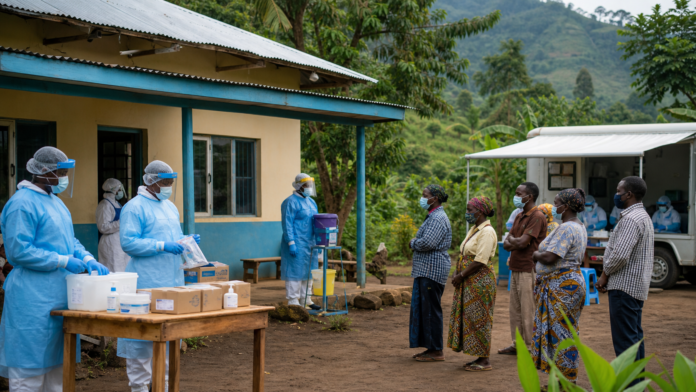
In the meantime, outbreak control still rests on early detection, laboratory confirmation, safe isolation, supportive clinical care, contact tracing, personal protective equipment and trusted communication with communities.
How the infection spreads
Ebola spreads through direct contact with the blood or other body fluids of an infected person, through contaminated objects, and through unsafe care or burial practices. It does not spread easily through the air like influenza. WHO advises avoiding unprotected direct contact with anyone showing suspected symptoms and informing local health authorities immediately.
Early symptoms such as fever, weakness, headache, muscle pain, vomiting or diarrhoea can look like other illnesses, so diagnosis cannot rest on symptoms alone; laboratory testing is essential.
Schools, displacement and the health system
Before schools reopened on September 1, some parents and teachers in Ituri asked for a delay, and reports of very high case fatality among young children added to the worry. Closing schools nationally is a separate policy decision, but the worst-hit zones need more screening, hygiene, referral and risk communication.
Armed conflict and displacement in Ituri and eastern Congo make the response even harder. Unsafe roads to treatment centres, attacks on hospitals, shortages of staff and protective equipment, and health-worker strikes can hide chains of infection that contact tracing misses. The role of logistics and cross-border coordination in hard terrain is also visible in our Nepal flood rescue coverage.
How big is the risk for India and Asia
WHO’s current assessment rates the risk as very high in Congo, high in neighbouring countries and low globally. That is not zero risk. International travel, humanitarian deployments and trade links mean airports and hospitals should be ready with travel-history checks, isolation protocols and laboratory referral.
There is no report so far of confirmed local transmission in India linked to this outbreak. Readers should avoid sharing viral “Ebola case” claims on social media that lack a location or laboratory evidence. Updates from WHO, the national health ministry and recognised public-health agencies are the most reliable basis for confirmation.
What to watch
- New health zones, daily confirmed cases, treatment outcomes, health-worker infections and contact follow-up in the next WHO update.
- Enrolment and safety reporting in the vaccine study.
- Whether geographic spread slows; rising cases alone do not prove the response is failing, since better testing also raises numbers, but continued spread shows transmission is not yet under control.
This article was first published in Hindi and has been translated. The Press of Asia now publishes in English only.
Sources
- WHO Disease Outbreak News, August 28, 2026
- WHO: IHR Emergency Committee meeting report on Bundibugyo virus disease
- WHO Disease Outbreak News, October 8, 2026

The International Desk covers world and Asian affairs, diplomacy and conflict, with a focus on what they mean for India. Stories are checked against at least two credible sources before publication.