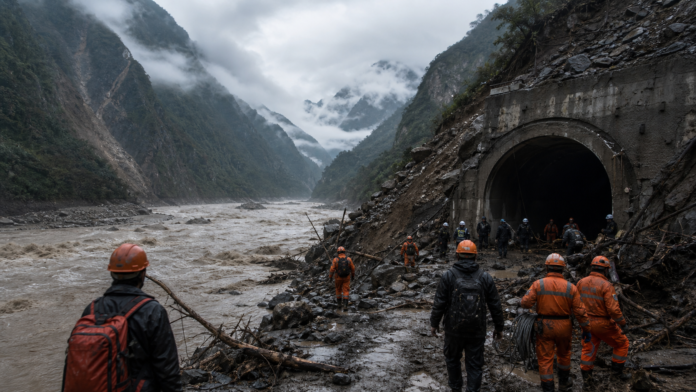
Update: On September 3, nine days after the floods, Nepal’s Army pulled two workers alive from a tunnel at the Trishuli 3A hydropower project in Rasuwa district, ABC News reported. The Independent Power Producers’ Association of Nepal said at least 557 workers were missing from the Trishuli 3A projects, with about 115 believed trapped in the tunnel. As of September 3, Nepal’s National Disaster Management Authority put the toll at 1,287 dead and 4,216 missing.
Kathmandu, August 30: Nepal stepped up rescue efforts on Sunday to reach people trapped in the tunnels of hydropower projects hit by the Himalayan flood. The army airlifted heavy machinery to high-altitude sites, while tunnel-rescue specialists from India and China are working alongside Nepali teams.
This is a developing disaster and casualty and missing figures keep changing. According to the latest Associated Press report on Sunday, 788 people had died and 2,502 were missing in Nepal. Chinese authorities reported 16 deaths and 546 missing on the Tibetan side. On that basis at least 804 people have died and 3,048 are missing on both sides, though totals may differ slightly because agencies use different cut-off times.
Key highlights
- About 10,000 Nepali soldiers have been deployed in tunnel-rescue operations, Reuters reported.
- Heavy equipment was airlifted to dam and tunnel sites under construction.
- The biggest effort is around the Upper Trishuli complex, where about 350 people may be trapped in one tunnel.
- Rescue work is under way at five hydropower projects, with concern for more than 900 workers in all.
- India and China have sent specialists, relief supplies and, in China’s case, satellite and hydrological data.
What is happening in the tunnel rescue
According to Reuters, Nepal’s army airlifted heavy equipment to under-construction dam and tunnel sites, and about 10,000 Nepali soldiers have been assigned to tunnel-rescue operations. Dharam Raj Uprety, head of the national disaster authority, said specialists from China and India had also joined the operation.
The largest effort is focused around the Upper Trishuli complex. Officials were told on Friday that about 350 people might be trapped in one tunnel. Rescue work is going on at five hydropower projects, and concern has been raised for more than 900 workers in all. These are estimates; the exact number of people inside the tunnels will be confirmed only when teams can enter safely.
The toll so far
| Side of the border | Deaths | Missing | Source |
|---|---|---|---|
| Nepal | 788 | 2,502 | AP, August 30 |
| Tibet (China) | 16 | 546 | Chinese authorities, via AP |
| Total | 804 | 3,048 | Our calculation |
Our calculation: adding the two sides gives at least 804 deaths and 3,048 people missing. Missing people outnumber confirmed deaths by almost four to one (3,048 ÷ 804 ≈ 3.8), which shows how much depends on reaching the tunnels and the debris zones.
Why reaching the tunnels is so hard
A fast torrent of ice, rock and debris damaged roads, bridges and power infrastructure. Tunnel entrances are blocked with mud, boulders and rubble, and rising rivers and continuing rain have made it riskier to operate machinery and send rescuers underground.
Teams are preparing debris clearance, water pumping, structural assessment and ventilation. Helicopters were used where heavy excavators and other equipment could not go by road. Before entering any tunnel, roof stability, oxygen levels, flooding risk and an alternative exit all have to be checked.
India’s specialist assistance
India’s 11-member reconnaissance team, including tunnel-rescue specialists and medical personnel, reached Nepal on Saturday and began aerial assessments in the Chilime and Langtang areas. India has also sent relief supplies and further help.
The Indian experts’ job is to give Nepali authorities technical support on tunnel access, equipment needs and an underground rescue plan. That does not mean contact has been made with everyone trapped; the latest verified reporting makes no such claim.
How China is helping
According to Chinese state media, Beijing is providing emergency cash aid, disaster-relief supplies, satellite and hydrological data and tunnel-rescue expertise. Chinese specialists matter especially because the disaster zone spans both sides of the Nepal–Tibet border, and upstream water conditions affect the safety of rescues downstream.
Nepal and China are also coordinating to identify missing citizens and foreign nationals. Those missing on the Tibetan side include citizens of several countries, among them people from India and Nepal.
Impact on hydropower and electricity
Reuters reported that the flood affected about 10% of Nepal’s power-generation capacity and submerged several hydropower projects under construction. The full infrastructure loss has not yet been assessed. The immediate priorities are reaching trapped workers, warning downstream communities and securing damaged dams and tunnels. The effects could show up in the coming weeks in electricity supply, project timelines and reconstruction costs, and since hydropower is central to Nepal’s economy and cross-border energy planning, the damage assessment will matter after the rescue phase.
Weather and the risk of new floods
Authorities sent fresh flood warnings to people’s phones on Sunday. Rain raised river levels and crews had to move to higher ground in some places. Hydrological monitoring continues on the temporary lake formed after the glacier collapse and debris avalanche, and on upstream blockages.
What to watch
- Whether rescuers can clear tunnel entrances enough, reduce water pressure and make controlled entries with specialist equipment.
- Official figures on survivors, trapped workers and casualties; any new claim should be accepted only after official confirmation.
- Fresh flood warnings and the state of the temporary lake and upstream blockages.
For more on Nepal and disaster response across Asia, see our Asia section. For Himalayan regional diplomacy, read our Bishkek SCO Summit 2026 report.
This article was first published in Hindi and has been translated. The Press of Asia now publishes in English only.
Sources
- Reuters (via Investing.com): Nepal steps up rescue effort to reach hundreds trapped in tunnels
- Associated Press: death toll and missing figures
- Associated Press: specialist rescue assistance
- CNA / Reuters: rescuers at tunnels in the Nepal–Tibet disaster
- ABC News: 2 people rescued alive from tunnel after deadly Nepal-Tibet flash flood

The International Desk covers world and Asian affairs, diplomacy and conflict, with a focus on what they mean for India. Stories are checked against at least two credible sources before publication.