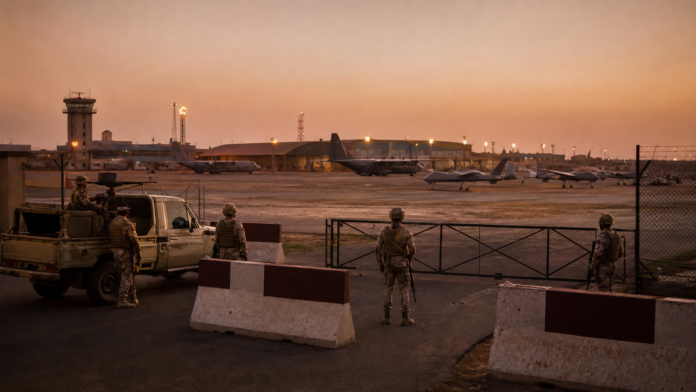
NIAMEY, August 31, 2026: Niger’s military-led government says loyalist forces have regained control of Air Base 101 and the surrounding airport area in Niamey after a roughly 24-hour mutiny by soldiers. Gunfire and explosions were reported from Friday night into Saturday near Diori Hamani International Airport and, according to residents and state media, in the vicinity of the presidential palace.
The Niger Military Mutiny is the most visible internal challenge to the junta since it seized power in 2023. State television said dozens of mutineers were killed or arrested, but authorities have not published a verified breakdown, identified those detained or explained what charges they may face. Independent confirmation of the casualty claims remains limited.
What happened at Air Base 101
Niger’s defence ministry said a group of soldiers took colleagues hostage and fired on “sensitive” sites. Loyalist units moved to retake the base, which shares the airport complex in the capital. By Sunday, traffic and daily life in much of Niamey appeared calm, and the government announced that it had restored control.
Loyalist troops were assisted by Russian forces. Russia’s Africa Corps has expanded its role in the Sahel after the withdrawal or reduction of several Western military missions. Nigerien officials have not released a detailed account of the Russian unit’s actions during the mutiny.
Air Base 101 is strategically important because it hosts military aircraft, drones and counterterrorism capabilities. It also supports the Alliance of Sahel States, the bloc formed by Niger, Mali and Burkina Faso. Any prolonged loss of control could have disrupted the junta’s command structure and operations against armed groups in the region.
Why the soldiers mutinied is still unclear
Officials have not provided a full account of the mutineers’ demands. Reports described them as aggrieved or disgruntled soldiers, but the source of the grievance has not been established publicly. Pay, deployment conditions, leadership disputes and frustration with battlefield losses are all common causes of military unrest, yet none should be presented as the confirmed trigger in this case.
The distinction between a mutiny and a coup attempt is important. A mutiny can involve soldiers refusing orders or seizing a facility without a coherent plan to replace the national leadership. A coup requires an organised effort to take state power. No evidence released so far shows that the soldiers controlled national broadcasting, detained the head of state or announced a new government. For that reason, this report uses the government’s description of a mutiny rather than calling it another coup.
The junta is led by Gen. Abdourahamane Tchiani, who came to power when soldiers removed elected President Mohamed Bazoum in July 2023. The regime has since tightened political control, shifted security partnerships away from France and the United States, and deepened ties with Russia and its military partners.
Security pressures across the Sahel
Niger remains under pressure from armed groups linked to al-Qaida and the Islamic State, particularly near its borders with Mali, Burkina Faso and Nigeria. Military rulers in the three central Sahel states promised that taking power would improve security, but militant violence and civilian displacement have continued. The mutiny exposes a separate risk: cohesion inside the armed forces that are expected to lead those campaigns.
State media’s claim that hundreds of soldiers were involved has not been independently verified. Nor is it clear whether all those arrested participated directly, surrendered after following orders or were detained for questioning. Transparent information about casualties, detainees and legal proceedings will be necessary to assess whether the government’s response followed Nigerien law and basic due-process standards.
Outside military assistance adds another layer. Russian support may help the junta secure key facilities, but it also increases Niamey’s reliance on a foreign security partner. Governments seeking short-term regime protection can face long-term questions about command authority, accountability and the terms under which foreign troops operate.
Regional and international implications
Niger, Mali and Burkina Faso have built a shared defence structure under the Alliance of Sahel States after distancing themselves from the West African bloc ECOWAS. An internal rupture at a base supporting that alliance could affect joint operations and the movement of aircraft or personnel. So far, the government has not reported a wider breakdown across Niger’s armed forces.
The episode arrives as countries across Africa and Asia are reassessing defence partnerships.
The government’s immediate priority will be to secure armouries, communications and transport links while determining whether the mutiny had support at other bases. International partners will watch for changes in Niger’s command structure and signs that militant groups may exploit the distraction.
Questions that remain unanswered
Authorities have not disclosed the identities of the mutiny’s organisers, the exact number of deaths and arrests, the fate of the soldiers reportedly taken hostage or whether any civilians were hurt. They have also not said whether the presidential palace itself was attacked or merely close to some of the reported gunfire.
The government said the airbase had been retaken, but public detail remains limited. Until independent reporting and official records converge, casualty figures and alleged motives should be treated as provisional.
The end of gunfire does not by itself settle the political consequences. A public inquiry, prosecutions or command reshuffle could follow, while heavy punishment without transparent evidence could deepen grievances inside the military. Niger’s leaders now face the dual task of preventing renewed unrest and maintaining operations against armed groups.
For broader international context on conflict, energy and security, read our report on the global oil shock during the Iran crisis, which examined how security disruptions affect economies far beyond the immediate battlefield.
This is a developing story. The Press of Asia will update confirmed casualty, arrest and command information when Niger’s authorities or independent monitors publish it.

The International Desk covers world and Asian affairs, diplomacy and conflict, with a focus on what they mean for India. Stories are checked against at least two credible sources before publication.