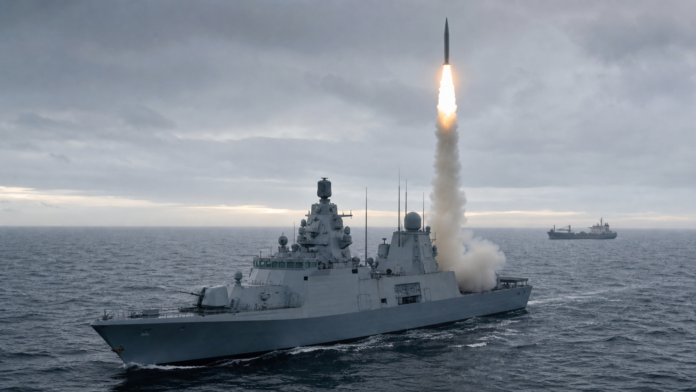
Berlin, September 2: The German Navy has carried out a successful live-fire test of Israel Aerospace Industries’ (IAI) LORA precision-strike missile system in the North Atlantic. The test is an important step towards a possible purchase, but Germany has not announced a final decision on buying the system, the number of missiles, the cost or a deployment timeline.
Key highlights
- The German Navy tested the LORA system from an operational naval vessel in the North Atlantic.
- Navy chief Vice Admiral Jan Christian Kaack called the trial a success and a new chapter for deterrence.
- IAI’s public specification gives LORA a range of 90–430 km; German reports have mentioned a possible configuration with a range of up to or over 500 km.
- The system uses GPS/INS guidance, a solid-fuel motor and a sealed canister.
- A successful test does not automatically mean a procurement contract.
What happened
According to German defence officials, the test took place at night in the North Atlantic. Reports by dpa and Deutschlandfunk said two German frigates were sent to waters between Ireland and Iceland, and that shipping and air traffic were given a public safety warning 45 days in advance, while operational details of the programme were kept limited.
According to an IAI release, the Naval LORA was launched from an operational German vessel and met its planned trajectory and target-hit objectives. Reports mention more than one test scenario. Public accounts differ in detail on which ship carried the launcher and the full firing sequence, so this report sticks to the facts available at official level.
What is LORA?
LORA stands for Long-Range Artillery weapon system. IAI describes it as an all-weather, surface-to-surface precision system that can be launched from land or sea platforms. Guidance is based on GPS and an inertial navigation system.
| Specification | IAI public figure | Note |
|---|---|---|
| Range | 90–430 km | German reports mention up to or over 500 km for a possible configuration |
| Weight | About 1,600 kg | Manufacturer figure |
| Length | 5.2 m | Manufacturer figure |
| Accuracy (circular error probable) | 10 m | Claimed by IAI |
| Guidance | GPS and inertial navigation | Solid-fuel motor, sealed canister |
Our calculation: a 500 km range would be about 16% more than the 430 km maximum on IAI’s public product page. The gap may reflect a different configuration, an operational requirement or reporting shorthand. Until Germany or IAI publishes a definitive range for the tested variant, 430 km should be read as the manufacturer’s public specification and 500 km as a reported potential.
Why it matters for Germany
If bought, LORA could become the Bundeswehr’s first ballistic missile capability. Germany has Taurus cruise missiles, but ballistic and cruise missiles fly differently: a ballistic missile reaches its target fast on a high trajectory, while a cruise missile flies under power on a lower, more manoeuvrable path. A naval version would give Germany the option of long-range precision strikes from ships against land or sea targets. Kaack said the test opened a new chapter in deterrence and naval readiness for Germany and its allies. The capability could matter in NATO planning too, given concern in Europe about long-range fires and saturating air defences.
The OPEX programme and “Marine 2035”
The trial is linked to the German Navy’s OPEX initiative, which aims to test new technologies and operating concepts quickly and in realistic conditions for its “Marine 2035 and Beyond” plans. OPEX is an experimentation framework, not procurement approval. A successful test shows military usefulness; budget, parliamentary approval, integration, training and lifecycle costs are separate steps. Germany is also strengthening its wider security posture: our report on Berlin’s response to the suspected Leipzig drone incident shows it is weighing both conventional and hybrid threats. The two events are operationally separate, and there is no public evidence linking them.
Israel–Germany defence cooperation
The LORA test is another step in the defence-industrial relationship between Germany and Israel. Germany has already adopted Israel’s Arrow 3 missile-defence system. LORA is a different category: Arrow 3 intercepts incoming ballistic missiles, while LORA is a precision-strike weapon. Treating a defensive interceptor and an offensive strike missile as the same would be technically wrong.
What it means for Europe and Asia
Demand for long-range precision weapons in Europe has grown because of the Ukraine war, ammunition readiness and the deterrence debate. Sea-launched systems like Naval LORA add options, but also raise questions about escalation risk, targeting rules, export controls and alliance coordination. In Asia, navies are investing in both missile defence and long-range strike; for the regional context, see our report on the Freedom Edge 2026 US–South Korea–Japan exercise. Germany’s test is not an Asian deployment, but it will be watched in the global defence-technology market.
What to watch
- A formal requirement from the German Defence Ministry, parliamentary budget documents, any IAI contract disclosure and an integration plan.
- Whether Germany continues evaluation or moves directly to acquisition talks.
- Training, command and control, target-authorisation rules and NATO interoperability, all needed before any operational deployment.
Still unknown: the purchase decision, quantity, contract value, final range of the tested variant, deployment date and details of permanent launcher integration on German ships. The successful firing proves technical feasibility; it is not a final deployment decision.
This article was first published in Hindi and has been translated. The Press of Asia now publishes in English only.
Sources

The International Desk covers world and Asian affairs, diplomacy and conflict, with a focus on what they mean for India. Stories are checked against at least two credible sources before publication.