Update: The exercise began on September 7 with an opening ceremony at Yokota Air Base in Japan. It covered the maritime, air and cyber domains as well as integrated air and missile defence, with drills in the East China Sea south of Jeju; Japan sent the destroyer Atago and a P-1 patrol aircraft. Adnkronos reported that this was the fourth edition of Freedom Edge and the first since September 2025. North Korean Defence Minister Kim Song-gi condemned the drill and vowed “more powerful and resolute action”, Korea JoongAng Daily reported on September 8. No North Korean missile launch tied to the exercise had been reported at that point.
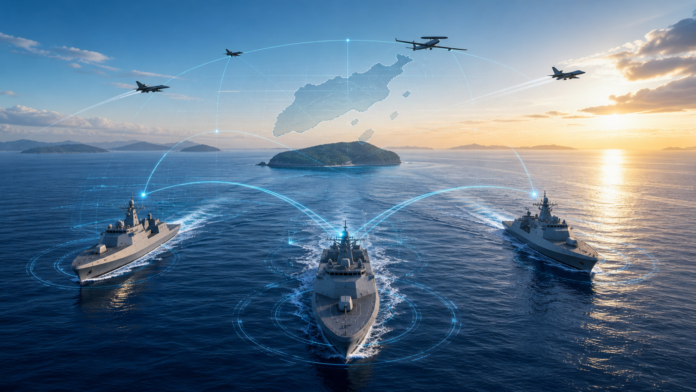
Seoul/Tokyo, August 29: The United States, South Korea and Japan will hold Freedom Edge 2026 from September 7 to 11 in international waters east and south of Jeju Island. The three countries describe it as a defensive, multi-domain exercise meant to strengthen information-sharing and interoperability against North Korea’s nuclear and missile threats.
South Korea’s Joint Chiefs of Staff and US Forces Japan announced the exercise on Friday. The drill links naval, air and other operational domains and will focus on real-time data sharing, joint planning and coordination between platforms from different countries.
North Korea condemned the exercise and warned of retaliation. For now that should be read as a political and military warning; no specific counter-action has been independently confirmed. The announcement comes as Washington tries both to signal openness to diplomacy and to keep up deterrence with its two main Northeast Asian allies.
Key highlights
- Dates: September 7 to 11, 2026.
- Location: international waters east and south of Jeju Island.
- Participants: the United States, the Republic of Korea and Japan.
- Format: a trilateral, multi-domain exercise.
- Main aims: missile warning, air and maritime coordination, data sharing and interoperability.
- Background: growing concern over North Korea’s nuclear programme, ballistic missiles and military activity in the region.
What Freedom Edge is
Freedom Edge trains the three militaries to work from a single operational picture. In a modern conflict a threat is rarely limited to the sea or the air. A missile launch may be detected by a satellite or radar, the tracking data has to move from one country’s command network to another’s, and an interceptor on a different platform needs its orders in time.
Interoperability therefore means more than ships sailing together. It covers communication protocols, secure data links, rules of engagement, search-and-rescue procedures, anti-submarine awareness and command decisions. Official statements describe the exercise as defensive and announce no actual attack operation, the US Forces Japan release and Yonhap’s report on the Joint Chiefs of Staff details show.
Why the location near Jeju matters
Jeju sits in a strategic position south of the Korean Peninsula. The surrounding waters connect to the East China Sea, the Korea Strait and wider Western Pacific routes. Drilling there lets the three partners test maritime surveillance and air coordination in an area where commercial shipping, naval movements and regional disputes sit close together.
The location also carries a political message. The exercise shows deterrence towards North Korea, while China and Russia also watch US-led security networking in Northeast Asia closely. Even so, the announcement names no aim of attacking any other country; the verified description focuses on defensive readiness and a shared response.
Who wants what from the drill
| Country | Main priority | What it gains from the trilateral format |
|---|---|---|
| Japan | Missile defence and the safety of sea lanes | Earlier warning data from Korean and US sensors |
| South Korea | The immediate threat on the Korean Peninsula | Faster tracking and response alongside two partners |
| United States | Linking two separate alliances | Shorter detection and response times across Northeast Asia |
Our calculation: the drill runs for five days, September 7 to 11. With three partners, there are three two-way links to keep in sync: US–South Korea, US–Japan and Japan–South Korea. The first two rest on long-standing alliances; the Japan–South Korea link is the newest and weakest, and it is the one a trilateral format like Freedom Edge exists to strengthen.
North Korea’s response
Pyongyang has long called US–South Korea exercises rehearsals for invasion. Washington and Seoul reject that description and call the drills defensive alliance readiness. Japan’s participation sharpens North Korea’s criticism, because trilateral cooperation can make regional missile tracking and sanctions enforcement more effective.
North Korea has warned of retaliation, but a warning and a confirmed action are different things. A missile test, artillery activity or an official statement in the coming days could be signals. Before treating any event as a direct answer to Freedom Edge, its timing, official attribution and independent reporting need to be checked, as AP’s report on the exercise and the North Korean response makes clear.
Balancing diplomacy and deterrence
According to AP, the Trump administration scaled back part of the bilateral Ulchi Freedom Shield exercise, which was seen as a diplomatic opening. The trilateral Freedom Edge is going ahead regardless. That shows Washington wants to keep the door to negotiations open without fully lowering alliance readiness.
This dual-track approach is not new. Governments often pursue talks and military preparedness at the same time so that negotiations do not leave them exposed. The risk is that each side reads the other’s defensive steps as offensive preparation, which is why crisis communication and clear notification matter as much as military capability.
Japan and South Korea’s changing cooperation
Tokyo and Seoul have a history of tension over the colonial period and territorial issues. Even so, North Korean missiles and wider regional security concerns have pushed them to share more intelligence and coordinate militarily. Freedom Edge tries to make that cooperation routine, so operational channels keep working despite political disagreements.
What it means for India and Asia
India is not part of the exercise, but its effect on Indo-Pacific security feeds into India’s strategic debate. Missile defence, maritime domain awareness, submarine tracking and secure data links are capabilities that countries across Asia are investing in. India works with Japan and the United States in the Quad, although Freedom Edge is a separate trilateral format, and New Delhi generally uses such partnerships for capacity building while keeping its strategic autonomy.
There is an economic angle too. South Korea and Japan are major technology, shipping and manufacturing hubs, and any miscalculation could hit markets, semiconductor supply chains and maritime insurance, with knock-on effects for Asian importers, India included.
What to watch
- Official imagery, statements from the participating commands and exercise-area notices, rather than unverified equipment lists on social media.
- How real-time missile-warning data was shared, and how detailed the anti-submarine and air-defence components were.
- North Korean rhetoric and military movements before and during the drill, and whether Seoul, Tokyo and Washington keep de-escalation channels open.
- The assessment the three countries release after the exercise ends.
The bigger message of Freedom Edge 2026 goes beyond a five-day training event. It tests how far US–Japan–South Korea security cooperation is becoming institutionalised in Northeast Asia, and how well the three countries can raise deterrence while keeping escalation under control.
This article was first published in Hindi and has been translated. The Press of Asia now publishes in English only.
Sources
- US Forces Japan: Japan, ROK, US announce trilateral exercise Freedom Edge 2026
- Yonhap: South Korean Joint Chiefs of Staff details
- Associated Press: the exercise, regional context and North Korea’s response
- SBS News: timing and exercise area
- Adnkronos: Japan, U.S., S. Korea kick off joint exercise
- Korea JoongAng Daily: North Korean defense minister vows ‘resolute action’

The International Desk covers world and Asian affairs, diplomacy and conflict, with a focus on what they mean for India. Stories are checked against at least two credible sources before publication.