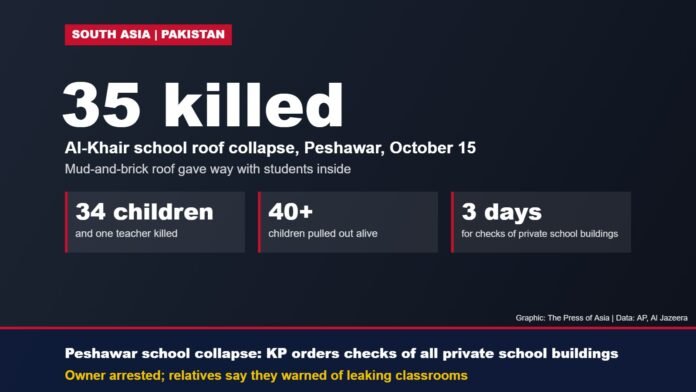
Peshawar, October 17: The roof of Al-Khair school in Peshawar, the capital of Pakistan’s Khyber Pakhtunkhwa province, collapsed on Thursday, October 15, killing 34 students and one teacher. Authorities have since ordered safety inspections of all private school buildings in the province, and police have arrested the school’s owner.
Relatives of the dead say they had repeatedly warned the owner that rainwater was seeping into the classrooms. Peshawar’s police chief said the building was structurally weak.
Key highlights
- At least 34 students aged 13 or younger and one teacher were killed when the mud-and-brick roof gave way.
- Rescuers pulled at least 40 children out alive; emergency crews reached the site within five minutes of the alert.
- Police arrested the owner, Mohammad Khan, who told officers that recent rains had weakened one of the roofs.
- District committees must inspect all private school buildings in Khyber Pakhtunkhwa, owned or rented, and report within three days.
- Buildings will be rated safe, in need of repairs, or potentially unsafe.
What happened at Al-Khair school
The roof fell on Thursday while students were inside. Emergency crews arrived within five minutes and pulled at least 40 children from the rubble alive, but some of those who died had suffocated under the debris. Two of the victims were named as Abdul, aged 9, and Abuzar, aged 10.
Peshawar Police Chief Saeed Ahmed said the building was structurally weak. The owner, Mohammad Khan, was arrested shortly after the collapse and told police that recent rains had weakened one of the roofs, according to police.
“We warned the owner”
Families said the danger was known. Relatives said they had complained to the owner several times about rainwater seeping into the classrooms and had warned that the building’s condition could lead to a tragedy, and demanded punishment for the officials who allowed the building to be used as a school.
The inspection order
The provincial government has told its education department to set up district committees to inspect every private school building in Khyber Pakhtunkhwa, whether owned or rented. The order followed a request from the national government for the province to check its schools; accounts differ on whether public schools are also covered.
| Item | What the order says |
|---|---|
| Buildings covered | All private school buildings in Khyber Pakhtunkhwa, owned or rented |
| What is checked | Roofs, ceilings, walls, columns, beams, foundations and staircases |
| Ratings | Safe; in need of repairs or improvements; potentially unsafe |
| Deadline | Findings and recommendations within three days |
| Follow-up | Districts must order urgent technical assessments where needed |
Our calculation: with at least 35 people killed and at least 40 children rescued alive, at least 75 people were inside the building when the roof fell. On those minimum figures, almost half of them (35 ÷ 75 ≈ 47%) died.
A pattern of collapses
This is not the first such disaster this year. In June, the roof of a private tuition centre in Lahore collapsed, killing 14 people. Poor construction standards and substandard building materials are long-standing problems in Pakistan.
The disaster also comes at a politically tense time for the province. Khyber Pakhtunkhwa was placed under an emergency and governor’s rule on October 11, as we reported, which means questions about accountability will land on an administration already under scrutiny.
What to watch
- The inspection reports due within three days, and how many buildings are rated potentially unsafe.
- Whether the order is widened to government schools and to other provinces.
- Charges against the owner, and whether officials who approved the building face action, as families demand.
- Any compensation announcement for the families of the victims.
What it means
Private schools fill a large gap in Pakistan’s education system, and an order that covers owned and rented buildings alike shows how little the authorities knew about the state of these classrooms. A three-day inspection drive can identify the most dangerous buildings quickly; whether children are actually moved out of them, and whether repairs are paid for, will decide whether the Peshawar collapse leads to lasting change.

The International Desk covers world and Asian affairs, diplomacy and conflict, with a focus on what they mean for India. Stories are checked against at least two credible sources before publication.