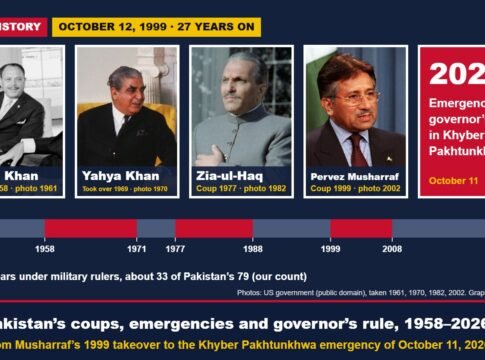
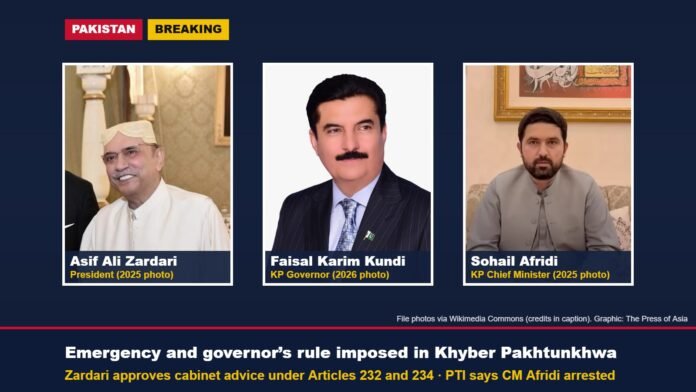
October 11: Pakistan has imposed an emergency and governor’s rule in Khyber Pakhtunkhwa, the province governed by Imran Khan’s Pakistan Tehreek-e-Insaf (PTI), after President Asif Ali Zardari approved the federal cabinet’s advice under Articles 232 and 234 of the Constitution, the President’s Office said, according to Dawn. Provincial Information Minister Shafi Jan said Chief Minister Sohail Afridi, who was leading the PTI’s long march, had been taken into custody, The Express Tribune reported. Police and the federal government had not confirmed the arrest by Sunday evening.
Key highlights
- The cabinet, chaired by Prime Minister Shehbaz Sharif, “took note” of the “provincial government’s deliberate disengagement from the fight against terrorism”, the Prime Minister’s Office said, according to Dawn.
- Executive authority over provincial departments passes to Governor Faisal Karim Kundi, acting under federal direction, and the provincial assembly’s legislative powers are suspended though it is not dissolved, Nukta reported, citing the Presidency’s notification. Nukta said the chief minister and his cabinet were removed with immediate effect.
- Dr Muhammad Fakhr Alam Irfan was appointed chief secretary of the province, and Muhammad Yahya Akhunzada was placed at the disposal of the provincial government, Dawn reported.
- Mobile and data services were slowed or shut in parts of some cities, including Peshawar, but there was no province-wide shutdown, Dawn reported, citing telecom sources.
- PTI chairman Gohar Ali Khan called the move “an extremely concerning and serious political mistake” and said it could still be reversed, The Express Tribune reported.
What the President and the cabinet did
The cabinet proposed, given the “gravity” of the situation, that the prime minister advise the president to use his “constitutional authority” to impose an emergency, Dawn reported. Zardari said on social media that he had approved the recommendations, Al Jazeera reported. According to Nukta, the decision also drew on a report from Governor Kundi that the provincial constitutional machinery had “completely broken down”. The Presidency cited a sharp rise in terrorist violence and attacks on government installations and law enforcement agencies.
At the cabinet meeting, ministers were shown security figures that, according to The Nation, said terrorist incidents in the province rose 195% between March 2024 and September 2026, and that drone attacks on police and security forces rose from none in 2024 to 170 in 2026.
How it came to this: one week
| Date | Event | Source |
|---|---|---|
| October 3 | Talks between the federal government and the PTI collapse | Dawn |
| October 4 | PTI long march, led by Afridi, sets off from Lakki Marwat | The Express Tribune |
| October 8–9 | Ministers Rana Sanaullah and Tariq Fazal Chaudhry link a possible emergency to counterterrorism cooperation | The Express Tribune; Shafaqna |
| October 10 | Sources say the centre has prepared an emergency for 12 districts; Zardari and Shehbaz meet; the march reaches Mardan | The Express Tribune; Dawn |
| October 11, morning | Cabinet meets; Interior Minister Mohsin Naqvi says “We have no room left now” | The Express Tribune |
| October 11 | President approves emergency and governor’s rule under Articles 232 and 234; new chief secretary appointed | Dawn |
| October 11, afternoon | Information Minister Shafi Jan says Afridi has been taken into custody; PTI says its provincial president Junaid Akbar was also arrested | The Express Tribune; Al Jazeera |
By our count, the federal government moved from a breakdown in talks to emergency rule in eight days, and from the first reports of a 12-district plan to a province-wide measure in one.
Articles 232 and 234: what they require
| Article 232 (emergency) | Article 234 (governor’s rule) | |
|---|---|---|
| What it does | Lets the president proclaim an emergency when security is threatened by war, external aggression or internal disturbance beyond a province’s control | Lets the president take over a province’s functions when its government cannot be carried on under the Constitution |
| Conditions | For internal disturbance, a resolution of the provincial assembly is required; if the president acts on his own, both houses of parliament must approve within ten days | Can be based on the governor’s report; the proclamation goes before a joint sitting of parliament |
| Time limit | Tied to parliamentary approval | Lapses after two months unless approved by a joint sitting; can be extended in two-month steps, up to six months |
| Rights | Article 233, which allows fundamental rights to be restricted, was not cited in the summary the president signed, according to Dawn |
This summary is based on the constitutional text and Dawn’s explanation; it is not a legal opinion. Separate sessions of the National Assembly and the Senate had already been agreed for Tuesday, October 13, according to the Presidency’s media wing, as reported by The Express Tribune.
How the PTI has responded
- Gohar Ali Khan, party chairman: The PTI “strongly condemns” and “categorically rejects” the move, which he called “an extremely concerning and serious political mistake”.
- Shafi Jan, provincial information minister: Called on people across the province to head to Peshawar: “The people will now have to come out.”
- Junaid Akbar, provincial party president: “Whether they impose governor’s rule or martial law, our long march will take place in every circumstance.” He said marchers had reached Swabi. The PTI later said he too had been arrested, according to Al Jazeera.
- Asad Qaiser, former National Assembly speaker: “Governor’s rule is unacceptable, emergency is unacceptable.”
- Zulfikar Bukhari, spokesman: The decision would lead to “further bloodshed, instability and collateral damage”, Reuters reported, via Al Jazeera.
The party’s parliamentary committee will weigh three options: a court challenge, a boycott of the National Assembly, Senate and provincial assemblies, and peaceful protests, PTI information secretary Sheikh Waqas Akram said, according to Dawn. Governor Kundi said the decision was aimed at peace and development and called for unity, Dawn reported. Our earlier report: Pakistan’s cabinet meets on emergency or governor’s rule.
What to watch
- Official confirmation of Afridi’s status, and of the arrest of Junaid Akbar.
- The National Assembly and Senate sessions on October 13, and any joint sitting to approve governor’s rule.
- Whether the PTI goes to court, boycotts parliament or calls supporters to Peshawar.
- The position of Maulana Fazlur Rehman’s JUI-F, whose core committee was due to meet on Sunday.
What it means
It is a rare and drastic step: an elected provincial administration run by the main opposition party has been suspended while its leader was marching against the centre. The government frames it as a counterterrorism decision, and its own figures show a sharp rise in attacks. The PTI frames it as a political move to stop the march. The next two months will decide which view prevails, in parliament, where governor’s rule needs a joint sitting’s approval, in the courts, and on the streets of Peshawar.
Sources
- Dawn: Emergency, governor’s rule imposed in KP as president approves cabinet decision
- The Express Tribune: PTI leaders condemn emergency in K-P, vow to continue political struggle
- Al Jazeera: Pakistan imposes emergency rule in province governed by Imran Khan’s party
- Nukta: Pakistan imposes emergency in Khyber Pakhtunkhwa; Chief Minister Afridi and provincial cabinet dismissed
- The Nation: Federal cabinet backs emergency in KP in principle
- The Express Tribune: PTI govt faces ouster as Centre weighs K-P options
- ANI, via The Tribune: Pakistan imposes emergency, Governor’s rule in PTI-led Khyber Pakhtunkhwa
- Constitution of Pakistan, Part X: Emergency Provisions

The International Desk covers world and Asian affairs, diplomacy and conflict, with a focus on what they mean for India. Stories are checked against at least two credible sources before publication.