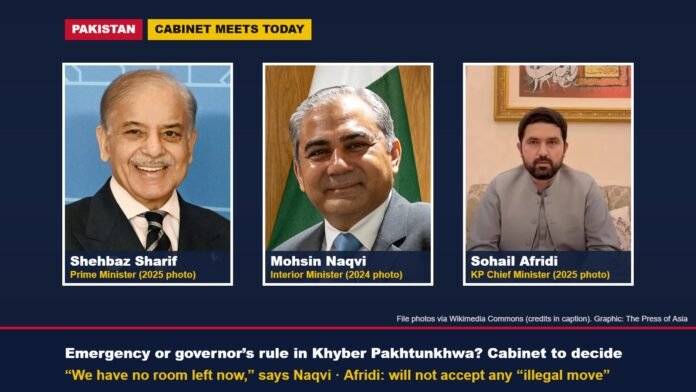
October 11: Pakistan’s federal cabinet was due to meet at 9:30 am on Sunday to consider imposing an emergency and governor’s rule in Khyber Pakhtunkhwa, after Interior Minister Mohsin Naqvi told journalists: “We have no room left now.” Chief Minister Sohail Afridi, who is leading the Pakistan Tehreek-e-Insaf (PTI) long march, said he would not accept any “illegal move”, including governor’s rule or an emergency. No decision had been announced at the time of writing.
Update, October 11, evening: President Asif Ali Zardari has approved an emergency and governor’s rule in Khyber Pakhtunkhwa under Articles 232 and 234; PTI says Chief Minister Sohail Afridi has been arrested. Read: Pakistan imposes emergency and governor’s rule in Khyber Pakhtunkhwa.
Key highlights
- President Asif Ali Zardari and Prime Minister Shehbaz Sharif met at Aiwan-e-Sadr on Saturday and reached an understanding on a possible emergency or governor’s rule, according to sources. The final decision rests with the cabinet, and any emergency would take effect only after the president approves it.
- Separate sessions of the National Assembly and the Senate have been agreed for Tuesday, October 13, according to the Presidency’s media wing.
- Parliamentary Affairs Minister Tariq Fazal Chaudhry said on Friday that “a final decision has been made” and that an emergency would cover the whole province, not only 12 districts, Shafaqna reported, citing his television interview.
- Afridi said in Charsadda: “I was asked to sign, but I refused,” and told supporters that the issue “had gone beyond seats and power”.
- Khyber Pakhtunkhwa police chief Zulfiqar Hameed issued guidelines calling for “maximum restraint” in handling protests, with any force to be used in phases.
The options before the cabinet
| Option | What it would mean | Source |
|---|---|---|
| Emergency and governor’s rule across the province | Federal control of the provincial government’s functions | Tariq Fazal Chaudhry |
| Emergency in 12 districts | Eight merged tribal districts plus Dera Ismail Khan, Tank, Bannu and Lakki Marwat | citing sources |
| New administrator | The chief secretary replaced by an administrator, and other senior officials transferred | citing sources |
| Transfer of powers | Certain important provincial powers moved to the federal government | citing sources |
The reports differ on scale: sources on Saturday described a first phase limited to 12 districts, while Chaudhry said any emergency would cover the whole province. Our report on the 12-district plan: Islamabad readies emergency plan for 12 KP districts.
Who said what
| Who | When | What they said |
|---|---|---|
| Rana Sanaullah, adviser on political affairs | October 8–9, on television | Governor’s rule or an emergency is about counterterrorism cooperation, not the march; “Imposing an emergency certainly does not mean that those districts will be evacuated” |
| Tariq Fazal Chaudhry, parliamentary affairs minister | October 9, on television | “I cannot give you a day or date, but a final decision has been made”; the provincial government should decide whether to cooperate against terrorism |
| Mohsin Naqvi, interior minister | Reported October 11 | “What scope remains for not imposing an emergency?” and “We have no room left now” |
| Sohail Afridi, chief minister | October 10, Charsadda and Mardan | Will not accept any “illegal move”; “The policy in K-P will be Imran Khan’s, and his rule will prevail” |
| Shaukat Yousafzai, PTI spokesman | October 10 | An emergency in 12 districts would be “a serious violation of the 18th Amendment” |
Afridi warned that any attempt to impose governor’s rule or an emergency would bring a strong public response and that people would then head to Peshawar instead of Swabi. He also said he was ready to “sacrifice” his seat. Maulana Fazlur Rehman is reported to favour giving political talks more time; the prime minister has invited him to the PM House.
What has to happen for an emergency
| Step | What is required | Status |
|---|---|---|
| 1. Cabinet | Federal cabinet approves and advises the president | Meeting due on Sunday morning |
| 2. President | President issues a proclamation under Article 232 | Zardari and Shehbaz reported to have reached an understanding |
| 3. Consent or parliament | For internal disturbance, a resolution of the provincial assembly is required; if the president acts on his own, both houses of parliament must approve within ten days | Separate National Assembly and Senate sessions agreed for October 13 |
| 4. Governor’s rule (Article 234) | A separate power for when a provincial government cannot be carried on under the Constitution | Under consideration |
The table summarises the constitutional text and the reports; it is not a legal opinion. With the PTI holding the provincial assembly, a resolution from it is unlikely, which would leave parliament’s approval as the route.
Where the march is
The march spent Saturday night in Mardan. Supporters have been asked to reach Swabi on October 11, and the party will announce its next steps there on October 13. Afridi’s earlier plan said convoys from Peshawar, Malakand and Kohat would reach Swabi Interchange on October 13 and those from Bannu, Dera Ismail Khan and Hazara on October 14, when “we will move beyond Swabi”.
What to watch
- The cabinet’s decision on Sunday and whether the president signs a proclamation.
- The National Assembly and Senate sessions on October 13.
- Whether the march turns towards Peshawar, as Afridi warned, or continues to Swabi.
- Any mediation by Maulana Fazlur Rehman.
What it means
The federal government has moved from warnings to a formal decision point within a week of the march starting. The language from ministers has hardened, from Sanaullah’s conditions earlier in the week to Naqvi’s “no room left” this weekend. If the cabinet approves an emergency, the timing matters: parliament would have to back it within ten days, and the PTI has threatened mass resignations. Either way, a province at the centre of Pakistan’s fight against militancy would be run, in part or in full, from Islamabad while its elected government leads a march against the centre.
Sources

The International Desk covers world and Asian affairs, diplomacy and conflict, with a focus on what they mean for India. Stories are checked against at least two credible sources before publication.