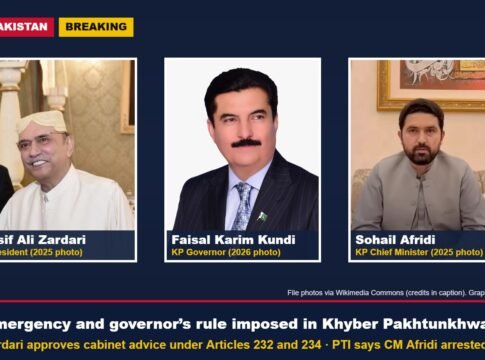
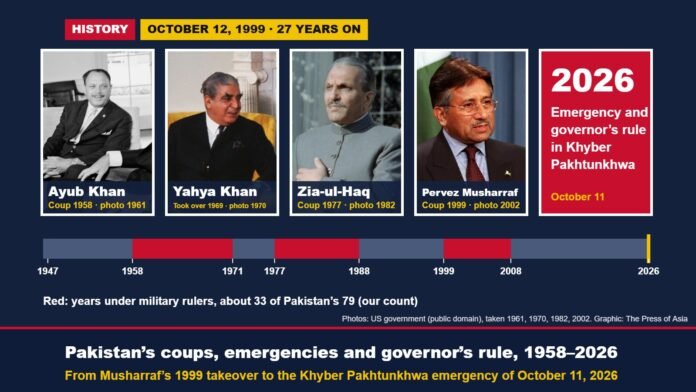
October 11: Monday marks 27 years since General Pervez Musharraf took power in Pakistan on October 12, 1999, hours after Prime Minister Nawaz Sharif tried to sack him while he was flying home from Sri Lanka. The anniversary comes a day after President Asif Ali Zardari, on the federal cabinet’s advice, approved an emergency under Article 232 of the Constitution and governor’s rule under Article 234 in Khyber Pakhtunkhwa, Dawn reported. The two events are not the same. The 1999 takeover was a military coup that put the Constitution “in abeyance”; this week’s step uses powers written into the Constitution, and the government says it is a response to terrorism. But both belong to a long pattern in which elected governments, national or provincial, have been pushed aside. The History Desk traces that pattern from 1958 to today.
Key highlights
- Pakistan has had four military takeovers: in October 1958, March 1969, July 1977 and October 1999. By our count, military rulers held power for about 33 of the 79 years since independence in 1947, or 42% of the country’s history.
- On October 12, 1999, Sharif dismissed Musharraf and named the ISI chief, Lt-Gen Ziauddin Butt, as army chief. Senior commanders refused to accept the order, and by the end of the day Sharif was under arrest, according to Human Rights Watch and Dawn.
- Musharraf’s Proclamation of Emergency of October 14, 1999, put the Constitution “in abeyance” and suspended the national and provincial assemblies and the Senate. He used the same words when he imposed an emergency on November 3, 2007.
- The 18th Amendment of 2010 made holding the Constitution in abeyance an act of high treason that no court may validate. In January 2024, the Supreme Court upheld the death sentence passed on Musharraf over the 2007 emergency, almost a year after his death.
- Governor’s rule has been imposed in every province, The News reported. Before October 11, the last case was in Balochistan in January 2013: by our count, a gap of 13 years and nine months.
Four takeovers at a glance
| Takeover | Military ruler | How it began | How it ended | Years in power (our count) |
|---|---|---|---|---|
| October 7, 1958 | Gen Ayub Khan | President Iskander Mirza abrogated the 1956 Constitution and proclaimed martial law; Ayub, named chief martial law administrator, forced Mirza out on October 27 | Ayub resigned on March 25, 1969, and handed power to the army chief | 10.5 |
| March 25, 1969 | Gen Yahya Khan | Took over from Ayub, abrogated the 1962 Constitution and declared martial law | Resigned on December 20, 1971, after defeat in the war with India, when East Pakistan became Bangladesh | 2.7 |
| July 5, 1977 | Gen Zia-ul-Haq | Overthrew Prime Minister Zulfikar Ali Bhutto; the 1973 Constitution was suspended rather than abrogated | Lifted martial law on December 30, 1985, but stayed president and army chief until he was killed in a plane crash on August 17, 1988 | 11.1 |
| October 12, 1999 | Gen Pervez Musharraf | Overthrew Prime Minister Nawaz Sharif; the Constitution was held “in abeyance” | Gave up command of the army in November 2007 and resigned as president on August 18, 2008 | 8.9 |
| Total | 33.2 of 79.2 years (42%) |
How we counted: from the first day of each takeover to the day the military ruler left office. We count Zia until his death in 1988 and Musharraf until his resignation in 2008, because both remained president after formal martial law or army command ended; counting only the years of formal martial law would give a lower figure. By the same method, the 18 years since August 2008 are the longest unbroken stretch of civilian-led government in Pakistan’s history.
October 12, 1999: how the day unfolded
| When | What happened | Source |
|---|---|---|
| 1998 | Sharif appoints Musharraf army chief, replacing Gen Jehangir Karamat | Dawn |
| 1999 | The Kargil crisis with India and disputes over senior army postings strain ties between Sharif and Musharraf | Dawn |
| October 12, around 5 pm | Sharif sacks Musharraf, who is flying home from Colombo, and appoints ISI chief Lt-Gen Ziauddin Butt as army chief | Dawn |
| October 12, evening | Air traffic control reportedly tells the PIA plane carrying Musharraf not to land at Karachi, and Nawabshah is also unavailable. Commanders loyal to Musharraf refuse to accept Butt and take control on the ground; the plane then lands | Dawn |
| October 12, night | In a bloodless coup, the army takes over; Sharif is under arrest and his cabinet under guard | Human Rights Watch |
| October 14 | Proclamation of Emergency, deemed to take effect from October 12: the Constitution “shall remain in abeyance”, the assemblies and Senate are suspended, the prime minister, ministers and governors leave office, and the country comes under the control of the armed forces | Proclamation text |
| October 18 | The Commonwealth suspends Pakistan | Human Rights Watch |
Sharif was later charged with hijacking the flight, PK-805, and it took him more than nine years to be cleared, Dawn reported in 2009. Musharraf first ruled with the title of Chief Executive; on June 20, 2001, he made himself president.
Emergencies: from war to internal politics
Article 232 lets the president proclaim an emergency when Pakistan’s security is threatened by war, external aggression or an internal disturbance beyond a province’s power to control. The country has used it, and twice issued orders with the same name outside the Constitution.
| When | What happened | Basis | Source |
|---|---|---|---|
| 1965 and 1971 | Emergencies during the wars with India | Constitution of the day | Samaa |
| May 1998 | Emergency after the nuclear tests, citing the threat of external aggression; the right to go to court to enforce fundamental rights was suspended | Article 232 | Radio Pakistan bulletin, May 29, 1998 |
| October 30, 1998 | Using the emergency still in force, the federal government took over Sindh: the governor assumed the provincial government’s powers, and the chief minister and ministers left office | Article 232 | Gazette order of October 30, 1998 |
| October 14, 1999 | Musharraf’s “Proclamation of Emergency”, signed as army chief and chairman of the joint chiefs | Outside the Constitution | Proclamation text |
| November 3, 2007 | Musharraf, as army chief, proclaims an emergency, citing terrorism and claims that some judges were obstructing the fight against it; lifted on December 15 after 42 days | Outside the Constitution | Proclamation text; UCA |
| October 11, 2026 | Emergency in Khyber Pakhtunkhwa together with governor’s rule; the cabinet cited the provincial government’s “deliberate disengagement from the fight against terrorism” | Articles 232 and 234 | Dawn |
Samaa also lists a constitutional emergency in 1990. By our reading, the October 1998 Sindh order is the closest precedent to this week: then, too, Islamabad used emergency powers to remove an elected provincial government, and it told the governor to restore law and order. The difference is that the 18th Amendment has since tightened the rules for doing so.
Governor’s rule: every province, many times
Article 234 lets the president take over a province’s government if, on a report from the governor, he is satisfied that it cannot be carried on in accordance with the Constitution. Before 1973, similar takeovers were carried out under earlier laws.
| When | Province | What was reported | Source |
|---|---|---|---|
| 1949–1951 | Punjab | Chief Minister Iftikhar Mamdot dismissed and the assembly dissolved | The News |
| 1951–1953 | Sindh | Chief Minister Ayub Khuhro dismissed and the assembly dissolved | The News |
| May 30, 1954 | East Pakistan | Governor-General Ghulam Muhammad dismissed A.K. Fazlul Huq’s government | The News |
| February 13 – April 27, 1973 | Balochistan | Ataullah Mengal’s government dismissed | The News |
| 1975 (76 days, to May 3) | NWFP (now Khyber Pakhtunkhwa) | Governor Syed Ghawas ran the province | The News |
| 1988 | Sindh | Ethnic violence in Karachi and Hyderabad | The News |
| 1994 | NWFP | Governor Khurshid Khan in charge | The News; Samaa |
| October 30, 1998 | Sindh | After the murder of Hakim Said and a split between the MQM and PML-N | The News; 1998 order |
| 1999–2002 | All provinces | After the coup, governors ran the provinces until elected governments returned in late 2002 | The News |
| February 25 – March 2009 | Punjab | After the Supreme Court disqualified Nawaz and Shahbaz Sharif; Governor Salman Taseer in charge | The News |
| January 14 – March 14, 2013 | Balochistan | Escalating sectarian violence; Chief Minister Aslam Raisani’s government dismissed | The News |
| October 11, 2026 | Khyber Pakhtunkhwa | Emergency and governor’s rule; Chief Minister Sohail Afridi and his cabinet cease to hold office | Dawn; Samaa; The Nation |
By our count from this list, Khyber Pakhtunkhwa has now come under direct central control four times: in 1975, 1994, after the 1999 coup and in 2026. PTI says Afridi has been arrested; police had not confirmed this, Dawn reported. Our report on Sunday’s decision has the details: Pakistan imposes emergency and governor’s rule in Khyber Pakhtunkhwa.
The courts and the “doctrine of necessity”
| When | Court or case | Outcome | Source |
|---|---|---|---|
| 1958 | State v. Dosso | Upheld the martial law regime, treating a successful coup as a lawful way to change the constitution | TBS News; LiveLaw |
| 1972 | Asma Jilani v. Government of Punjab | Declared Yahya Khan’s martial law illegal, after he had left office | TBS News; LiveLaw |
| 1977 | Begum Nusrat Bhutto v. Chief of Army Staff | Validated Zia’s coup on the ground of state necessity | TBS News; LiveLaw |
| 2000 | Supreme Court (Zafar Ali Shah case) | Validated Musharraf’s coup under the doctrine of necessity and gave him three years to restore democracy | LiveLaw |
| November 24, 2007 | Seven-member bench under Chief Justice Abdul Hameed Dogar | Validated the November 3 emergency and the Provisional Constitutional Order | TBS News |
| July 31, 2009 | Supreme Court | Declared the November 3, 2007 steps illegal and unconstitutional | TBS News |
| December 17, 2019 | Special court | Sentenced Musharraf to death for high treason over the 2007 emergency | ARY News |
| January 10, 2024 | Supreme Court, four-member bench led by Chief Justice Qazi Faez Isa | Upheld the death sentence; Musharraf had died in Dubai on February 5, 2023 | ARY News |
The 18th Amendment, signed on April 19, 2010, was Parliament’s answer to this history. It rewrote Article 6 so that anyone who “abrogates or subverts or suspends or holds in abeyance” the Constitution commits high treason, the same language the 1999 and 2007 proclamations had used, and it added that such an act cannot be validated by any court. It also stopped the president from proclaiming an emergency over an internal disturbance without either a resolution of the provincial assembly or the approval of both houses of parliament within ten days.
What the Constitution now requires in Khyber Pakhtunkhwa
| Step | Deadline, counted from October 11, 2026 | Source |
|---|---|---|
| If the president is deemed to have acted on his own, both houses must approve the Article 232 emergency | 10 days, by October 21. The government says it acted on the prime minister’s advice, so whether this applies is disputed | Article 232; Samaa |
| A joint sitting of parliament must be summoned | 30 days, by November 10 | Article 232(7); Samaa |
| Both proclamations lapse unless a joint sitting approves them | Two months, by December 11 | Articles 232(7) and 234(3); Samaa |
| Maximum length of governor’s rule, extended two months at a time | Six months, to April 11, 2027 | Article 234(3); Samaa |
The deadlines are our reading of the Constitution and Samaa’s explainer, not a legal opinion.
Why it matters today
Pakistan’s coups ended in 2008, but the question they raised did not: who holds power when the centre and an elected government clash? The 18th Amendment tried to answer it by moving power to parliament and the provinces. This week’s step in Khyber Pakhtunkhwa uses the same articles that amendment tightened, and the decision now rests with a parliament in which the governing coalition last November passed the 27th Amendment. That amendment, signed on November 13, 2025, made army chief Gen Asim Munir the new Chief of Defence Forces and created a Federal Constitutional Court to hear constitutional cases, Arab News reported. Critics said it would clip the judiciary’s power; the government said it would speed up justice. Article 6 now also bars the new court from validating high treason.
PTI chairman Gohar Ali Khan “completely rejected” the Khyber Pakhtunkhwa decision as undemocratic, and the party is considering court challenges, a boycott of parliament and peaceful protests, Dawn reported.
What to watch
- Whether a joint sitting of parliament is summoned by November 10 and approves the proclamations before December 11.
- Court challenges by PTI, and which court hears them now that constitutional cases go to the Federal Constitutional Court.
- Confirmation of Chief Minister Sohail Afridi’s status, which PTI says is arrest.
- Whether the emergency is used to restrict rights in the province, and whether internet disruptions reported in Peshawar continue.
What it means
The history shows a shift, not an end. From 1958 to 1999, the army took power directly, and the courts more often than not found a way to accept it. Since 2008, power in Islamabad has changed hands only through elections and the Constitution, and parliament has made a coup a crime that no court may validate. But the tools for the centre to override a province remain, and they are now being used against the one province run by the main opposition party. Whether this week’s emergency is remembered as a lawful response to militancy, as the government says, or as another chapter in an old pattern, as PTI argues, will depend on what parliament and the courts do in the next two months.
From the History Desk: in-depth stories on the people, events and turning points behind today’s news.
Sources
- Dawn: Emergency, governor’s rule imposed in KP as president approves cabinet decision
- Samaa: KP emergency and governor’s rule: what happens now
- The Nation: Govt issues official notification of emergency in KP
- The News: Governor’s rule debate grips Pakistan after a gap of 50 months
- Dawn (2009): Back to the future? Countdown to the Oct 12 coup
- Human Rights Watch: World Report 2000, Pakistan
- Proclamation of Emergency, October 14, 1999 (original text, pakistani.org)
- Proclamation of Emergency, November 3, 2007 (pakistani.org)
- Order imposing Governor’s Rule in Sindh, October 30, 1998 (pakistani.org)
- Radio Pakistan news bulletin, May 29, 1998 (via GlobalSecurity.org)
- Constitution of Pakistan, Part I: Article 6 (pakistani.org)
- Constitution of Pakistan, Part X: Emergency Provisions, Articles 232–234 (pakistani.org)
- University of Central Arkansas, Dynamic Analysis of Dispute Management Project: Pakistan (1947–present)
- The Christian Science Monitor (December 31, 1985): News in brief
- The Friday Times: How Pakistan’s military constitutional understanding favoured suspension over abrogation
- Wikipedia: 1962 Constitution of Pakistan
- TBS News: History of Pak SC interventions in constitutional crises
- LiveLaw: How the Supreme Court of Pakistan has legitimized every military coup under the doctrine of necessity
- ARY News: SC upholds Pervez Musharraf’s death sentence in treason case
- JURIST: Pakistan constitutional amendment curbing presidential powers signed into law
- Arab News: Pakistan president signs into law 27th constitutional amendment

The History Desk tells the stories behind the news: the people, events and turning points of India, Asia and the world, with timelines and original sources. Stories are checked against at least two credible sources before publication.