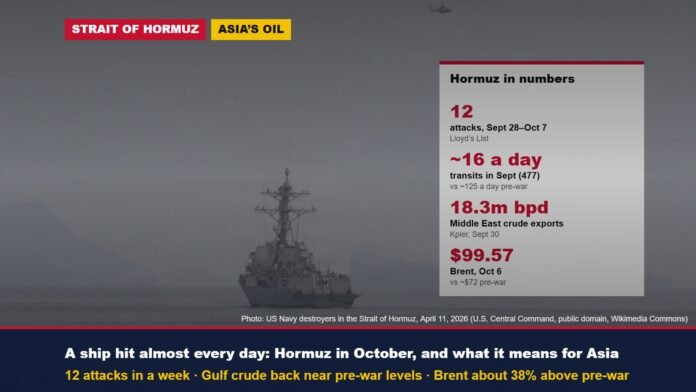
October 11: A ship has been struck in or near the Strait of Hormuz almost every day this month, according to the International Maritime Organization. Yet Middle East crude exports have climbed back to around pre-war levels, largely through a ship-to-ship “shuttle” system. For Asian importers, who depend heavily on Gulf oil and gas, the result is supply that is moving again but at a higher price and higher risk.
Key highlights
- Nine ships, mostly crude tankers, were struck in the Strait of Hormuz or off Oman between October 1 and October 6, according to the IMO. UKMTO recorded nine attacks in October by October 7, about half the September total for the strait and the Gulf combined.
- Indian sailors have been among the victims: on October 6, a projectile hit the Panama-flagged tanker On Peace off Oman, injuring 12 of the 19 people on board, 11 of them Indian, India’s Ministry of External Affairs said.
- Middle East crude exports reached a seven-day average of 18.3 million barrels a day on September 30, slightly above the 18 million average of the year before the war, according to Kpler data. About 40% of exports now bypass the strait.
- Brent crude was $99.57 a barrel on October 6, compared with about $72 before the war. By our calculation, that is about 38% higher.
The attacks so far in October
Many attacks are reported without the ship’s name or flag. The table lists the incidents for which details have been published.
| Date | Incident | Source |
|---|---|---|
| October 1 | Kuwaiti-flagged supertanker Kazimah III struck and set on fire; five staff rescued | UKMTO / IMO |
| October 4 | Liberian-flagged Aframax tanker Lipsi struck off Oman, engine room damaged; no casualties | UKMTO / IMO |
| October 5 | A tanker hailed by Iran’s Revolutionary Guards and ordered to turn back or face attack; US Central Command says US forces disabled three vessels | UKMTO / IMO |
| October 6 | Panama-flagged tanker On Peace hit off Oman; 12 of 19 on board injured, 11 of them Indian | India’s Ministry of External Affairs |
| October 7 | Tanker hit by several projectiles north of Madinat ash Shamal, off Qatar; casualties reported | UKMTO |
| October 9 | A vessel struck off Al Jazeera, UAE | UKMTO |
By our count, at least six separate days in the first nine days of October saw an attack or an armed incident involving shipping, matching the IMO’s description of “nearly every day”. The Kuwaiti, Liberian and Panamanian flags show that the targets are not only ships linked to one country.
Shipping and oil: the numbers
| Measure | Figure | Comparison | Source |
|---|---|---|---|
| Large commercial vessels through Hormuz, before the war | About 125 a day | About 20% of global crude and LNG supplies | UKMTO / IMO |
| Non-Iranian-linked transits in September | 477 (246 eastbound, 231 westbound) | Highest month since the conflict began; about 16 a day by our calculation | Industry shipping data |
| Transits, September 28 to October 7 | 143 | Up three on the previous week; tanker and gas carrier transits down 10.2% | Lloyd’s List Intelligence |
| Attacks in the same week | 12 | Highest weekly total since the war began | Industry shipping data |
| Middle East crude exports, 7-day average, September 30 | 18.3 million barrels a day | About 18 million before the war | Kpler data |
| Share of oil exports now bypassing the strait | About 40% | Kpler data | |
| Brent crude, October 6 | $99.57 | About $72 before the war (+38%, our calculation) | UKMTO / IMO |
The comparison of transits is not exact: the pre-war figure counts all large commercial vessels, while the September figure counts only ships not linked to Iran. Even so, by our calculation September’s traffic was about an eighth of the pre-war level, which shows how much of the recovery in exports depends on pipelines and ship-to-ship transfers rather than normal traffic through the strait.
What it means for Asia
Asian buyers are increasingly having to source crude from further afield, because demand for ships in the Gulf shuttle system is pushing up freight costs and reducing the number of tankers available elsewhere.
Gas is a bigger problem than oil for some South Asian buyers. QatarEnergy has extended force majeure on LNG deliveries to Asia and Europe through the end of November, and buyers in Bangladesh, Pakistan and at least one in India have been notified. Saudi Aramco chief executive Amin Nasser has said nearly three billion barrels of supply have been lost since the conflict began and that rebuilding inventories could take up to two years. The G7 has said it will release up to 100 million barrels from strategic reserves.
Our earlier reports: Tanker with 17 Indian crew hit near Hormuz and Tanker hit off northern Qatar.
What to watch
- Whether attacks keep pace with October’s near-daily rate, and whether they spread further into the western Gulf after the strike off Qatar.
- Freight and insurance costs for Asian importers, and whether Brent stays near $100.
- QatarEnergy’s LNG deliveries after its force majeure runs out at the end of November.
- Any progress in US–Iran talks, which would decide whether normal traffic can return.
What it means
October shows two trends running side by side: oil is getting out of the Gulf again, and ships are being hit more often. The recovery rests on workarounds, such as pipelines and ship-to-ship transfers, that need more vessels and more money. For Asian economies, that means energy at prices well above pre-war levels, a risk to crews from countries such as India, and a supply chain that one bad week could disrupt again. As Lloyd’s List’s editor put it, this is not a “sustainable new normal”.

The Business Desk covers markets, the economy, companies and personal finance. Stories are checked against at least two credible sources before publication.